

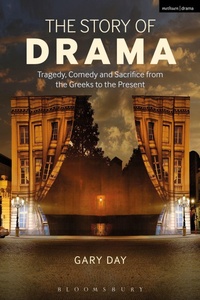
The Story of Drama
Tragedy, Comedy and Sacrifice from the Greeks to the Present
Erschienen am 25. August 2016
Buch
Softcover
248 Seiten
978-1-4081-8312-0 (ISBN)
Beschreibung
Tracing the history of tragedy and comedy from their earliest beginnings to the present, this book offers readers an exceptional study of the development of both genres, grounded in analysis of landmark plays and their context. It argues that sacrifice is central to both genres, and demonstrates how it provides a key to understanding the grand sweep of Western drama. For students of literature and drama the volume serves as an accessible companion to over two millennia of drama organised by period, and reveals how sacrifice represents a through-line running from classical drama to today's reality TV and blockbuster movies.
Across the chapters devoted to each period, Day explores how the meanings of sacrifice change over time, but never quite disappear. He charts the influences of religion, social change and politics on the status and purposes of theatre in each period, and on the drama itself. But it is through a close study of key plays that he reveals the continuities centred around sacrifice that persist and which illuminate aspects of human psychology and social organisation.
Among the many plays and events considered are Aeschylus' trilogy The Oresteia, Aristophanes' Women at the Thesmorphia, Menander's The Bad-Tempered Man, the spectacles of the Roman Games, Seneca's The Trojan Women, Plautus's The Rope, the Cycle plays and Everyman from the Middle Ages, Shakespeare's King Lear and A Midsummer Night's Dream, Middleton's The Revenger's Tragedy, Jonson's Every Man in His Humour, Thomas Otway's The Orphan, William Wycherley's The Country Wife, Wilde's A Woman of No Importance, Beckett' Waiting for Godot, Tennessee Williams's A Streetcar Named Desire, Suzan-Lori Parks's Topdog/Underdog, Sarah Kane's Blasted and Charlotte Jones' Humble Boy. A conclusion examines the persistence of ideas of sacrifice in today's reality TV and blockbuster movies.
Across the chapters devoted to each period, Day explores how the meanings of sacrifice change over time, but never quite disappear. He charts the influences of religion, social change and politics on the status and purposes of theatre in each period, and on the drama itself. But it is through a close study of key plays that he reveals the continuities centred around sacrifice that persist and which illuminate aspects of human psychology and social organisation.
Among the many plays and events considered are Aeschylus' trilogy The Oresteia, Aristophanes' Women at the Thesmorphia, Menander's The Bad-Tempered Man, the spectacles of the Roman Games, Seneca's The Trojan Women, Plautus's The Rope, the Cycle plays and Everyman from the Middle Ages, Shakespeare's King Lear and A Midsummer Night's Dream, Middleton's The Revenger's Tragedy, Jonson's Every Man in His Humour, Thomas Otway's The Orphan, William Wycherley's The Country Wife, Wilde's A Woman of No Importance, Beckett' Waiting for Godot, Tennessee Williams's A Streetcar Named Desire, Suzan-Lori Parks's Topdog/Underdog, Sarah Kane's Blasted and Charlotte Jones' Humble Boy. A conclusion examines the persistence of ideas of sacrifice in today's reality TV and blockbuster movies.
Rezensionen / Stimmen
The Story of Drama is an ambitious book, richly informative, consistently readable and conscientiously argued. * Times Literary Supplement * [A] concise, valuable survey ... Its warm, conversational tone suggests that students on the De Montfort University course whose lectures informed this volume had a fine teacher indeed. * Times Higher Education * Definitely one for any sixth former doing Drama or Theatre Studies and for anyone teaching drama to any age group. * InkPellet * If you want to bone up on the history of drama ... then try Gary Day's very readable The Story of Drama which examines drama and how it has developed from the Greeks to the 21st century mostly through the themes of tragedy, comedy and sacrifice. * SusanElkin.co.uk * In helping us to rethink how we discuss theatre, Day is providing critics and educators a new set of tools with which to work ... This book would be most useful in a script-analysis classroom as a way to begin interesting discussions about plays-or rather to rethink how we approach those discussions. Rather than asking 'What does this play mean?,' Day wants us to ask 'How does this play maintain social cohesion through sacrifice?' * Theatre Topics * Offers powerful insights into the workings of sacrifice in both tragic and comic modes of drama, and offers a wide set of historical examples of how sacrifice is embedded in both modes ... The book's final chapters bring its insights together, offering the kind of critical depth and potential richness that reward close reading ... Day's last chapter ... builds a compelling case for how complexly the power of these deep-seated, ancient structures-ways of shaping the world and how we feel about it-are embedded in contemporary, popular sensibilities and entertainments ... I am grateful to Gary Day for his labors in bringing these volcanic forces to light, showing how we might unbury them, and revealing how they persist in contemporary dramatic forms far from the ancient circumstances of their birth. * Journal of Dramatic Theory and Criticism * What is fascinating about this study is the way in which Day repositions familiar plays, using them as evidence of radical changes in our concepts of sacrifice and in the process casting new light on their well-worn pages ... [A] solid work that should be especially useful in courses on script analysis, as well as in those that attempt to link the history of great dramas to the cultural contexts from which they emerge. * Theatre Survey *Weitere Details
Sprache
Englisch
Verlagsort
London
Großbritannien
Verlagsgruppe
Bloomsbury Publishing PLC
Zielgruppe
Für höhere Schule und Studium
Für Beruf und Forschung
Maße
Höhe: 234 mm
Breite: 156 mm
Dicke: 14 mm
Gewicht
383 gr
ISBN-13
978-1-4081-8312-0 (9781408183120)
DOI
CBID177079
Copyright in bibliographic data and cover images is held by Nielsen Book Services Limited or by the publishers or by their respective licensors: all rights reserved.
Schweitzer Klassifikation
Weitere Ausgaben
Andere Ausgaben
E-Book
08/2016
1. Auflage
Methuen Drama
27,49 €
Als Download verfügbar
E-Book
08/2016
1. Auflage
Methuen Drama
27,49 €
Als Download verfügbar
Person
Gary Day recently retired as principal lecturer at De Montfort University, UK, where he taught courses on the history of drama, the eighteenth century, modernism, contemporary drama and contemporary fiction. He is the author of Literary Criticism: A New History (2008) and Modernist Literature: 1890-1950 (2010). He has edited a dozen books, the latest being The Wiley Encyclopaedia of British Eighteenth Century Literature (2015) with Jack Lynch. He has contributed to the Cambridge History of Literary Criticism and to the Oxford Guide to Literary Theory and Criticism. He has also been a regular columnist and reviewer for the Times Higher.
Inhalt
Acknowledgements
Chapter 1: Sacrifice
Chapter 2: Tragedy, Comedy and Ritual
Chapter 3: Greek Tragedy and Comedy and Sacrifice
Chapter 4: Roman Tragedy and Comedy and Sacrifice
Chapter 5: Medieval Tragedy and Comedy
Chapter 6: Renaissance Tragedy and Comedy and Sacrifice
Chapter 7: Restoration and Eighteenth Century Tragedy and Comedy and Sacrifice
Chapter 8: Victorian Melodrama, Comedy, Naturalism and Sacrifice
Chapter 9: Tragedy, Comedy and Sacrifice in the Twentieth and Twenty First Centuries
Conclusion: Tragedy, Comedy and Sacrifice in Popular Culture
Notes
Index
About the Author
Chapter 1: Sacrifice
Chapter 2: Tragedy, Comedy and Ritual
Chapter 3: Greek Tragedy and Comedy and Sacrifice
Chapter 4: Roman Tragedy and Comedy and Sacrifice
Chapter 5: Medieval Tragedy and Comedy
Chapter 6: Renaissance Tragedy and Comedy and Sacrifice
Chapter 7: Restoration and Eighteenth Century Tragedy and Comedy and Sacrifice
Chapter 8: Victorian Melodrama, Comedy, Naturalism and Sacrifice
Chapter 9: Tragedy, Comedy and Sacrifice in the Twentieth and Twenty First Centuries
Conclusion: Tragedy, Comedy and Sacrifice in Popular Culture
Notes
Index
About the Author