

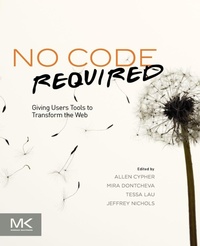
No Code Required
Giving Users Tools to Transform the Web
Erschienen am 21. Mai 2010
Buch
Softcover
512 Seiten
978-0-12-381541-5 (ISBN)
Beschreibung
No Code Required presents the various design, system architectures, research methodologies, and evaluation strategies that are used by end users programming on the Web. It also presents the tools that will allow users to participate in the creation of their own Web.
Comprised of seven parts, the book provides basic information about the field of end-user programming. Part 1 points out that the Firefox browser is one of the differentiating factors considered for end-user programming on the Web. Part 2 discusses the automation and customization of the Web. Part 3 covers the different approaches to proposing a specialized platform for creating a new Web browser. Part 4 discusses three systems that focus on the customized tools that will be used by the end users in exploring large amounts of data on the Web. Part 5 explains the role of natural language in the end-user programming systems. Part 6 provides an overview of the assumptions on the accessibility of the Web site owners of the Web content. Lastly, Part 7 offers the idea of the Web-active end user, an individual who is seeking new technologies.
Comprised of seven parts, the book provides basic information about the field of end-user programming. Part 1 points out that the Firefox browser is one of the differentiating factors considered for end-user programming on the Web. Part 2 discusses the automation and customization of the Web. Part 3 covers the different approaches to proposing a specialized platform for creating a new Web browser. Part 4 discusses three systems that focus on the customized tools that will be used by the end users in exploring large amounts of data on the Web. Part 5 explains the role of natural language in the end-user programming systems. Part 6 provides an overview of the assumptions on the accessibility of the Web site owners of the Web content. Lastly, Part 7 offers the idea of the Web-active end user, an individual who is seeking new technologies.
Rezensionen / Stimmen
"The web is becoming not only a venue for people to receive information but increasingly a place for them to create new forms of information and to share them. The transition in the role from being a passive consumer to an active consumer as well as contributor is made possible by exactly the kind of work described in this book." -- Dr. Margaret Burnett, Dept of Computer Science, Oregon State UniversityWeitere Details
Sprache
Englisch
Verlagsort
San Francisco
USA
Verlagsgruppe
Elsevier Science & Technology
Zielgruppe
Für Beruf und Forschung
Practitioners, researchers, and students in end user programming, human computer interaction, web design user experience design, software and web interaction/interface designers, information design, information architecture, usability engineers, web application designers
Produkt-Hinweis
Broschur/Paperback
Maße
Höhe: 236 mm
Breite: 195 mm
Dicke: 30 mm
Gewicht
877 gr
ISBN-13
978-0-12-381541-5 (9780123815415)
Copyright in bibliographic data and cover images is held by Nielsen Book Services Limited or by the publishers or by their respective licensors: all rights reserved.
Schweitzer Klassifikation
Weitere Ausgaben
Andere Ausgaben
E-Book
05/2010
Morgan Kaufmann
40,95 €
Als Download verfügbar
Personen
Allen has provided, substantial contributions in the research, design, and implementation of innovative end-user applications. His primary interest is in creating simple interfaces for complex tasks, including intelligent interfaces, customizable software, user interface design, software design, and instruction. Edited the book "Watch What I Do: Programming by Demonstration", which was published by MIT Press in 1993 (~3000 sold). He has created several successful end-user programming systems: Eager, Stagecast Creator, and CoScripter. Ph.D. Computer Science, Yale University, A.B. A.B. Mathematics, Princeton University. Mira has been building web summarization and customization systems since 2005. Mira is interested in a variety of problems including managing, sharing, and repurposing Web content and visualizing heterogenous data. Her dissertation work was on interaction techniques for semi-automatic gathering and customization of web content. Mira is interested in creating systems that allow users to access the information they need quickly and easily. Ph.D. in Computer Science, University of Washington. Tessa has been doing research on end user programming since 1997, resulting in more than a dozen technical papers on the various aspects of EUP. Tessa's research goal is to develop innovative interfaces for enhancing human productivity and creativity through the use of techniques drawn from artificial intelligence. Her research interests include intelligent user interfaces, machine learning, artificial intelligence, human-computer interaction, programming by demonstration, and email classification. She also contributed a chapter about her SMARTedit system to the second EUP book, "Your Wish Is My Command?. PhD, University of Washington's Department of CS&E. Jeffrey currently leads the Highlight project, which is building technology that allows users to easily create their own mobile versions of existing web sites. His research interests are in the field of human-computer interaction, with a specific focus on automated design, mobile computing, end-user programming, and ubiquitous computing. He received his Ph.D. in December 2006 from the Human-Computer Interaction Institute in Carnegie Mellon University's School of Computer Science. His thesis described the first system to automatically generate interfaces that are consistent with a user's previous experience and provided the first evidence from user studies that automatically generated interfaces can be more usable than human-designed interfaces in certain situations. He received a BS degree in computer engineering from the University of Washington in 2000.
Inhalt
Introduction
End User Programming on the Web Allen Cypher (IBM)
Why We Customize the Web Robert Miller (MIT)
I. End User Programming Languages for the Web
Sloppy Programming Greg Little (MIT)
Mixing the reactive with the personal: Opportunities for end user programming in Personal information management (system) Max Van Kleek (MIT)
Going beyond PBD: A Play-by-Play and Mixed-initiative Approach (system) Hyuckchul Jung (Institute for Human and Machine Cognition)
Rewriting the Web with Chickenfoot (system) Robert Miller (MIT)
A Goal-Oriented Web Browser (system) Alexander Faaborg (Mozilla)
II. Systems and Applications
Clip, Connect, Clone: Combining Application Elements to Build Custom Interfaces for Information Access (system) Jun Fujima (Hokkaido)
Mash Maker (system) Robert Ennals (Intel)
Collaborative scripting on the web (system) Tessa Lau (IBM)
Programming by a Sample: Rapidly Creating Web Applications with d.mix (system) Bjoern Hartmann (Stanford)
Highlight: End User Mobilization of Existing Web Sites (system) Jeffrey Nichols (IBM)
Subjunctive Interfaces for the Web Aran Lunzer (University of Copenhagen)
From Web Summaries to Search Templates: Automation for Personal Web Content (system) Mira Dontcheva (Adobe Systems)
Access to the Temporal Web Through Zoetrope (system) Eytan Adar (University of Washington)
Enabling End Users to Independently Build Accessibility into the Web Jeffrey Bigham (University of Washington)
Social Accessibility: A Collaborative Approach For Improving Web Accessibility (system) Yevgen Borodin (Stony Brook)
III. Data Management and Interoperability
A World Wider than the Web: End User Programming Across Multiple Domains (system) Will Haines (SRI)
Knowing What You're Talking About: Natural Language Programming of a Multi-Player Online Game (system) Henry Lieberman (MIT)
IV. User Studies
Mashups for Web-Active End Users Nan Zang (Penn State)
Mashed layers and muddled models: debugging mashup applications M. Cameron Jones (Yahoo!)
Reuse in the world of end-user programmers Christopher Scaffidi (CMU)
Using Web Search to Write Programs Joel Brandt (Stanford)
End User Programming on the Web Allen Cypher (IBM)
Why We Customize the Web Robert Miller (MIT)
I. End User Programming Languages for the Web
Sloppy Programming Greg Little (MIT)
Mixing the reactive with the personal: Opportunities for end user programming in Personal information management (system) Max Van Kleek (MIT)
Going beyond PBD: A Play-by-Play and Mixed-initiative Approach (system) Hyuckchul Jung (Institute for Human and Machine Cognition)
Rewriting the Web with Chickenfoot (system) Robert Miller (MIT)
A Goal-Oriented Web Browser (system) Alexander Faaborg (Mozilla)
II. Systems and Applications
Clip, Connect, Clone: Combining Application Elements to Build Custom Interfaces for Information Access (system) Jun Fujima (Hokkaido)
Mash Maker (system) Robert Ennals (Intel)
Collaborative scripting on the web (system) Tessa Lau (IBM)
Programming by a Sample: Rapidly Creating Web Applications with d.mix (system) Bjoern Hartmann (Stanford)
Highlight: End User Mobilization of Existing Web Sites (system) Jeffrey Nichols (IBM)
Subjunctive Interfaces for the Web Aran Lunzer (University of Copenhagen)
From Web Summaries to Search Templates: Automation for Personal Web Content (system) Mira Dontcheva (Adobe Systems)
Access to the Temporal Web Through Zoetrope (system) Eytan Adar (University of Washington)
Enabling End Users to Independently Build Accessibility into the Web Jeffrey Bigham (University of Washington)
Social Accessibility: A Collaborative Approach For Improving Web Accessibility (system) Yevgen Borodin (Stony Brook)
III. Data Management and Interoperability
A World Wider than the Web: End User Programming Across Multiple Domains (system) Will Haines (SRI)
Knowing What You're Talking About: Natural Language Programming of a Multi-Player Online Game (system) Henry Lieberman (MIT)
IV. User Studies
Mashups for Web-Active End Users Nan Zang (Penn State)
Mashed layers and muddled models: debugging mashup applications M. Cameron Jones (Yahoo!)
Reuse in the world of end-user programmers Christopher Scaffidi (CMU)
Using Web Search to Write Programs Joel Brandt (Stanford)