

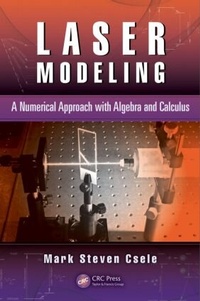
Laser Modeling
A Numerical Approach with Algebra and Calculus
1. Auflage
Erschienen am 8. April 2014
Buch
Hardcover
274 Seiten
978-1-4665-8250-7 (ISBN)
Beschreibung
Offering a fresh take on laser engineering, Laser Modeling: A Numerical Approach with Algebra and Calculus presents algebraic models and traditional calculus-based methods in tandem to make concepts easier to digest and apply in the real world. Each technique is introduced alongside a practical, solved example based on a commercial laser. Assuming some knowledge of the nature of light, emission of radiation, and basic atomic physics, the text:
Explains how to formulate an accurate gain threshold equation as well as determine small-signal gain
Discusses gain saturation and introduces a novel pass-by-pass model for rapid implementation of "what if?" scenarios
Outlines the calculus-based Rigrod approach in a simplified manner to aid in comprehension
Considers thermal effects on solid-state lasers and other lasers with new and efficient quasi-three-level materials
Demonstrates how the convolution method is used to predict the effect of temperature drift on a DPSS system
Describes the technique and technology of Q-switching and provides a simple model for predicting output power
Addresses non-linear optics and supplies a simple model for calculating optimal crystal length
Examines common laser systems, answering basic design questions and summarizing parameters
Includes downloadable Microsoft (R) Excel (TM) spreadsheets, allowing models to be customized for specific lasers
Don't let the mathematical rigor of solutions get in the way of understanding the concepts. Laser Modeling: A Numerical Approach with Algebra and Calculus covers laser theory in an accessible way that can be applied immediately, and numerically, to real laser systems.
Explains how to formulate an accurate gain threshold equation as well as determine small-signal gain
Discusses gain saturation and introduces a novel pass-by-pass model for rapid implementation of "what if?" scenarios
Outlines the calculus-based Rigrod approach in a simplified manner to aid in comprehension
Considers thermal effects on solid-state lasers and other lasers with new and efficient quasi-three-level materials
Demonstrates how the convolution method is used to predict the effect of temperature drift on a DPSS system
Describes the technique and technology of Q-switching and provides a simple model for predicting output power
Addresses non-linear optics and supplies a simple model for calculating optimal crystal length
Examines common laser systems, answering basic design questions and summarizing parameters
Includes downloadable Microsoft (R) Excel (TM) spreadsheets, allowing models to be customized for specific lasers
Don't let the mathematical rigor of solutions get in the way of understanding the concepts. Laser Modeling: A Numerical Approach with Algebra and Calculus covers laser theory in an accessible way that can be applied immediately, and numerically, to real laser systems.
Rezensionen / Stimmen
"One of Marc Csele's key strengths is his clear and illustrative style; he grounds the material in everyday words and examples. ...the choice and order of the chapters brings the reader along gradually from basic knowledge to practical application in a logical and comfortable way."--Marc Nantel, Niagara College, Niagara Falls, Ontario, Canada
"This is a textbook, written so as to be accessible to undergraduate students. The aim is to introduce the reader to laser science, parallel with the presentation of basic mathematical models used for the description of lasers of various types, and of basic physical properties of those lasers. Accordingly, the mathematical models are classified as algebra-based and calculus-based ones. Particular chapters are dealing with fundamental topics, such as the lasing threshold, gain saturation, thermal effects, Q-switching, and some basic effects of nonlinear optics. Many particular examples are included, which may be used as teaching material. The book also contains a lot of practical material about basic types of existing lasers, such as gas lasers, semiconductor lasers, and solid-state ones."
--Boris A. Malomed (Tel Aviv), from Zentralblatt MATH 1320 - 1
Weitere Details
Sprache
Englisch
Verlagsort
Bosa Roca
USA
Verlagsgruppe
Taylor & Francis Inc
Zielgruppe
Für höhere Schule und Studium
Undergraduate students studying lasers and laser technology as well as engineers in industries designing lasers and laser systems, including telecomm and solid-state lasers.
Illustrationen
157 s/w Abbildungen, 18 s/w Tabellen
18 Tables, black and white; 157 Illustrations, black and white
Maße
Höhe: 234 mm
Breite: 156 mm
Gewicht
521 gr
ISBN-13
978-1-4665-8250-7 (9781466582507)
Copyright in bibliographic data and cover images is held by Nielsen Book Services Limited or by the publishers or by their respective licensors: all rights reserved.
Schweitzer Klassifikation
Weitere Ausgaben
Andere Ausgaben
E-Book
12/2017
1. Auflage
CRC Press
119,99 €
Als Download verfügbar
E-Book
12/2017
CRC Press
119,99 €
Als Download verfügbar
Buch
03/2017
1. Auflage
CRC Press
128,10 €
Versand in 10-20 Tagen
Person
Mark Steven Csele is a full-time professor at Niagara College, Welland, Ontario, Canada. A physicist and professional engineer, he has taught for over 20 years at levels ranging from two-year technician to four-year undergraduate. Currently, he teaches photonics at Niagara College, which features an array of dedicated laboratories hosting a variety of laser systems. He has authored a previous book on fundamental laser concepts as well as several articles in magazines and trade encyclopedias.
Inhalt
Basic Laser Processes. Threshold Gain. Gain Saturation. Analytical Solutions. Thermal Issues. Generating Massive Inversions: Q-Switching. Non-Linear Optics. Common Lasers and Parameters.