

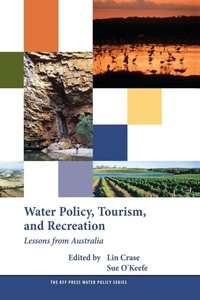
Water Policy, Tourism, and Recreation
Lessons from Australia
1. Auflage
Erschienen am 15. Juli 2011
Buch
Hardcover
240 Seiten
978-1-61726-087-2 (ISBN)
Beschreibung
This book explores the complicated interrelationships between freshwater resources and tourism and recreation. The focus is on Australia, but comparisons with the experience of other countries are also made throughout. Yet Australia has been at the forefront of conflicts over drought and water use, particularly for irrigated agriculture, as well as of the design of policies and institutions for water policy, so there are many lessons which can be applied to other parts of the world.
The authors examine in detail the relationships between water economics and supply, and the needs for tourism and recreation. The book discusses water use and access and the conflict between urban and recreational demands. It considers the institutional arrangements around water and the significance of property rights, including water markets and water pricing. Theoretical and practical models for increasing collaboration and cooperation such as the use of trusts are also developed and water trusts in the USA are examined. Specific chapters highlight the role of interest groups, such as the boating industry, to influence policy thinking and the practical trade-offs between access to urban water supplies and the requirements of recreation. Tourist behavior in relation to water use and pricing is also assessed.
The authors examine in detail the relationships between water economics and supply, and the needs for tourism and recreation. The book discusses water use and access and the conflict between urban and recreational demands. It considers the institutional arrangements around water and the significance of property rights, including water markets and water pricing. Theoretical and practical models for increasing collaboration and cooperation such as the use of trusts are also developed and water trusts in the USA are examined. Specific chapters highlight the role of interest groups, such as the boating industry, to influence policy thinking and the practical trade-offs between access to urban water supplies and the requirements of recreation. Tourist behavior in relation to water use and pricing is also assessed.
Rezensionen / Stimmen
'The subject matter of the book is of great relevance to the evolution of water policy and practice in Australia today. Because Australian water policy has also become a global standard, the book is of high relevance to other rich countries (who face similar issues today) and poor countries (who will face them in the future).'John Briscoe, Gordon McKay Professor of the Practice of Environmental Engineering, Harvard University
Weitere Details
Reihe
Sprache
Englisch
Verlagsort
Washington
USA
Verlagsgruppe
Taylor & Francis Inc
Zielgruppe
Für höhere Schule und Studium
Maße
Höhe: 260 mm
Breite: 183 mm
Dicke: 18 mm
Gewicht
654 gr
ISBN-13
978-1-61726-087-2 (9781617260872)
Copyright in bibliographic data and cover images is held by Nielsen Book Services Limited or by the publishers or by their respective licensors: all rights reserved.
Schweitzer Klassifikation
Weitere Ausgaben
Andere Ausgaben
Buch
11/2018
1. Auflage
CRC Press
76,40 €
Versand in 10-20 Tagen
E-Book
12/2012
1. Auflage
RFF Press
69,99 €
Als Download verfügbar
E-Book
12/2012
1. Auflage
RFF Press
69,99 €
Als Download verfügbar
Personen
Lin Crase is Professor of Applied Economics with the Regional School of Business at La Trobe University, Australia. His edited books include 'Reforming Institutions in Water Resource Management' and 'Water Policy in Australia'
Sue O'Keefe is Associate Head of the Regional School of Business at La Trobe University. She has a PhD in Economics from the University of New England and her fields of competence are in water policy, decision making and incentives and consumer preferences
Sue O'Keefe is Associate Head of the Regional School of Business at La Trobe University. She has a PhD in Economics from the University of New England and her fields of competence are in water policy, decision making and incentives and consumer preferences
Inhalt
Contributors. Foreword. Acknowledgements. Abbreviations Part 1: Context, Values and Trade-Offs 1. The Policy Landscape and Challenges for Tourism and Recreation in Australia 2. The Environmental Status of Australia's Rivers: A Production Systems Perspective 3. Challenges of Estimating the Value of Tourism and Recreation in the Murray-Darling Basin 4. Access to Inland Waters for Tourism: Ecosystem Services and Trade-Offs Part 2: Property Rights and Institutional Arrangements 5. Why Rights Matter 6. Institutional Considerations for Collaborative Behavior in Tourism and Recreation 7. Collaborating and Coordinating Disparate Interests: Lessons from Water Trusts Part 3: Practical Challenges and Policy Formulation 8. The Swan River: Look, but do not Touch 9. Recreational Access to Urban Water Supplies 10. Cases in Policy Suasion and Influence: The Boating Industry 11. Science, Policy and Knowledge: Is there a Better Way for the Tourism and Recreation Sector? Part 4: Tourists and Urban Water and Lessons for the Future 12. The Use of Potable Water by Tourists: Accounting for Behavioral Differences 13. Water Pricing, Water Restrictions and Tourism Water Demand 14. Lessons for the Tourism and Recreation Sector. Index