

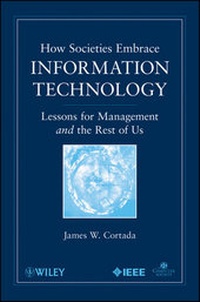
How Societies Embrace Information Technology
Lessons for Management and the Rest of Us
Erschienen am 20. November 2009
Buch
Softcover
288 Seiten
978-0-470-53498-4 (ISBN)
Beschreibung
This book discusses how computers are shaping contemporary society, with a tight focus on the role of corporations and governments. It is aimed at government policymakers interested in economic development and at private-sector managers who routinely make decisions to acquire and use information technology, now a worldwide expenditure of over $2 trillion annually. The book will also interest a wide range of academics concerned with the sociology, history, economics, and the effects of IT on contemporary society, ands to the general trade market.
Rezensionen / Stimmen
"The book also presents ideas for educators. For instance, to encourage IT people to be naturally proactive, courses should leverage the creation and production of IT projects with solving society's problems. With some effort, this can be done in computers and society courses, at both the general and professional education level. At the professional level, IT workers with such experience and training will more likely choose to work on problem areas. At the general level, people with such experience will act politically, to vocalize the expectation that the IT industry will create products that help society." (Computing Reviews, September 2010)Weitere Details
Produkt-Info
Paperback
Auflage
1. Auflage
Sprache
Englisch
Verlagsort
New York
USA
Zielgruppe
Für Beruf und Forschung
Produkt-Hinweis
Broschur/Paperback
Klebebindung
Illustrationen
Charts: 2 B&W, 0 Color; Drawings: 4 B&W, 0 Color; Tables: 12 B&W, 0 Color; Graphs: 2 B&W, 0 Color
Maße
Höhe: 234 mm
Breite: 156 mm
Dicke: 16 mm
Gewicht
445 gr
ISBN-13
978-0-470-53498-4 (9780470534984)
Schweitzer Klassifikation
Weitere Ausgaben
Andere Ausgaben
James W. Cortada
How Societies Embrace Information Technology
Lessons for Management and the Rest of Us
E-Book
03/2010
Wiley
33,99 €
Als Download verfügbar
Person
James W. Cortada has thirty-five years of experience with IBM in various sales, consulting, and managerial positions related to information technology and its use. In particular, he helped design and deploy processes related to employee skills development, including IBM's worldwide consultant skills certification process, sales processes, and specialized training seminars. An author of more than fifty books on the management and history of information technology, Cortada's work has been translated into Spanish, Portuguese, Chinese, and Korean.
Inhalt
Preface.
1 Introducing the Big Picture.
The presence of information technology.
Megatrends at work.
How societies use technology to shape their world.
Notes and references.
2 How Computers Spread Around the World So Fast.
Definitions and issues.
Government-supported/private-sector-driven model.
National champion model.
Asian private-sector-driven model.
Planned economy: public policy model.
Industry-driven model.
Corporate diffusion model.
Application diffusion model.
Technology-standards diffusion model.
Patterns, practices, and implications.
Notes and references.
3 How Governments Leverage Information Technologies to Improve Their National Economies.
A brief historical reminder.
Economic development in a connected world: the big picture.
How governments use it to encourage economic development.
What motivates governments to encourage their citizens and economies to use it?.
Emerging strategies for the most advanced nations compared to rapidly advancing nations.
The special role of labor.
Global recession, twenty-first century style.
Implications for public officials.
Implications for business leaders.
The way forward with policies and practices.
Notes and references.
4 How Managers and Officials Decide What Technology to Use.
The kinds of decisions made by managers.
Types of justification.
Managerial practices.
Some possible less effective practices.
Special role of industries.
Path forward.
Notes and references.
5 Adding Up the Results So Far: Do We Now Live in the Information Age?
Why naming an age is a useful exercise and so hard to do.
What historians can teach us about the process.
The case against the information age.
Can we coexist on the frontiers of a new age?
Lessons for management and a strategy for change.
Concluding thoughts.
Notes and references.
6 An Expanding Role for Scientists and Engineers.
The rise of the computer scientist.
Their role in modern society.
When scientists and tech folk take things into their own hands.
When technologists go green.
Their future world.
An old role made new.
Notes and references.
7 Looking Down the Road into the Twenty-First Century.
How to see the future of an industry.
Knowing how information technology is evolving.
A strategy for managers and public officials.
Special role of the computer science community.
The ultimate trend.
Notes and references.
8 Keeping Up: Bibliographic Essay.
The big picture.
How computers spread around the world.
Governments leveraging it for economic development.
Deciding what technology to use.
Living in the information age.
Role of technologists.
Into the twenty-first century.
Index.