

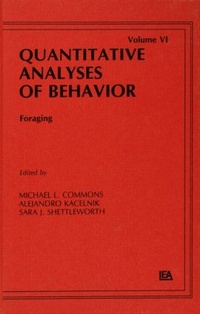
Foraging
Quantitative Analyses of Behavior, Volume Vi
Erschienen am 1. Februar 1987
Buch
Hardcover
324 Seiten
978-0-89859-550-5 (ISBN)
Beschreibung
The sixth volume in this respected series systematically presents and evaluates quantitative models of various foraging phenomena, including: steady state decision rules; acquisition of decision rules; perception and learning in foraging behavior.
Weitere Details
Reihe
Sprache
Englisch
Verlagsort
Mahwah
USA
Verlagsgruppe
Taylor & Francis Inc
Zielgruppe
Für höhere Schule und Studium
Maße
Höhe: 229 mm
Breite: 152 mm
Gewicht
566 gr
ISBN-13
978-0-89859-550-5 (9780898595505)
Copyright in bibliographic data and cover images is held by Nielsen Book Services Limited or by the publishers or by their respective licensors: all rights reserved.
Schweitzer Klassifikation
Weitere Ausgaben
Andere Ausgaben
Michael L. Commons | Alejandro Kacelnik | Sara J. Shettleworth
Foraging
Quantitative Analyses of Behavior, Volume Vi
E-Book
05/2013
1. Auflage
Psychology Press Ltd
16,99 €
Als Download verfügbar
Michael L. Commons | Alejandro Kacelnik | Sara J. Shettleworth
Foraging
Quantitative Analyses of Behavior, Volume Vi
E-Book
05/2013
1. Auflage
Psychology Press Ltd
16,99 €
Als Download verfügbar
Personen
Michael L. Commons, Alejandro Kacelnik, Sara J. Shettleworth
Inhalt
I: Aspects of Optimal-Foraging Theory; 1: Survival, Energy Budgets, and Foraging Risk; 2: Foraging in Patches; 3: The Control of Foraging Decisions; II: Foraging in a Changing Environment; 4: Foraging in a Changing Environment; 5: Foraging in a Changing Environment; 6: Learning and Foraging in Pigeons; 7: Environmental Constraints on Optimal-Foraging Behavior; III: Operant and Pavlovian Processes; 8: Mechanisms of Signal-Controlled Foraging Behavior; 9: Choice and Optimal Foraging; IV: Special Foraging Adaptations; 10: Foraging for Stored Food; 11: The Influence of Context on Choice Behavior; V: Methodology; 12: Detecting and Eliminating Spatial Bias when Tracking Foraging Behavior in a Laboratory Experiment