

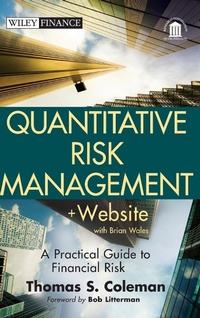
Quantitative Risk Management, + Website
A Practical Guide to Financial Risk
1. Auflage
Erschienen am 18. Mai 2012
Buch
Hardcover
576 Seiten
978-1-118-02658-8 (ISBN)
Beschreibung
State of the art risk management techniques and practices-supplemented with interactive analytics All too often risk management books focus on risk measurement details without taking a broader view. Quantitative Risk Management delivers a synthesis of common sense management together with the cutting-edge tools of modern theory. This book presents a road map for tactical and strategic decision making designed to control risk and capitalize on opportunities. Most provocatively it challenges the conventional wisdom that "risk management" is or ever should be delegated to a separate department. Good managers have always known that managing risk is central to a financial firm and must be the responsibility of anyone who contributes to the profit of the firm.
A guide to risk management for financial firms and managers in the post-crisis world, Quantitative Risk Management updates the techniques and tools used to measure and monitor risk. These are often mathematical and specialized, but the ideas are simple. The book starts with how we think about risk and uncertainty, then turns to a practical explanation of how risk is measured in today's complex financial markets.
Covers everything from risk measures, probability, and regulatory issues to portfolio risk analytics and reporting
Includes interactive graphs and computer code for portfolio risk and analytics
Explains why tactical and strategic decisions must be made at every level of the firm and portfolio
Providing the models, tools, and techniques firms need to build the best risk management practices, Quantitative Risk Management is an essential volume from an experienced manager and quantitative analyst.
A guide to risk management for financial firms and managers in the post-crisis world, Quantitative Risk Management updates the techniques and tools used to measure and monitor risk. These are often mathematical and specialized, but the ideas are simple. The book starts with how we think about risk and uncertainty, then turns to a practical explanation of how risk is measured in today's complex financial markets.
Covers everything from risk measures, probability, and regulatory issues to portfolio risk analytics and reporting
Includes interactive graphs and computer code for portfolio risk and analytics
Explains why tactical and strategic decisions must be made at every level of the firm and portfolio
Providing the models, tools, and techniques firms need to build the best risk management practices, Quantitative Risk Management is an essential volume from an experienced manager and quantitative analyst.
Weitere Details
Reihe
Sprache
Englisch
Verlagsort
New York
USA
Zielgruppe
Für Beruf und Forschung
Produkt-Hinweis
Fadenheftung
Pappband
mit Schutzumschlag
Maße
Höhe: 235 mm
Breite: 157 mm
Dicke: 35 mm
Gewicht
979 gr
ISBN-13
978-1-118-02658-8 (9781118026588)
Copyright in bibliographic data and cover images is held by Nielsen Book Services Limited or by the publishers or by their respective licensors: all rights reserved.
Schweitzer Klassifikation
Weitere Ausgaben
Andere Ausgaben
E-Book
03/2012
Wiley
63,99 €
Als Download verfügbar
E-Book
03/2012
Wiley
63,99 €
Als Download verfügbar
Personen
THOMAS S. COLEMAN has worked in the finance industry for more than twenty years and has considerable experience in trading, risk management, and quantitative modeling. Mr. Coleman currently manages a risk advisory consulting firm. He is the author, together with Roger Ibbotson and Larry Fisher, of Historical U.S. Treasury Yield Curves.
Inhalt
Foreword ix
Preface xiii
Acknowledgments xvii
PART ONE Managing Risk 1
CHAPTER 1 Risk Management versus Risk Measurement 3
CHAPTER 2 Risk, Uncertainty, Probability, and Luck 15
CHAPTER 3 Managing Risk 67
CHAPTER 4 Financial Risk Events 101
CHAPTER 5 Practical Risk Techniques 137
CHAPTER 6 Uses and Limitations of Quantitative Techniques 169
PART TWO Measuring Risk 173
CHAPTER 7 Introduction to Quantitative Risk Measurement 175
CHAPTER 8 Risk and Summary Measures: Volatility and VaR 187
CHAPTER 9 Using Volatility and VaR 269
CHAPTER 10 Portfolio Risk Analytics and Reporting 311
CHAPTER 11 Credit Risk 377
CHAPTER 12 Liquidity and Operational Risk 481
CHAPTER 13 Conclusion 529
About the Companion Web Site 531
References 533
About the Author 539
Index 541
Preface xiii
Acknowledgments xvii
PART ONE Managing Risk 1
CHAPTER 1 Risk Management versus Risk Measurement 3
CHAPTER 2 Risk, Uncertainty, Probability, and Luck 15
CHAPTER 3 Managing Risk 67
CHAPTER 4 Financial Risk Events 101
CHAPTER 5 Practical Risk Techniques 137
CHAPTER 6 Uses and Limitations of Quantitative Techniques 169
PART TWO Measuring Risk 173
CHAPTER 7 Introduction to Quantitative Risk Measurement 175
CHAPTER 8 Risk and Summary Measures: Volatility and VaR 187
CHAPTER 9 Using Volatility and VaR 269
CHAPTER 10 Portfolio Risk Analytics and Reporting 311
CHAPTER 11 Credit Risk 377
CHAPTER 12 Liquidity and Operational Risk 481
CHAPTER 13 Conclusion 529
About the Companion Web Site 531
References 533
About the Author 539
Index 541