

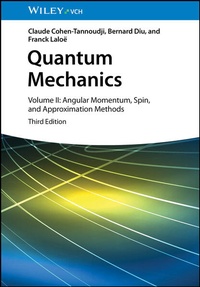
Quantum Mechanics
Beschreibung
Volume II of the unrivalled textbook contains the quantum theory of scattering by a potential, addition of angular momenta, time-independent and time-dependent perturbation theory, and systems of identical particles. The new edition also includes a new complement in order to treat an important subject that was missing in the previous editions: the linear response theory, very often used in many fields of physics such as atomic physics and quantum optics, condensed matter physics, and nuclear physics.
The textbook retains its typical style also in the third edition: it explains the fundamental concepts in chapters which are elaborated in accompanying complements that provide more detailed discussions, examples and applications.
- The quantum mechanics classic: written by 1997 Nobel laureate Claude Cohen-Tannoudji and his colleagues Bernard Diu and Franck Laloë
- As easily comprehensible as possible: all steps of the physical background and its mathematical representation are spelled out explicitly
- Comprehensive: in addition to the fundamentals themselves, the book contains more than 170 worked examples plus exercises
Weitere Details
Weitere Ausgaben
Andere Ausgaben
Vorauflage
Personen
Claude Cohen-Tannoudji is a researcher at the Kastler-Brossel laboratory of the Ecole Normale Supérieure in Paris where he also studied and received his PhD in 1962. In 1973 he became Professor of atomic and molecular physics at the Collège des France. His main research interests were optical pumping, quantum optics and atom-photon interactions. In 1997, Claude Cohen-Tannoudji, together with Steven Chu and William D. Phillips, was awarded the Nobel Prize in Physics for his research on laser cooling and trapping of neutral atoms.
Bernard Diu (1935-2025) was Professor at the Denis Diderot University (Paris VII). He was engaged in research at the Laboratory of Theoretical Physics and High Energy where his focus was on strong interactions physics and statistical mechanics.
Franck Laloë is a researcher at the Kastler-Brossel laboratory of the Ecole Normale Supérieure in Paris. His first assignment was with the University of Paris VI before he was appointed to the CNRS, the French National Research Center. His research was focused on optical pumping, statistical mechanics of quantum gases, musical acoustics and the foundations of quantum mechanics.
Inhalt
Volume I
I WAVES AND PARTICLES. INTRODUCTION TO THE BASIC IDEAS OF QUANTUM MECHANICS 1
READER'S GUIDE FOR COMPLEMENTS 33
AI Order of magnitude of the wavelengths associated with material particles 35
BI Constraints imposed by the uncertainty relations 39
CI Heisenberg relation and atomic parameters 41
DI An experiment illustrating the Heisenberg relations 45
EI A simple treatment of a two-dimensional wave packet 49
FI The relationship between one- and three-dimensional problems 53
GI One-dimensional Gaussian wave packet: spreading of the wave packet 57
HI Stationary states of a particle in one-dimensional square potentials 63
JI Behavior of a wave packet at a potential step 75
II THE MATHEMATICAL TOOLS OF QUANTUM MECHANICS 87
READER'S GUIDE FOR COMPLEMENTS 159
AII The Schwarz inequality 161
BII Review of some useful properties of linear operators 163
CII Unitary operators 173
DII A more detailed study of the r and p representations 181
EII Some general properties of two observables, Q and P, whose commutator is equal to i¿ 187
FII The parity operator 193
GII An application of the properties of the tensor product: the twodimensional inðEnite well 201
HII Exercises 205
III THE POSTULATES OF QUANTUM MECHANICS 213
READER'S GUIDE FOR COMPLEMENTS 267
AIII Particle in an inðEnite one-dimensional potential well 271
BIII Study of the probability current in some special cases 283
CIII Root mean square deviations of two conjugate observables 289
DIII Measurements bearing on only one part of a physical system 293
EIII The density operator 299
FIII The evolution operator 313
GIII The Schrödinger and Heisenberg pictures 317
HIII Gauge invariance 321
JIII Propagator for the Schrödinger equation 335
KIII Unstable states. Lifetime 343
LIII Exercises 347
MIII Bound states in a "potential well" of arbitrary shape 359
NIII Unbound states of a particle in the presence of a potential well or barrier 367
OIII Quantum properties of a particle in a one-dimensional periodic structure 375
IV APPLICATIONS OF THE POSTULATES TO SIMPLE CASES: SPIN 1/2 AND TWO-LEVEL SYSTEMS 393
READER'S GUIDE FOR COMPLEMENTS 423
AIV The Pauli matrices 425
BIV Diagonalization of a 2 × 2 Hermitian matrix 429
CIV Fictitious spin 1/2 associated with a two-level system 435
DIV System of two spin 1/2 particles 441
EIV Spin density matrix 449
FIV Spin 1/2 particle in a static and a rotating magnetic ðEelds: magnetic resonance 455
GIV A simple model of the ammonia molecule 469
HIV EðDects of a coupling between a stable state and an unstable state 485
JIV Exercises 491
V THE ONE-DIMENSIONAL HARMONIC OSCILLATOR 497
READER'S GUIDE FOR COMPLEMENTS 525
AV Some examples of harmonic oscillators 527
BV Study of the stationary states in the x representation. Hermite polynomials 547
CV Solving the eigenvalue equation of the harmonic oscillator by the polynomial method 555
DV Study of the stationary states in the momentum representation 563
EV The isotropic three-dimensional harmonic oscillator 569
FV A charged harmonic oscillator in a uniform electric ðEeld 575
GV Coherent "quasi-classical" states of the harmonic oscillator 583
HV Normal vibrational modes of two coupled harmonic oscillators 599
JV Vibrational modes of an inðEnite linear chain of coupled harmonic oscillators; phonons 611
KV Vibrational modes of a continuous physical system. Photons 631
LV One-dimensional harmonic oscillator in thermodynamic equilibrium at a temperature T 647
MV Exercises 661
VI GENERAL PROPERTIES OF ANGULARMOMENTUM IN QUANTUM MECHANICS 667
READER'S GUIDE FOR COMPLEMENTS 703
AVI Spherical harmonics 705
BVI Angular momentum and rotations 717
CVI Rotation of diatomic molecules 739
DVI Angular momentum of stationary states of a two-dimensional harmonic oscillator 755
EVI A charged particle in a magnetic ðEeld: Landau levels 771
FVI Exercises 795
VII PARTICLE IN A CENTRAL POTENTIAL, HYDROGEN ATOM 803
READER'S GUIDE FOR COMPLEMENTS 831
AVII Hydrogen-like systems 833
BVII A soluble example of a central potential: The isotropic three-dimensional harmonic oscillator 841
CVII Probability currents associated with the stationary states of the hydrogen atom 851
DVII The hydrogen atom placed in a uniform magnetic ðEeld. Paramagnetism and diamagnetism. The Zeeman eðDect 855
EVII Some atomic orbitals. Hybrid orbitals 869
FVII Vibrational-rotational levels of diatomic molecules 885
GVII Exercises 899
Index 901