

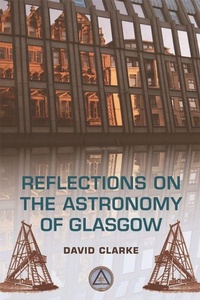
Reflections on the Astronomy of Glasgow
A story of some 500 years
Erschienen am 24. Mai 2013
Buch
Hardcover
336 Seiten
978-0-7486-7889-1 (ISBN)
Beschreibung
How Astronomy contributed to the educational enlightenment of Glasgow, to its society and to its commerce
The words 'Astronomy' and 'Glasgow' seem an incongruous juxtaposition, and yet the two are closely linked over 500 years of history. This is a tale of enlightenment and scientific progress at both institutional and public levels. Combined with the ambitions of civic commerce, it is a story populated with noteworthy personalities and intense rivalries.
It is remarkable to realise that the first Astronomy teaching in the Glasgow 'Colledge' presented an Earth-centred Universe, prior to the Copernican revolution of the mid sixteenth Century. Glasgow was later known astronomically for the telescope observations of sunspots made by Wilson in the 1760s, but less well known are the ideas related to mono-chromaticity within light, to dew point and hoar frost, and Herschel's discovery of infra-red energy in solar radiation by application of Glasgow-made thermometers.
This engrossing and entertaining scientific history includes the story of Glasgow's 'Big Bang' of 1863, the controversy over 'Astronomer Royal for Scotland' and a historical survey of the eight observatories that once populated Glasgow. David Clarke brings us a complex weave of science and accompanying social history in this unique and fascinating work.
Key Features:
A comprehensive narrative of 500+ years of Glasgow's connections with Astronomy, the story being unique and non-comparable with any other city around the worldContributions made to Astronomy directly by Glasgow University, and new ideas developed there and picked up by others outside its walls are relatedProvides short biographies of colourful contributors to the Astronomical scene in GlasgowPresents the history, architecture and structures of eight Glasgow observatoriesGives insight on social aspects of Astronomy within Glasgow, its relationships with commerce, and the upsurge of interests in Astronomy by the general public
The words 'Astronomy' and 'Glasgow' seem an incongruous juxtaposition, and yet the two are closely linked over 500 years of history. This is a tale of enlightenment and scientific progress at both institutional and public levels. Combined with the ambitions of civic commerce, it is a story populated with noteworthy personalities and intense rivalries.
It is remarkable to realise that the first Astronomy teaching in the Glasgow 'Colledge' presented an Earth-centred Universe, prior to the Copernican revolution of the mid sixteenth Century. Glasgow was later known astronomically for the telescope observations of sunspots made by Wilson in the 1760s, but less well known are the ideas related to mono-chromaticity within light, to dew point and hoar frost, and Herschel's discovery of infra-red energy in solar radiation by application of Glasgow-made thermometers.
This engrossing and entertaining scientific history includes the story of Glasgow's 'Big Bang' of 1863, the controversy over 'Astronomer Royal for Scotland' and a historical survey of the eight observatories that once populated Glasgow. David Clarke brings us a complex weave of science and accompanying social history in this unique and fascinating work.
Key Features:
A comprehensive narrative of 500+ years of Glasgow's connections with Astronomy, the story being unique and non-comparable with any other city around the worldContributions made to Astronomy directly by Glasgow University, and new ideas developed there and picked up by others outside its walls are relatedProvides short biographies of colourful contributors to the Astronomical scene in GlasgowPresents the history, architecture and structures of eight Glasgow observatoriesGives insight on social aspects of Astronomy within Glasgow, its relationships with commerce, and the upsurge of interests in Astronomy by the general public
Weitere Details
Sprache
Englisch
Verlagsort
Edinburgh
Großbritannien
Zielgruppe
Für höhere Schule und Studium
Für Beruf und Forschung
Produkt-Hinweis
Klebebindung
Pappband
Illustrationen
169 black and white illustrations, 12 colour illustrations
Maße
Höhe: 236 mm
Breite: 160 mm
Dicke: 23 mm
Gewicht
794 gr
ISBN-13
978-0-7486-7889-1 (9780748678891)
Copyright in bibliographic data and cover images is held by Nielsen Book Services Limited or by the publishers or by their respective licensors: all rights reserved.
Schweitzer Klassifikation
Weitere Ausgaben
Andere Ausgaben
E-Book
05/2013
1. Auflage
Edinburgh University Press
0,00 €
Als Download verfügbar
Person
David Clarke is a Practical Astronomer and has worked around the world on optical telescopes and on space missions such as Skylab and Pioneer 10. His main focus is Astronomical Polarimetry, having designed instruments to study scattering processes within stellar atmospheres, the interstellar medium and the Earth's atmosphere. Spending most of his career within Glasgow University in Education and Research as Observatory Director, his energies have now turned to exploring historical themes.
Inhalt
Chapter 1 -- Glasgow Astronomy Chapter 2 -- Some Early Astronomy Chapter 3 -- Establishing Astronomy Chapter 4 -- The Wilsons Chapter 5 -- The Early Nineteenth CenturyChapter 6 -- A Professor of Eloquence Chapter 7 -- The Glory of Glasgow Chapter 8 -- Time is of the Essence Chapter 9 -- The Turn of The Century Chapter 10 -- The Astronomical Society of Glasgow Chapter 11 -- University Gardens Chapter 12 -- To The New Millennium List of Figures [Including acknowledgements, etc.] General Index Full contents:Table of ContentsPreface ixChapter 1: Glasgow Astronomy 1 1.1 Introduction 1 1.2 The Influence of the University 5 1.3 The Early Syllabus 12 1.4 Glasgow University Library 18 1.5 Glasgow University Hunterian Museum 19 1.6 A Clannish People 20 References to Chapter 1 21 Appendix ? Hunterian Museum Artifacts 29 Chapter 2: Some Early Astronomy 35 2.1 A Mathematical Professor 35 2.2 Hydrostatics and the Diving Bell 37 2.3 Sinclair the Practical Natural Philosopher 41 2.3.1 Latitude Determination 42 2.3.2 The Great Comet of 1680 45 2.3.3 Astronomy and Navigation 47 2.3.4 The Barometer 48 2.3.5 Other Texts 50 2.4 The Turn of the Century 53 2.5 Early Time Keeping 54 References to Chapter 2 55Chapter 3: Establishing Astronomy 653.1 Experimental Philosophy 65 3.2 Early Astronomical Equipment 67 3.3 The Macfarlane Bequest 68 3.4 James Watt 74 3.5 The Regius Chair of Practical Astronomy 80 3.6 The MacFarlane Observatory 84 References to Chapter 3 92Chapter 4: The Wilsons 99 4.1 Introduction 99 4.2 Alexander Wilson -- The Early Years 99 4.3 Alexander Wilson the Astronomer 108 4.4 Transit of Venus 111 4.5 Observations of Sunspots 114 4.6 Solar Motion and Universal Gravity 120 4.7 A Cold Winter 123 4.8 Alexander Wilson ? Conclusion 123 4.9 Patrick Wilson 126 4.10 Investigations of Dew Point 131 4.11 A Friendship with William Herschel 133 4.12 Meteors and Meterorites 138 References to Chapter 4 143 Chapter 5: The Early Nineteenth Century 157 5.1 Introduction 157 5.2 William Meikleham 157 5.3 James Couper 162 5.4 Garnethill Observatory 166 5.5 Fulton's Orrery 176 5.6 Conclusion 178 References to Chapter 5 179 Chapter 6: A Professor of Eloquence 187 6.1 Introduction 187 6.2 The Horselethill Observatory 196 6.3 Equipment Expansion 206 6.4 The Ertel Transit Telescope 210 6.5 Meteorology 213 6.6 Horselethill under Nichol 216 6.7 Nichol's Books 224 6.8 Conclusion References to Chapter 6 227Chapter 7: The Glory of Glasgow 241 7.1 Professor Robert Grant 241 7.2 Observing at Horselethill 253 7.3 Meteorological Observations 257 7.4 Some General Astronomy 259 7.4.1 The Observatory 259 7.4.2 The Ochtertyre Refractor 260 7.4.3 Telescopic Observations 264 7.4.4 Meteor Showers 266 7.5 The Glasgow Star Catalogue 269 7.6 Professor Grant's Legacy 274 References to Chapter 7 276 Chapter 8: Time is of the Essence 287 8.1 Introduction 287 8.2 The Broomielaw Time-Ball 289 8.3 The Distribution of Time 301 8.3.1 Professor Grant's Remit 301 8.3.2 Glasgow's Big Bang of 1863 302 8.3.3 The Distribution of Regular Time 335 8.4 Duncan McGregor & Co. 343 8.5 Other Architectural Artefacts 345 References to Chapter 8 346 Chapter 9: The Turn of The Century 355 9.1 The Appointment of Professor Becker 355 9.2 Early Years at Glasgow 357 9.3 Research Frustrations 361 9.4 The Best of a Bad Job 365 9.5 World War I 366 9.6 The Later Years 368 9.7 Astronomy Teaching 370 References to Chapter 9 375 Chapter 10: The Astronomical Society of Glasgow 383 10.1 Early Days 383 10.2 Other Glasgow Activities 384 10.3 The Scottish Branch 385 10.4 The ASG 391 References to Chapter 10 395 Chapter 11: University Gardens 399 11.1 Introduction 399 11.2 The Cambridge Years 400 11.3 The Glasgow Years 404 11.4 Neptune Again 408 11.5 The University's Refractor 409 References to Chapter 11 Chapter 12: To The New Millennium 425 12.1 Introduction 425 12.2 The Years under Professor Sweet 427 12.3 Celestial Mechanics 431 12.4 The Garscube Observatory 433 12.4.1 Stellar Polarimetry 437 12.5 Solar, Stellar and Laboratory Plasma Physics 439 12.6 The New Physics and Astronomy Department 442 12.7 The Glasgow Science Centre 445 12.8 Conclusion 446 References to Chapter 12 447 List of Figures 457