

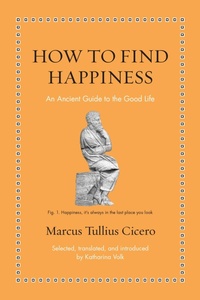
How to Find Happiness
An Ancient Guide to the Good Life
Erschienen am 24. Februar 2026
Buch
Hardcover
256 Seiten
978-0-691-26339-7 (ISBN)
Beschreibung
Does happiness come from the pursuit of pleasure or moral virtue? A vivid new translation of Cicero's exploration of a timeless question
"Of course, we all want to be happy." So wrote the Roman statesman, orator, and philosopher Marcus Tullius Cicero. He and his fellow Greek and Roman philosophers agreed that the secret to happiness-or what they called the "good life"-is pursuing the "greatest good." The only problem is that they couldn't agree on what the greatest good is. Cicero addressed this dilemma by composing a set of dialogues, On the Greatest Good and Evil (De finibus bonorum et malorum), in which he pitted advocates of different philosophical approaches to happiness against one another. Notably, these include the Epicureans (who believe that the greatest good is pleasure) and the Stoics (according to whom it is moral virtue). Rather than choosing sides, Cicero considers the pros and cons of the different philosophies, ultimately leaving it to his readers to make up their own minds. In How to Find Happiness, Katharina Volk offers a vivid new translation of selections from Cicero's work, complete with an introduction and the original Latin text on facing pages. The result is a lively and engaging debate that invites each of us to discover our own path to happiness.
"Of course, we all want to be happy." So wrote the Roman statesman, orator, and philosopher Marcus Tullius Cicero. He and his fellow Greek and Roman philosophers agreed that the secret to happiness-or what they called the "good life"-is pursuing the "greatest good." The only problem is that they couldn't agree on what the greatest good is. Cicero addressed this dilemma by composing a set of dialogues, On the Greatest Good and Evil (De finibus bonorum et malorum), in which he pitted advocates of different philosophical approaches to happiness against one another. Notably, these include the Epicureans (who believe that the greatest good is pleasure) and the Stoics (according to whom it is moral virtue). Rather than choosing sides, Cicero considers the pros and cons of the different philosophies, ultimately leaving it to his readers to make up their own minds. In How to Find Happiness, Katharina Volk offers a vivid new translation of selections from Cicero's work, complete with an introduction and the original Latin text on facing pages. The result is a lively and engaging debate that invites each of us to discover our own path to happiness.
Weitere Details
Reihe
Sprache
Englisch
Verlagsort
New Jersey
USA
Produkt-Hinweis
Standardbindung
Maße
Höhe: 177 mm
Breite: 118 mm
Dicke: 27 mm
Gewicht
264 gr
ISBN-13
978-0-691-26339-7 (9780691263397)
Copyright in bibliographic data and cover images is held by Nielsen Book Services Limited or by the publishers or by their respective licensors: all rights reserved.
Schweitzer Klassifikation
Weitere Ausgaben
Personen
Marcus Tullius Cicero (106-43 BCE) was a Roman statesman, orator, and writer who was active during the turbulent times of the fall of the Roman Republic. Famous for his rhetorical skills and his superb Latin style, he left behind a large body of writings in many genres, including highly influential philosophical works. Katharina Volk is professor of classics at Columbia University and the author of The Roman Republic of Letters (Princeton), among other books.