

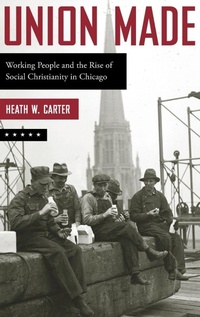
Union Made
Working People and the Rise of Social Christianity in Chicago
Erschienen am 24. September 2015
Buch
Hardcover
296 Seiten
978-0-19-938595-9 (ISBN)
Beschreibung
In Union Made, Heath W. Carter advances a bold new interpretation of the origins of American Social Christianity. While historians have often attributed the rise of the Social Gospel to middle-class ministers, seminary professors, and social reformers, this book places working people at the very center of the story. The major characters--blacksmiths, glove makers, teamsters, printers, and the like--have been mostly forgotten, but as Carter convincingly argues, their collective contribution to American Social Christianity was no less significant than that of Walter Rauschenbusch or Jane Addams.
Leading readers into the thick of late-19th-century Chicago's tumultuous history, Carter shows that countless working-class believers participated in the heated debates over the implications of Christianity for industrializing society, often with as much fervor as they did in other contests over wages and the length of the workday. Throughout the Gilded Age the city's trade unionists, socialists, and anarchists advanced theological critiques of laissez faire capitalism and protested "scab ministers" who cozied up to the business elite. Their criticisms compounded church leaders' anxieties about losing the poor, such that by the turn-of-the-century many leading Christians were arguing that the only way to salvage hopes of a Christian America was for the churches to soften their position on "the labor question." As denomination after denomination did just that, it became apparent that the Social Gospel was, indeed, ascendant-from below.
Leading readers into the thick of late-19th-century Chicago's tumultuous history, Carter shows that countless working-class believers participated in the heated debates over the implications of Christianity for industrializing society, often with as much fervor as they did in other contests over wages and the length of the workday. Throughout the Gilded Age the city's trade unionists, socialists, and anarchists advanced theological critiques of laissez faire capitalism and protested "scab ministers" who cozied up to the business elite. Their criticisms compounded church leaders' anxieties about losing the poor, such that by the turn-of-the-century many leading Christians were arguing that the only way to salvage hopes of a Christian America was for the churches to soften their position on "the labor question." As denomination after denomination did just that, it became apparent that the Social Gospel was, indeed, ascendant-from below.
Rezensionen / Stimmen
More than an important contribution to understandings of religion and the labor movement, the book also challenges interpretations of the Progressive Era by arguing that the Social Gospel-widely accepted as the creation of middle-class ministers-was in fact inspired by working people who had developed their own vision of Christianity a generation earlier....Written in a style sophisticated enough for the scholar yet accessible enough for the advanced undergraduate, this book is a must read for students of labor, religious, Gilded Age, and Progressive Era history. * Evelyn Sterne, History of Religions * Pathbreaking is an overused word in book notices, but in this case hardly any other one will do. * Grant Wacker, Christian Century * Animated with moral energy, Union Made is engagingly written and passionately argued. * Sociology of Religion * Carter's work offers a helpful intervention within the historiography of American religion by emphasizing the role of working-class individuals in the creation of social Christianity during this era. Such an intervention shifts perceptions away from the more paternalistic elements of the middle-class Social Gospel towards the more liberative theological claims created by working-class individuals. * Andrew Gardner, Reading Religion *Weitere Details
Sprache
Englisch
Verlagsort
New York
USA
Zielgruppe
Für höhere Schule und Studium
Illustrationen
18 illustrations
Maße
Höhe: 240 mm
Breite: 161 mm
Dicke: 20 mm
Gewicht
605 gr
ISBN-13
978-0-19-938595-9 (9780199385959)
Copyright in bibliographic data and cover images is held by Nielsen Book Services Limited or by the publishers or by their respective licensors: all rights reserved.
Schweitzer Klassifikation
Weitere Ausgaben
Andere Ausgaben
Buch
01/2018
Oxford University Press Inc
45,10 €
Versand in 15-20 Tagen
E-Book
08/2015
1. Auflage
OUP eBook
11,99 €
Als Download verfügbar
E-Book
08/2015
1. Auflage
OUP eBook
11,99 €
Als Download verfügbar
Person
Heath W. Carter is an assistant professor at Valparaiso University, where he teaches a variety of courses on the history of the modern United States. He is a co-editor of two forthcoming volumes that study religion in American history.
Inhalt
Acknowledgements ; Introduction: The Working-Class Origins of Social Christianity ; Chapter 1 - "Is the Laborer Worthy of his Hire?" The Decline of Democratized Christianity in Antebellum Chicago ; Chapter 2: "Undefiled Christianity" - The Rise of a Working-Class Social Gospel ; Chapter 3: "It Pays To Go to Church" - Ministers, "the Mob," and the Scramble for Working-Class Souls ; Chapter 4: "With the Prophets of Old" - Working People's Challenge to the Gilded Age Church ; Chapter 5: "The Divorce Between Labor and the Church" - Working People Strike Out on Their Own in 1894 Chicago ; Chapter 6: "To Christianize Christianity" - Labor On the Move in Turn-of-the-Century Chicago ; Chapter 7: "Social Christianity Becomes Official" - The Rise of a Middle-Class Social Gospel ; Epilogue: The Fate of American Social Christianity in the Twentieth Century and Beyond ; Notes ; Bibliography ; Index