

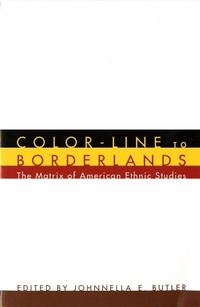
Color-Line to Borderlands
The Matrix of American Ethnic Studies
Erschienen am 1. Oktober 2001
Buch
Softcover
337 Seiten
978-0-295-98091-1 (ISBN)
Beschreibung
"Ethnic Studies . . . has drawn higher education, usually kicking and screaming, into the borderlands of scholarship, pedagogy, faculty collegiality, and institutional development," Johnnella E. Butler writes in her Introduction to this collection of lively and insightful essays. Some of the most prominent scholars in Ethnic Studies today explore varying approaches, multiple methodologies, and contrasting perspectives within the field. Essays trace the historical development of Ethnic Studies, its place in American universities and the curriculum, and new directions in contemporary scholarship. The legitimation of the field, the need for institutional support, and the changing relations between academic scholarship and community activism are also discussed.
The institutional structure of Ethnic Studies continues to be affected by national, regional, and local attitudes and events, and Ronald Takaki's essay explores the contested terrains of these culture wars. Manning Marable delves into theoretical aspects of writing about race and ethnicity, while John C. Walter surveys the influence of African American history on U.S. history textbooks. Elizabeth Cook-Lynn and Craig Howe explain why American Indian Studies does not fit into the Ethnic Studies model, and Lauro H. Flores traces the historical development of Chicano/a Studies, forged from the student and community activism of the late 1960s.
Ethnic Studies is simultaneously discipline-based and interdisciplinary, self-containing and overlapping. This volume captures that dichotomy as contributors raise questions that traditional disciplines ignore. Essays include Lane Ryo Hirabayashi and Marilyn Caballero Alquizola on the gulf between postmodernism and political and institutional realities; Rhett S. Jones on the evolution of Africana Studies; and Judith Newton on the trajectories of Ethnic Studies and Women's Studies and their relations with marginalized communities. Shirley Hune and Evelyn Hu-DeHart each make a case for the separation of Asian American Studies from Asian Studies, while Edna Acosta-Belen argues for a hemispheric approach to Latin American and U.S. Latino/a Studies. T. V. Reed rounds out the volume by offering through cultural studies bridges to the twenty-first century.
The institutional structure of Ethnic Studies continues to be affected by national, regional, and local attitudes and events, and Ronald Takaki's essay explores the contested terrains of these culture wars. Manning Marable delves into theoretical aspects of writing about race and ethnicity, while John C. Walter surveys the influence of African American history on U.S. history textbooks. Elizabeth Cook-Lynn and Craig Howe explain why American Indian Studies does not fit into the Ethnic Studies model, and Lauro H. Flores traces the historical development of Chicano/a Studies, forged from the student and community activism of the late 1960s.
Ethnic Studies is simultaneously discipline-based and interdisciplinary, self-containing and overlapping. This volume captures that dichotomy as contributors raise questions that traditional disciplines ignore. Essays include Lane Ryo Hirabayashi and Marilyn Caballero Alquizola on the gulf between postmodernism and political and institutional realities; Rhett S. Jones on the evolution of Africana Studies; and Judith Newton on the trajectories of Ethnic Studies and Women's Studies and their relations with marginalized communities. Shirley Hune and Evelyn Hu-DeHart each make a case for the separation of Asian American Studies from Asian Studies, while Edna Acosta-Belen argues for a hemispheric approach to Latin American and U.S. Latino/a Studies. T. V. Reed rounds out the volume by offering through cultural studies bridges to the twenty-first century.
Weitere Details
Reihe
Sprache
Englisch
Verlagsort
Seattle
USA
Zielgruppe
Für Beruf und Forschung
Produkt-Hinweis
Broschur/Paperback
Maße
Höhe: 235 mm
Breite: 155 mm
Dicke: 19 mm
Gewicht
472 gr
ISBN-13
978-0-295-98091-1 (9780295980911)
Copyright in bibliographic data and cover images is held by Nielsen Book Services Limited or by the publishers or by their respective licensors: all rights reserved.
Schweitzer Klassifikation
Weitere Ausgaben
Andere Ausgaben

E-Book
07/2011
1. Auflage
University of Washington Press
29,49 €
Als Download verfügbar
Person
Edited by Johnnella E. Butler
Inhalt
Acknowledgments
Introduction Color-Line to Borderlands
Part One Ethnic Studies as a Matrix: Moving from Color-Line to Borderlands
Multiculturalism: Battleground or Meeting Ground?
Ethnic Studies as a Matrix for the Humanities, the Social Sciences, and the Common Good
The Problematics of Ethnic Studies
The Influence of African American history on U.S. History Survey Textbooks since the 1970s
Part Two Institutional Structure and Knowledge Production
Ethnic Studies in U.S. Higher Education: The State of the Discipline
From Ideology to institution: the Evolution of Africana Studies
The Dialetics of Ethnicity in America: A View from American Indian Studies
Whither the Asian American Subject?
Thirty Years of Chicono and Chicana Studies
Part Three Changing and Emerging Paradigms
Asian American Studies and Asian studies: Boundars and Borderlands of Ethnic Studies and Area Studies
Reimaginging Borders; A Hemispheric Approach to Latin American and U.S. Latino and Latina Studies
Bridges to the twenty-first century: Making Cultural Studies-- and making it work
Heavy Traffic at the Intersections: Ethnic, American, Women's, Queer, and Cultural Studies
Contributors
Index
Introduction Color-Line to Borderlands
Part One Ethnic Studies as a Matrix: Moving from Color-Line to Borderlands
Multiculturalism: Battleground or Meeting Ground?
Ethnic Studies as a Matrix for the Humanities, the Social Sciences, and the Common Good
The Problematics of Ethnic Studies
The Influence of African American history on U.S. History Survey Textbooks since the 1970s
Part Two Institutional Structure and Knowledge Production
Ethnic Studies in U.S. Higher Education: The State of the Discipline
From Ideology to institution: the Evolution of Africana Studies
The Dialetics of Ethnicity in America: A View from American Indian Studies
Whither the Asian American Subject?
Thirty Years of Chicono and Chicana Studies
Part Three Changing and Emerging Paradigms
Asian American Studies and Asian studies: Boundars and Borderlands of Ethnic Studies and Area Studies
Reimaginging Borders; A Hemispheric Approach to Latin American and U.S. Latino and Latina Studies
Bridges to the twenty-first century: Making Cultural Studies-- and making it work
Heavy Traffic at the Intersections: Ethnic, American, Women's, Queer, and Cultural Studies
Contributors
Index