

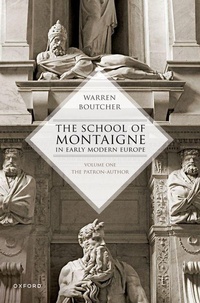
The School of Montaigne in Early Modern Europe
Volume One: The Patron Author
Erschienen am 8. September 2022
Buch
Softcover
464 Seiten
978-0-19-286714-8 (ISBN)
Beschreibung
This major two-volume study offers an interdisciplinary analysis of Montaigne's Essais and their fortunes in early modern Europe and the modern western university. Volume one focuses on contexts from within Montaigne's own milieu, and on the ways in which his book made him a patron-author or instant classic in the eyes of his editor Marie de Gournay and his promoter Justus Lipsius. Volume two focuses on the reader-writers across Europe who used the Essais to make their own works, from corrected editions and translations in print, to life-writing and personal records in manuscript.
The two volumes work together to offer a new picture of the book's significance in literary and intellectual history. Montaigne's is now usually understood to be the school of late humanism or of Pyrrhonian scepticism. This study argues that the school of Montaigne potentially included everyone in early modern Europe with occasion and means to read and write for themselves and for their friends and family, unconstrained by an official function or scholastic institution. For the Essais were shaped by a battle that had intensified since the Reformation and that would continue through to the pre-Enlightenment period. It was a battle to regulate the educated individual's judgement in reading and acting upon the two books bequeathed by God to man. The book of scriptures and the book of nature were becoming more accessible through print and manuscript cultures. But at the same time that access was being mediated more intensively by teachers such as clerics and humanists, by censors and institutions, by learned authors of past and present, and by commentaries and glosses upon those authors. Montaigne enfranchised the unofficial reader-writer with liberties of judgement offered and taken in the specific historical conditions of his era.
The study draws on new ways of approaching literary history through the history of the book and of reading. The Essais are treated as a mobile, transnational work that travelled from Bordeaux to Paris and beyond to markets in other countries from England and Switzerland, to Italy and the Low Countries. Close analysis of editions, paratexts, translations, and annotated copies is informed by a distinct concept of the social context of a text. The concept is derived from anthropologist Alfred Gell's notion of the 'art nexus': the specific types of actions and agency relations mediated by works of art understood as 'indexes' that give rise to inferences of particular kinds. Throughout the two volumes the focus is on the particular nexus in which a copy, an edition, an extract, is embedded, and on the way that nexus might be described by early-modern people.
The two volumes work together to offer a new picture of the book's significance in literary and intellectual history. Montaigne's is now usually understood to be the school of late humanism or of Pyrrhonian scepticism. This study argues that the school of Montaigne potentially included everyone in early modern Europe with occasion and means to read and write for themselves and for their friends and family, unconstrained by an official function or scholastic institution. For the Essais were shaped by a battle that had intensified since the Reformation and that would continue through to the pre-Enlightenment period. It was a battle to regulate the educated individual's judgement in reading and acting upon the two books bequeathed by God to man. The book of scriptures and the book of nature were becoming more accessible through print and manuscript cultures. But at the same time that access was being mediated more intensively by teachers such as clerics and humanists, by censors and institutions, by learned authors of past and present, and by commentaries and glosses upon those authors. Montaigne enfranchised the unofficial reader-writer with liberties of judgement offered and taken in the specific historical conditions of his era.
The study draws on new ways of approaching literary history through the history of the book and of reading. The Essais are treated as a mobile, transnational work that travelled from Bordeaux to Paris and beyond to markets in other countries from England and Switzerland, to Italy and the Low Countries. Close analysis of editions, paratexts, translations, and annotated copies is informed by a distinct concept of the social context of a text. The concept is derived from anthropologist Alfred Gell's notion of the 'art nexus': the specific types of actions and agency relations mediated by works of art understood as 'indexes' that give rise to inferences of particular kinds. Throughout the two volumes the focus is on the particular nexus in which a copy, an edition, an extract, is embedded, and on the way that nexus might be described by early-modern people.
Rezensionen / Stimmen
[Boutcher] gives us an in-depth account of Montaigne's literary influence across the Western world from the sixteenth century to the present day. * Patrick J. Murray, The Times Literary Supplement * Boutcher follows Montaigne and his Essais around Europe, and constructs as he goes an intricate, learned, and very readable reassessment of early modern authorship which scrupulously locates Montaigne's practice within a mobile portrait of contemporary norms...the work offers much of interest to scholars of Elizabethan literature and culture, not least as a case study in itself of an alternative mode of literary history. * Harriet Archer, The English Association * [B]eneath the vast scope of Boutcher's study of the European fortunes of the Essais-in their own time, in the long seventeenth century, and in the modern Western university-lies the nagging question: but why has this book been ever arresting, and in what changing ways? If the answer has been, for many readers, "because Montaigne teaches me to think for myself," Boutcher's achievement is to show that this deceptively simple answer is variously predicated on historical conditions, hierarchies, constraints, exclusions, and technologies. ... Boutcher [turns] the long-cherished ideal of a one-to-one encounter with Montaigne from an unquestioned method of study into part of what studying and questioning the Essais should be about * Neil Kenny, Common Knowledge * Warren Boutcher ... [has] transformed the study of Montaigne's Essais ... Boutcher's ... exhaustive study of Montaigne's influence traces the actual history of his book: how it was read in numerous editions and translations across early modern Europe and how these editions inspired a new kind of reader-writer in the post-Reformation world ... Boutcher seeks to restore the Essais to its early modern milieu, to a time before it was "great." * Zachary S. Schiffman, The Journal of Modern History * Warren Boutcher's masterful study of the genesis and reception of the Essays within a European social network concerned with the training of liberal minds.'; 'Original wide-ranging study of Montaigne's place at the center of a European intellectual network focused on the education and training of the nobility; opens new modes of inquiry within literary/cultural interrelations * William Hamlin, Montaigne: A Very Short Introduction * Boutcher puts [his] methodology into practice in impressive style ... [He] follows Montaigne and his Essais around Europe, and constructs as he goes an intricate, learned, and very readable reassessment of early modern authorship which scrupulously locates Montaigne's practice within a mobile portrait of contemporary norms. ... [T]he work offers much of interest to scholars of Elizabethan literature and culture, not least as a case study in itself of an alternative mode of literary history * Harriet Archer and Richard Wood, The Year's Work in English Studies * Resembling nothing so much as an Anthony Grafton of vernacular scholarship, Boutcher leaps from France to the Netherlands, from England to Italy, and from Spain to Germany in order to track thousands of interlinked references to the Essays. ... The book's impressive span aims at two distinct ends: as a summation of Montaigne's reception and influence, Boutcher's School of Montaigne stands as a reference work for all scholars ... ; at the same time, it mounts a novel and provocative challenge to current literary studies in how it shows that contextualization can not only determine historical actors, it can liberate them * George Hoffmann, Renaissance and Reformation * Warren Boutcher's prodigious-and prodigiously important-book'; '[T]he school of Montaigne has had-and continues to have-textbooks in many editions, countless students, myriad teachers. Warren Boutcher is, quite simply, one of its finest instructors * Peter Platt, Renaissance Quarterly *Weitere Details
Sprache
Englisch
Verlagsort
Oxford
Großbritannien
Zielgruppe
Für höhere Schule und Studium
Produkt-Hinweis
Broschur/Paperback
Klebebindung
Maße
Höhe: 237 mm
Breite: 157 mm
Dicke: 25 mm
Gewicht
739 gr
ISBN-13
978-0-19-286714-8 (9780192867148)
Copyright in bibliographic data and cover images is held by Nielsen Book Services Limited or by the publishers or by their respective licensors: all rights reserved.
Schweitzer Klassifikation
Weitere Ausgaben
Andere Ausgaben
Buch
03/2017
Oxford University Press
171,50 €
Versand in 15-20 Tagen
Person
Warren Boutcher is Professor of Renaissance Studies in the School of English and Drama, Faculty of Humanities and Social Sciences, Queen Mary University of London. He has published extensively on Montaigne and on humanism, translation, and the history of the book and of libraries in early modern England, France, and Italy.
Inhalt
- Introduction
- 1.1 Prologue: Literature and agency in late medieval and early modern Europe
- 1.1.1: The force of the imagination
- 1.1.2: Montaigne's medallion as index
- 1.1.3: Art, agency, and the offices of self-knowledge
- 1.1.4: The qualities of a freeman
- 1.1.5: Reading-and-writing
- 1.1.6: Lady Anne Clifford
- 1.1.7: The book in the post-Reformation age
- 1.1.8: Acting and conversing through books
- 1.1.9: Imagines ingeniorum
- 1.1.10: Montaigne's imago
- 1.1.11: Pierre Eyquem's Sebond
- 1.1.12: Paratexts and the story of a book
- 1.1.13: Medallion and book
- 1.1.14: Van Ravesteyn's portrait of Pieter van Veen
- 1.1.15: Settings and situations
- 1.2 Villey and the making of the modern critical reader
- 1.2.1: This great reader
- 1.2.2: Villey's reception
- 1.2.3: Rival transcriptions of Montaigne's evolution
- 1.2.4: Strowski and Brunetiÿre
- 1.2.5: The distinctive evolution of Villey's Montaigne
- 1.2.6: Creating an oeuvre
- 1.3 The patron's oeuvre
- 1.3.1: Montaigne's self-portrait: Essais (1580) II 17 and II 18
- 1.3.2: The Journal de voyage
- 1.3.3: Urbino
- 1.3.4: The Journal and the Essais
- 1.3.5: Florence's patron
- 1.3.6: The place of books in the patron's oeuvre
- 1.3.7: Statues and books in Rome
- 1.3.8: Two works by patron-authors
- 1.3.9: Inauthentic patrons of books
- 1.3.10: Coda: the patron's book
- 1.4 Offices without names
- 1.4.1: London 1603
- 1.4.2: The desire for knowledge and the fall of man
- 1.4.3: Apology
- 1.4.4: Madame de Duras and the art of balneology
- 1.4.5: Offices without names in the Journal de voyage
- 1.5 The unpremeditated and accidental philosopher
- 1.5.1: Vettori and Montaigne on Tacitus
- 1.5.2: Extracting and applying literary curiosities
- 1.5.3: From ancient extracts to new pieces of man
- 1.5.4: Pierre de Lancre
- 1.5.5: Examining witches
- 1.5.6: On the lame (in Pierre Dheure's eyes)
- 1.5.7: The Montaigne effect
- 1.6 Caring for fortunes
- 1.6.1: 'La franchise de ma conversation'
- 1.6.2: Bienheureuse franchise
- 1.6.3: The French Thales
- 1.6.4: Gournay and Montaigneâs cold reception
- 1.6.5: Lipsius
- 1.6.6: Montaigne's missing letters
- 1.6.7: Pierre de Brachâs letters: Montaigne as 'patron'
- 1.6.8: Caring for fortunes
- 1.6.9: The genesis of the Essais
- 1.6.10: Amyot's Plutarch
- 1.6.11: The III 12 anecdotes
- 1.6.12: Essais I 23 (in 1580)
- 1.6.13: La BoÃ(c)tie
- 1.6.14: Pierre's Sebond and the liberty to judge
- 1.7 Montaigne at Rome, 1580-81: The Essais and the Papal court
- 1.7.1: Montaigne at Rome
- 1.7.2: 'Le Seneque de Rome'
- 1.7.3: Censoring the 1580 Essais
- 1.7.4: Roman topics in the Essais and the Journal
- 1.7.5: Rome's liberty
- 1.7.6: Montaigne's Roman citizenship
- 1.7.7: Essais III 9, 'De la vanitÃ(c)' (1588)
- Conclusion
- Bibliography