

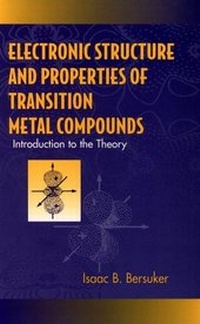
Electronic Structure and Properites of Transition Metal Compounds
Introduction to the Theory
Erschienen am 28. März 1996
Buch
Hardcover
696 Seiten
978-0-471-13079-6 (ISBN)
Beschreibung
Covering all the latest developments, and applying the theory of electronic structure to problem solving at every opportunity, Electronic Structure and Properties of Transition Metal Compounds places the reader at the cutting edge of this important field of research. The book focuses on the electronic structure and related properties of coordination compounds, essentially treating chemical bonding as an electronic phenomenon. It also covers the central concepts of quantum chemistry and atomic states, examines theories of electronic structure and vibronic coupling, and explores physical methods of investigation. The applications of the theory to stereochemistry and crystal chemistry, electron transfer and electron-conformational effects, and reactivity and catalytic action are also discussed.
Weitere Details
Sprache
Englisch
Verlagsort
New York
USA
Verlagsgruppe
John Wiley and Sons Ltd
Zielgruppe
Für höhere Schule und Studium
Für Beruf und Forschung
Illustrationen
Ill.
Maße
Höhe: 238 mm
Breite: 164 mm
Dicke: 39 mm
Gewicht
1106 gr
ISBN-13
978-0-471-13079-6 (9780471130796)
Copyright in bibliographic data and cover images is held by Nielsen Book Services Limited or by the publishers or by their respective licensors: all rights reserved.
Schweitzer Klassifikation
Weitere Ausgaben
Nachauflagen
Isaac B. Bersuker
Electronic Structure and Properties of Transition Metal Compounds
Introduction to the Theory
Buch
05/2010
2. Auflage
Wiley
205,00 €
Artikel ist vergriffen; siehe Neuauflage
Person
ISAAC B. BERSUKER is Professor of Chemistry at the University of Texas. He has been involved in the field of transition metal compounds for thirty--five years, in both the United States and the Soviet Union, and has published numerous reviews and three books on the subject.
Inhalt
Introduction: Subject and Methods.; Atomic States.; Symmetry Ideas and Group--Theoretical Description.; Crystal Field Theory.; The Method of Molecular Orbitals and Related Approaches.; Electronic Structure and Chemical Bonding.; Electronic Control of Nuclear Configuration: Vibrations and Vibronic Coupling.; Electronic Structure Investigated by Physical Methods.; Stereochemistry and Crystal Chemistry.; Electron Transfer, Redox Properties, and Electron--Conformational Effects.; Reactivity and Catalytic Action.; Appendices.; Indexes.