

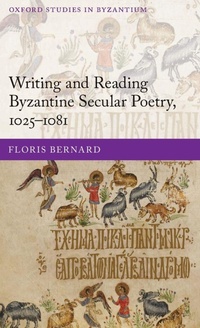
Writing and Reading Byzantine Secular Poetry, 1025-1081
Erschienen am 17. Juli 2014
Buch
Hardcover
400 Seiten
978-0-19-870374-7 (ISBN)
Beschreibung
In the mid-eleventh century, secular Byzantine poetry attained a hitherto unseen degree of wit, vividness, and personal involvement, chiefly exemplified in the poetry of Christophoros Mitylenaios, Ioannes Mauropous, and Michael Psellos. This is the first volume to consider this poetic activity as a whole, critically reconsidering modern assumptions about Byzantine poetry, and focusing on Byzantine conceptions of the role of poetry in society.
By providing a detailed account of the various media through which poetry was presented to its readers, and by tracing the initial circulation of poems, this volume takes an interest in the Byzantine reader and his/her reading habits and strategies, allowing aspects of performance and visual representation, rarely addressed, to come to the fore. It also examines the social interests that motivated the composition of poetry, establishing a connection with the extraordinary social mobility of the time. Self-representative strategies are analyzed against the background of an unstable elite struggling to find moral justification, which allows the study to raise the question of patronage, examine the discourse used by poets to secure material rewards, and explain the social dynamics of dedicatory epigrams. Finally, gift exchange is explored as a medium that underlines the value of poetry and confirms the exclusive nature of intellectual friendship.
By providing a detailed account of the various media through which poetry was presented to its readers, and by tracing the initial circulation of poems, this volume takes an interest in the Byzantine reader and his/her reading habits and strategies, allowing aspects of performance and visual representation, rarely addressed, to come to the fore. It also examines the social interests that motivated the composition of poetry, establishing a connection with the extraordinary social mobility of the time. Self-representative strategies are analyzed against the background of an unstable elite struggling to find moral justification, which allows the study to raise the question of patronage, examine the discourse used by poets to secure material rewards, and explain the social dynamics of dedicatory epigrams. Finally, gift exchange is explored as a medium that underlines the value of poetry and confirms the exclusive nature of intellectual friendship.
Rezensionen / Stimmen
Rich in close readings and approaching its subject from a variety of angles, this book is in a sense a literary history of Byzantine secular poetry in the eleventh century, or more precisely 1025-1081.. . . [A]n important synthesis of previous scholarship on the, until lately, somewhat ignored category of Byzantine verse. It is, however, also an important contribution in itself, promoting several ideas about the writers of verse and their audience. . . . [A] very useful reference tool for further work. * Christian Hogel and Jonas J.H. Christensen, Bryn Mawr Classical Review *Weitere Details
Reihe
Sprache
Englisch
Verlagsort
Oxford
Großbritannien
Zielgruppe
Für höhere Schule und Studium
Für Beruf und Forschung
Illustrationen
6 halftones
Maße
Höhe: 222 mm
Breite: 145 mm
Dicke: 25 mm
Gewicht
628 gr
ISBN-13
978-0-19-870374-7 (9780198703747)
Copyright in bibliographic data and cover images is held by Nielsen Book Services Limited or by the publishers or by their respective licensors: all rights reserved.
Schweitzer Klassifikation
Weitere Ausgaben
Andere Ausgaben
Floris Bernard
Writing and Reading Byzantine Secular Poetry, 1025-1081
E-Book
07/2014
1. Auflage
OUP eBook
55,99 €
Als Download verfügbar
Person
Floris Bernard studied Classics in Ghent and Athens, and obtained a PhD in Literature at Ghent University with a dissertation on eleventh-century poetry. He was a Fellow at the Dumbarton Oaks Research Library and Collection in Washington DC and is currently post-doctoral research fellow in Ghent.
Inhalt
List of Figures ; List of Abbreviations ; Note to the Reader ; 1. Introduction ; 2. Concepts ; 3. Readings ; 4. Collections ; 5. Ambitions ; 6. Education ; 7. Competitions ; 8. Patronage ; Conclusions ; Bibliography ; General Index ; Index of Poems ; Index of Manuscripts