

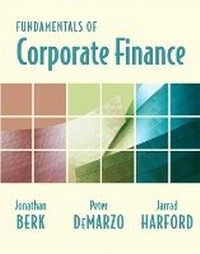
Fundamentals of Corporate Finance and MyFinanceLab with Pearson eText Student Access Code Card Package
Erschienen am 28. März 2011
Buch
Mixed media Artikel
978-0-13-247952-3 (ISBN)
Beschreibung
For students taking a undergraduate corporate finance or financial management course.
The core concepts you expect. The new ideas you want. The pedagogy your students need to succeed. Fundamentals of Corporate Finance's applied perspective cements students' understanding of the modern-day core principles by equipping students with a problem-solving methodology and profiling real-life financial management practices, all within a clear valuation framework.
The core concepts you expect. The new ideas you want. The pedagogy your students need to succeed. Fundamentals of Corporate Finance's applied perspective cements students' understanding of the modern-day core principles by equipping students with a problem-solving methodology and profiling real-life financial management practices, all within a clear valuation framework.
Weitere Details
Sprache
Englisch
Verlagsort
Upper Saddle River
USA
Verlagsgruppe
Pearson Education (US)
Zielgruppe
Für höhere Schule und Studium
ISBN-13
978-0-13-247952-3 (9780132479523)
Copyright in bibliographic data and cover images is held by Nielsen Book Services Limited or by the publishers or by their respective licensors: all rights reserved.
Schweitzer Klassifikation
Weitere Ausgaben
Nachauflagen
Jonathan Berk | Peter DeMarzo | Jarrad Harford
Fundamentals of Corporate Finance
International Financial Reporting Standards Edition
Buch
10/2010
Pearson Education (US)
189,40 €
Artikel ist vergriffen; siehe Neuauflage
Personen
Jonathan Berk is the Professor of Finance in the Haas School of Business at the University of California, Berkeley and is a Research Associate at the National Bureau of Economic Research. He currently teaches the introductory Corporate Finance course for first-year MBA students at Berkeley. Before getting his Ph.D., he worked as an Associate at Goldman Sachs, where his education in finance really began.
Professor Berk is an Associate Editor of the Journal of Finance. His research interests in finance include corporate valuation, capital structure, mutual funds, asset pricing, experimental economics, and labor economics. His work has won a number of research awards including the TIAA-CREF Paul A. Samuelson Award, the Smith Breeden Prize, Best Paper of the Year in The Review of Financial Studies, and the FAME Research Prize. His paper, "A Critique of Size Related Anomalies," was recently selected as one of the two best papers ever published in The Review of Financial Studies. In recognition of his influence on the practice of finance he has received the Bernstein-Fabozzi/Jacobs Levy Award, the Graham and Dodd Award of Excellence, and the Roger F. Murray Prize.
Born in Johannesburg, South Africa, Professor Berk is married, with two daughters aged 10 and 14, and is an avid skier and biker.
Peter DeMarzo is the Mizuho Financial Group Professor of Finance at the Stanford Graduate School of Business and is a Research Associate at the National Bureau of Economic Research. He currently teaches the "turbo" core finance course for Stanford's first-year MBA students. In addition to his experience at the Stanford Graduate School of Business, Professor DeMarzo has taught at the Haas School of Business and the Kellogg Graduate School of Management, and he was a National Fellow at the Hoover Institution.
Professor DeMarzo received the Sloan Teaching Excellence Award at Stanford in 2004 and 2006, and the Earl F. Cheit Outstanding Teaching Award at U.C. Berkeley in 1998. Professor DeMarzo has served as an Associate Editor for The Review of Financial Studies, Financial Management, and the B.E. Journals in Economic Analysis and Policy, as well as a Director of the Western Finance Association. Professor DeMarzo's research is in the area of corporate finance, asset securitization, and contracting, as well as market structure and regulation. His recent work has examined issues of the optimal design of securities, the regulation of insider trading and broker-dealers, and the influence of information asymmetries on corporate investment. He has received numerous awards including the Western Finance Association Corporate Finance Award and the Barclays Global Investors/Michael Brennan best-paper award from The Review of Financial Studies.
Professor DeMarzo was born in Whitestone, New York and is married with three boys. He and his family enjoy hiking, biking, and skiing.
Jarrad Harford is the Marion B. Ingersoll Associate Professor of Finance at the University of Washington. He received his PhD in Finance with a minor in Organizations and Markets from the University of Rochester. Professor Harford has taught the core undergraduate finance course, Business Finance, for eleven years at the University of Oregon, as well as an elective in mergers and acquisitions, and Finance for non-financial executives in the executive education program. He has won numerous awards for his teaching, including the IFC Excellence in Teaching Award (2006-2007), ISMBA Excellence in Teaching Award (2006), and the Wells Fargo Faculty Award for Undergraduate Teaching (2005). He is also the Faculty Director of the CFO Forum and the Faculty Director of the UW Business School Undergraduate Honors Program. Professor Harford serves as an Associate Editor for The Journal of Financial Economics, Journal of Financial and Quantitative Analysis, and Journal of Corporate Finance.
Professor Harford was born in State College, Pennsylvania, and is married with two boys. He and his family enjoy traveling to Alaska to visit his in-laws.
Professor Berk is an Associate Editor of the Journal of Finance. His research interests in finance include corporate valuation, capital structure, mutual funds, asset pricing, experimental economics, and labor economics. His work has won a number of research awards including the TIAA-CREF Paul A. Samuelson Award, the Smith Breeden Prize, Best Paper of the Year in The Review of Financial Studies, and the FAME Research Prize. His paper, "A Critique of Size Related Anomalies," was recently selected as one of the two best papers ever published in The Review of Financial Studies. In recognition of his influence on the practice of finance he has received the Bernstein-Fabozzi/Jacobs Levy Award, the Graham and Dodd Award of Excellence, and the Roger F. Murray Prize.
Born in Johannesburg, South Africa, Professor Berk is married, with two daughters aged 10 and 14, and is an avid skier and biker.
Peter DeMarzo is the Mizuho Financial Group Professor of Finance at the Stanford Graduate School of Business and is a Research Associate at the National Bureau of Economic Research. He currently teaches the "turbo" core finance course for Stanford's first-year MBA students. In addition to his experience at the Stanford Graduate School of Business, Professor DeMarzo has taught at the Haas School of Business and the Kellogg Graduate School of Management, and he was a National Fellow at the Hoover Institution.
Professor DeMarzo received the Sloan Teaching Excellence Award at Stanford in 2004 and 2006, and the Earl F. Cheit Outstanding Teaching Award at U.C. Berkeley in 1998. Professor DeMarzo has served as an Associate Editor for The Review of Financial Studies, Financial Management, and the B.E. Journals in Economic Analysis and Policy, as well as a Director of the Western Finance Association. Professor DeMarzo's research is in the area of corporate finance, asset securitization, and contracting, as well as market structure and regulation. His recent work has examined issues of the optimal design of securities, the regulation of insider trading and broker-dealers, and the influence of information asymmetries on corporate investment. He has received numerous awards including the Western Finance Association Corporate Finance Award and the Barclays Global Investors/Michael Brennan best-paper award from The Review of Financial Studies.
Professor DeMarzo was born in Whitestone, New York and is married with three boys. He and his family enjoy hiking, biking, and skiing.
Jarrad Harford is the Marion B. Ingersoll Associate Professor of Finance at the University of Washington. He received his PhD in Finance with a minor in Organizations and Markets from the University of Rochester. Professor Harford has taught the core undergraduate finance course, Business Finance, for eleven years at the University of Oregon, as well as an elective in mergers and acquisitions, and Finance for non-financial executives in the executive education program. He has won numerous awards for his teaching, including the IFC Excellence in Teaching Award (2006-2007), ISMBA Excellence in Teaching Award (2006), and the Wells Fargo Faculty Award for Undergraduate Teaching (2005). He is also the Faculty Director of the CFO Forum and the Faculty Director of the UW Business School Undergraduate Honors Program. Professor Harford serves as an Associate Editor for The Journal of Financial Economics, Journal of Financial and Quantitative Analysis, and Journal of Corporate Finance.
Professor Harford was born in State College, Pennsylvania, and is married with two boys. He and his family enjoy traveling to Alaska to visit his in-laws.
Inhalt
Part I: Introduction
Ch. 1: Corporate Finance and the Financial Manager
Ch. 2: Introduction to Financial Statement Analysis
Part II: Interest Rates and Valuing Cash Flows
Ch. 3: The Valuation Principle: The Foundation of Financial Decision Making
Ch. 4: NPV and the Time Value of Money
Ch. 5: Interest Rates
Ch. 6: Bonds
Part III: Valuation and the Firm
Ch. 7: Investment Decision Rules
Ch. 8: Fundamentals of Capital Budgeting
Ch. 9: Valuing Stocks
Part IV: Risk and Return
Ch. 10: Risk and Return in Capital Markets
Ch. 11: Systematic Risk and the Equity Risk Premium
Ch. 12: The Cost of Capital
Part V: Long-Term Financing
Ch. 13: Raising Capital
Ch. 14: Debt Financing
Part VI: Capital Structure and Valuation
Ch. 15: Capital Structure
Ch. 16: Payout Policy
Part VII: Financial Planning
Ch. 17: Financial Modeling and Pro Forma Analysis
Ch. 18: Working Capital Management
Ch. 19: Short-Term Financial Planning
Part VIII: Special Topics
Ch. 20: Option Applications and Corporate Finance
Ch. 21: Insurance and Risk Management
Ch. 22: International Corporate Finance
Ch. 1: Corporate Finance and the Financial Manager
Ch. 2: Introduction to Financial Statement Analysis
Part II: Interest Rates and Valuing Cash Flows
Ch. 3: The Valuation Principle: The Foundation of Financial Decision Making
Ch. 4: NPV and the Time Value of Money
Ch. 5: Interest Rates
Ch. 6: Bonds
Part III: Valuation and the Firm
Ch. 7: Investment Decision Rules
Ch. 8: Fundamentals of Capital Budgeting
Ch. 9: Valuing Stocks
Part IV: Risk and Return
Ch. 10: Risk and Return in Capital Markets
Ch. 11: Systematic Risk and the Equity Risk Premium
Ch. 12: The Cost of Capital
Part V: Long-Term Financing
Ch. 13: Raising Capital
Ch. 14: Debt Financing
Part VI: Capital Structure and Valuation
Ch. 15: Capital Structure
Ch. 16: Payout Policy
Part VII: Financial Planning
Ch. 17: Financial Modeling and Pro Forma Analysis
Ch. 18: Working Capital Management
Ch. 19: Short-Term Financial Planning
Part VIII: Special Topics
Ch. 20: Option Applications and Corporate Finance
Ch. 21: Insurance and Risk Management
Ch. 22: International Corporate Finance