

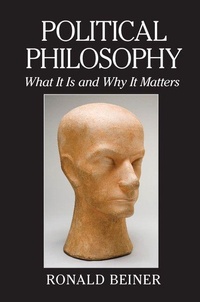
Political Philosophy
What It Is and Why It Matters
Erschienen am 11. August 2014
Buch
Hardcover
304 Seiten
978-1-107-06995-4 (ISBN)
Beschreibung
What is political philosophy? Ronald Beiner makes the case that it is centrally defined by supremely ambitious reflection on the ends of life. We pursue this reflection by exposing ourselves to, and participating in, a perennial dialogue among epic theorists who articulate grand visions of what constitutes the authentic good for human beings. Who are these epic theorists, and what are their strengths and weaknesses? Beiner selects a dozen leading candidates: Arendt, Oakeshott, Strauss, Loewith, Voegelin, Weil, Gadamer, Habermas, Foucault, MacIntyre, Rawls, and Rorty. In each case, he shows both why the political philosophies continue to be intellectually compelling and why they are problematic or can be challenged in various ways. In this sense, Political Philosophy attempts to draw up a balance sheet for political philosophy in the twentieth century, by identifying a canon of towering contributions and reviewing the extent to which they fulfil their intellectual aspirations.
Rezensionen / Stimmen
'In this extraordinarily learned, clear, and wide-ranging book, Ronald Beiner analyzes the contributions of twelve leading thinkers of the twentieth century to political philosophy, from Arendt to Rorty, Strauss to Foucault, and Oakeshott to Rawls ... every reader, I believe, will be impressed by the humane seriousness that beats at the center of this impressive book, which seeks not to score points but to understand, eschewing scholarly quibbles in favor of the central question of the human good. Beiner makes for an outstanding guide through the intellectual life of the modern era.' Robert C. Bartlett, Boston College 'A terrific book - beautifully written, elegantly argued, wise, passionate, and personal - that both succinctly summarizes the compelling visions of twelve writers and defends their commitment, acknowledged or not, to the idea that properly 'epic' political philosophy should offer an ideal of the good life. Beiner makes a persuasive case for the view that inspiring and substantive political philosophy was not dead before the arrival of Rawls but very much alive and responsive to the crisis of modernity provoked by the tragedies of the past century.' Dave Archard, Queen's University Belfast '[Beiner] examines concepts and systematizations regarding esotericism, performative politics, the common good, and communicative rationality, among others. Furthermore, he does so in an accessible, nearly jargon-free, discursive style with detailed knowledge and intelligent discussions of the twelve theorists. The quality of Beiner's intellectual presence affirms his own right to occupy a thirteenth place in this volume of political philosophy. Summing up: highly recommended.' J. R. Pottenger, ChoiceWeitere Details
Sprache
Englisch
Verlagsort
Cambridge
Großbritannien
Zielgruppe
Für höhere Schule und Studium
Für Beruf und Forschung
Maße
Höhe: 235 mm
Breite: 157 mm
Dicke: 21 mm
Gewicht
594 gr
ISBN-13
978-1-107-06995-4 (9781107069954)
Copyright in bibliographic data and cover images is held by Nielsen Book Services Limited or by the publishers or by their respective licensors: all rights reserved.
Schweitzer Klassifikation
Weitere Ausgaben
Andere Ausgaben
Buch
08/2014
Cambridge University Press
37,40 €
Versand in 15-20 Tagen
E-Book
08/2014
Cambridge University Press
21,99 €
Als Download verfügbar
E-Book
07/2014
1. Auflage
Cambridge University Press
26,49 €
Als Download verfügbar
Person
Ronald Beiner is a Professor of Political Science at the University of Toronto and a Fellow of the Royal Society of Canada. He is the editor of Hannah Arendt: Lectures on Kant's Political Philosophy (1982) and the author of Political Judgment (1983); What's the Matter with Liberalism? (1992), which was awarded the Canadian Political Science Association's C. B. Macpherson Prize in 1994; Philosophy in a Time of Lost Spirit (1997); Liberalism, Nationalism, Citizenship (2003); and Civil Religion (Cambridge, 2011).
Inhalt
1. First prologue: horizons of political reflection; 2. Second prologue: Freud, Weber, and political philosophy; 3. Hannah Arendt: the performativity of politics; 4. Michael Oakeshott: life's adventure; 5. Leo Strauss: the politics of philosophy; 6. Karl Loewith: in awe of the cosmos; 7. Excursus on nature and history in the Strauss-Loewith correspondence; 8. Eric Voegelin: modernity's vortex; 9. Simone Weil: the politics of the soul; 10. Hans-Georg Gadamer: philosophy without hubris; 11. Juergen Habermas: politics as rational discourse; 12. Michel Foucault's carceral society; 13. Alasdair MacIntyre: fragmentation and wholeness; 14. Short excursus on the rise and decline of communitarianism as a political philosophy; 15. John Rawls and the death of political philosophy; 16. Richard Rorty: knocking philosophy off its pedestal; or, the death of political philosophy postmodernized; 17. Epilogue: on not throwing in the towel.