

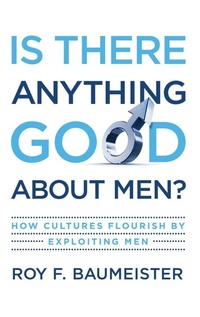
Is There Anything Good About Men?
How Cultures Flourish by Exploiting Men
Erschienen am 19. August 2010
Buch
Hardcover
320 Seiten
978-0-19-537410-0 (ISBN)
Beschreibung
Have men really been engaged in a centuries-old conspiracy to exploit and oppress women? Have the essential differences between men and women really been erased? Have men now become unnecessary? Are they good for anything at all?
In Is There Anything Good About Men?, Roy Baumeister offers provocative answers to these and many other questions about the current state of manhood in America. Baumeister argues that relations between men and women are now and have always been more cooperative than antagonistic, that men and women are different in basic ways, and that successful cultures capitalize on these differences to outperform rival cultures. Amongst our ancestors---as with many other species--only the alpha males were able to reproduce, leading them to take more risks and to exhibit more aggressive and protective behaviors than women, whose evolutionary strategies required a different set of behaviors. Whereas women favor and excel at one-to-one intimate relationships, men compete with one another and build larger organizations and social networks from which culture grows. But cultures in turn exploit men by insisting that their role is to achieve and produce, to provide for others, and if necessary to sacrifice themselves. Baumeister shows that while men have greatly benefited from the culture they have created, they have also suffered because of it. Men may dominate the upper echelons of business and politics, but far more men than women die in work-related accidents, are incarcerated, or are killed in battle--facts nearly always left out of current gender debates.
Engagingly written, brilliantly argued, and based on evidence from a wide range of disciplines, Is There Anything Good About Men? offers a new and far more balanced view of gender relations.
In Is There Anything Good About Men?, Roy Baumeister offers provocative answers to these and many other questions about the current state of manhood in America. Baumeister argues that relations between men and women are now and have always been more cooperative than antagonistic, that men and women are different in basic ways, and that successful cultures capitalize on these differences to outperform rival cultures. Amongst our ancestors---as with many other species--only the alpha males were able to reproduce, leading them to take more risks and to exhibit more aggressive and protective behaviors than women, whose evolutionary strategies required a different set of behaviors. Whereas women favor and excel at one-to-one intimate relationships, men compete with one another and build larger organizations and social networks from which culture grows. But cultures in turn exploit men by insisting that their role is to achieve and produce, to provide for others, and if necessary to sacrifice themselves. Baumeister shows that while men have greatly benefited from the culture they have created, they have also suffered because of it. Men may dominate the upper echelons of business and politics, but far more men than women die in work-related accidents, are incarcerated, or are killed in battle--facts nearly always left out of current gender debates.
Engagingly written, brilliantly argued, and based on evidence from a wide range of disciplines, Is There Anything Good About Men? offers a new and far more balanced view of gender relations.
Rezensionen / Stimmen
"[Baumeister] does make the fascinating point that men operate at the extremes, socially and biologically." --Bitch'Male readers may find some solace in Roy F. Baumeister's "Is There Anything Good About Men?" Mr. Baumeister is less concerned about the wimpification of modern man than about the degree to which men have been historically "exploited." The very cultures that men have built, he says, have considered males more expendable than women... But men, Mr. Baumeister says, are often taken for granted and denigrated as the bane of female existence, with some gender
activist insisting that women would be better off without them. In a feisty rejoinder, Mr. Baumeister says that "'if women really would have been happier without men, they would have set up shop on their own
long ago."
--Dave Shiflett, Wall Street Journal
"Read this if you're open to a thought-provoking take on so-called battle of the sexes. Packed with counterintuitive but convincing points, the book will reshape how you think about sexism, feminism, and gender differences." Andrea Bartz, Psychology Todayl
"There are some interesting arguments concerning marriage, procreation, and the creation of culture that students and professionals in the field of evolutionary psychology probably
would be interested in discussing further." -- Elin Weiss, Sex Roles
Weitere Details
Sprache
Englisch
Verlagsort
New York
USA
Zielgruppe
Für die Erwachsenenbildung
Maße
Höhe: 240 mm
Breite: 161 mm
Dicke: 22 mm
Gewicht
643 gr
ISBN-13
978-0-19-537410-0 (9780195374100)
Copyright in bibliographic data and cover images is held by Nielsen Book Services Limited or by the publishers or by their respective licensors: all rights reserved.
Schweitzer Klassifikation
Weitere Ausgaben
Andere Ausgaben

E-Book
08/2010
1. Auflage
OUP eBook
9,99 €
Als Download verfügbar
E-Book
08/2010
1. Auflage
OUP eBook
9,99 €
Als Download verfügbar
Person
Roy F. Baumeister is the Eppes Eminent Professor of Psychology and head of the social psychology graduate program at Florida State University. The Institute for Scientific Information lists him among the handful of most cited (most influential) psychologists in the world. He is the co-editor, with John Baer and James Kaufman, of Are We Free? Psychology and Free Will and The Cultural Animal: Human Nature, Meaning, and Social Life.
Inhalt
Chapter 1: What a Question!
Chapter 2: Are Women Better than Men, or Vice Versa?
Chapter 3: The Most Underappreciated Fact about Men
Chapter 4: Are Women More Social?
Chapter 5: How Culture Works
Chapter 6: Women, Men, and Culture: The Roots of Inequality
Chapter 7: Expendable Beings, Disposable Lives
Chapter 8: Earning Manhood, and the Male Ego
Chapter 9 Exploiting Men through Marriage and Sex
Chapter 10: What Else, What Next?
Chapter 2: Are Women Better than Men, or Vice Versa?
Chapter 3: The Most Underappreciated Fact about Men
Chapter 4: Are Women More Social?
Chapter 5: How Culture Works
Chapter 6: Women, Men, and Culture: The Roots of Inequality
Chapter 7: Expendable Beings, Disposable Lives
Chapter 8: Earning Manhood, and the Male Ego
Chapter 9 Exploiting Men through Marriage and Sex
Chapter 10: What Else, What Next?