

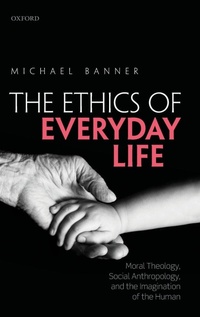
The Ethics of Everyday Life
Moral Theology, Social Anthropology, and the Imagination of the Human
Erschienen am 23. Oktober 2014
Buch
Hardcover
238 Seiten
978-0-19-872206-9 (ISBN)
Beschreibung
Why do we have children and what do we raise them for? Does the proliferation of depictions of suffering in the media enhance, or endanger, compassion? How do we live and die well in the extended periods of debility which old age now threatens? Why and how should we grieve for the dead? And how should we properly remember other grief and grievances?
In addressing such questions, the Christian imagination of human life has been powerfully shaped by the imagination of Christ's life Christs conception, birth, suffering, death, and burial have been subjects of profound attention in Christian thought, just as they are moments of special interest and concern in each and every human life. However, they are also sites of contention and controversy, where what it is to be human is discovered, constructed, and contested. Conception, birth, suffering, burial, and death are occasions, in other words, for profound and continuing questioning regarding the meaning of human life, as controversies to do with IVF, abortion, euthanasia, and the use of bodies and body parts post mortem, indicate.
In The Ethics of Everyday Life, Michael Banner argues that moral theology must reconceive its nature and tasks if it is not only to articulate its own account of human being, but also to enter into constructive contention with other accounts. In particular, it must be willing to learn from and engage with social anthropology if it is to offer powerful and plausible portrayals of the moral life and answers to the questions which trouble modernity. Drawing in wide-ranging fashion from social anthropology and from Christian thought and practice from many periods, and influenced especially by his engagement in public policy matters including as a member of the UK's Human Tissue Authority, Banner develops the outlines of an everyday ethics, stretching from before the cradle to after the grave.
In addressing such questions, the Christian imagination of human life has been powerfully shaped by the imagination of Christ's life Christs conception, birth, suffering, death, and burial have been subjects of profound attention in Christian thought, just as they are moments of special interest and concern in each and every human life. However, they are also sites of contention and controversy, where what it is to be human is discovered, constructed, and contested. Conception, birth, suffering, burial, and death are occasions, in other words, for profound and continuing questioning regarding the meaning of human life, as controversies to do with IVF, abortion, euthanasia, and the use of bodies and body parts post mortem, indicate.
In The Ethics of Everyday Life, Michael Banner argues that moral theology must reconceive its nature and tasks if it is not only to articulate its own account of human being, but also to enter into constructive contention with other accounts. In particular, it must be willing to learn from and engage with social anthropology if it is to offer powerful and plausible portrayals of the moral life and answers to the questions which trouble modernity. Drawing in wide-ranging fashion from social anthropology and from Christian thought and practice from many periods, and influenced especially by his engagement in public policy matters including as a member of the UK's Human Tissue Authority, Banner develops the outlines of an everyday ethics, stretching from before the cradle to after the grave.
Rezensionen / Stimmen
a welcome corrective * Comment (Cardus), Philip Lorish * It is impossible to summarise all that Banner has to say but there can be little doubt that he has opened up new areas for theological reflection. * Church of England Newspaper, Paul Richards * ... an extremely rewarding read. * Kirst Jane McCluskey, Vulpes Libris * Michael Banner does not mince words. Moral theology is odd; moral philosophy is odder; and bioethics, depending on the page to which one turns, is limited, irrelevant and/or uncomprehending. These claims alone recommend The Ethics of Everyday Life both to those who might find them surprising, as well as to those whose work joins Professor Banner's much-needed project: that of re-envisaging and reconfiguring moral theology ... Each chapter provides a deep engagement with a spectrum of historical figures, texts, and aspects of material culture that challenges or upends contemporary cultural assumptions often blithely adopted within contemporary Christian discourse. * M. Therese Lysaught, Studies in Christian Ethics * When moral topics are discussed, we spend too much time fiercely debating controversial questions and too little time reflecting on the meanings of the relations, feelings, institutions and practices which the questions presuppose. That is one of the valuable thoughts pursued in this book. And whether you come to it as a moral philosopher, a moral theologian or a social anthropologist there is much to be learned from Michael Banner's challenging and moving reflections. * Jane Heal, Emeritus Professor of Philosophy, University of Cambridge * Michael Banner's work long been known for its theological depth and analytic acuity. Here we have a comprehensive Christian ethics of the "everyday," inspired by his profound engagement with recent developments in anthropology, enriched by that discipline's empirical attentiveness and sharpened by its rigorous, but (for theologians) under-appreciated, theoretical self-awareness. There is no other account of Christian ethics as freshly illuminating, as intelligently displayed, or as systematically powerful as Banner's. I recommend this book to anyone wishing a more intelligent and perspicacious Christian ethics; they will not be disappointed. * Charles Mathewes, Carolyn M. Barbour Professor of Religious Studies, University of Virginia * This book is an interdisciplinary tour de force. Michael Banner is a first-rate moral philosopher and theologian who has learned to think about the intricacies of social life like a first-rate anthropologist. He has written that rare kind of work that not only can teach you new things about topics you thought you knew well, but can transform the very way you think about them. Anyone interested in socially grounded moral philosophy or in the anthropology of morality or of Christianity should read it as soon as they can. * Joel Robbins, University of Cambridge *Weitere Details
Sprache
Englisch
Verlagsort
Oxford
Großbritannien
Zielgruppe
Für höhere Schule und Studium
Maße
Höhe: 240 mm
Breite: 161 mm
Dicke: 18 mm
Gewicht
534 gr
ISBN-13
978-0-19-872206-9 (9780198722069)
Copyright in bibliographic data and cover images is held by Nielsen Book Services Limited or by the publishers or by their respective licensors: all rights reserved.
Schweitzer Klassifikation
Weitere Ausgaben
Andere Ausgaben
Michael Banner
The Ethics of Everyday Life
Moral Theology, Social Anthropology, and the Imagination of the Human
E-Book
10/2014
1. Auflage
OUP eBook
13,99 €
Als Download verfügbar
Michael Banner
The Ethics of Everyday Life
Moral Theology, Social Anthropology, and the Imagination of the Human
E-Book
10/2014
1. Auflage
OUP eBook
13,99 €
Als Download verfügbar
Person
Michael Banner is Dean and Fellow at Trinity College, University of Cambridge. He has had wide involvement in ethical thinking and policy making in government and the private sector, as chair or member of committees across Whitehall Departments from Health to Defence. His publications include Christian Ethics: A Brief History (Wiley Blackwell, 2009) and Christian Ethics and Contemporary Moral Problems (CUP, 1999).
Inhalt
Preface and acknowledgments ; Introduction ; 1. Moral Theology, Moral Philosophy, Social Anthropology, and the State We Are In: On (the Lack of) Everyday Ethics ; 2. Conceiving Conception: On IVF, Virgin Births, and the Troubling of Kinship ; 3. Being Born and Being Born Again: On Having or Not Having a Child of One's Own ; 4. Regarding Suffering: On the Discovery of the Pain of Christ, the Politics of Compassion, and the Contemporary Mediation of the Woes of the World ; 5. Dying and 'Death before Death': On Hospices, Euthanasia, Alzheimer's, and on (not) Knowing How to Dwindle ; 6. Contesting Burial and Mourning: On Relics, Alder Hey, and Keeping the Dead Close ; 7. Remembering Christ and Making Time Count: On the Practice and Politics of Memory ; 8. In Conclusion: Some Final (but not Last) Word ; Bibliography ; Index