

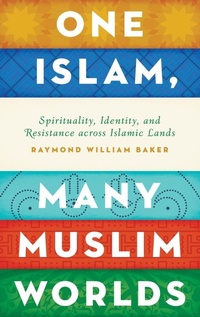
One Islam, Many Muslim Worlds
Spirituality, Identity, and Resistance across Islamic lands
Erschienen am 1. Oktober 2015
Buch
Hardcover
392 Seiten
978-0-19-984647-4 (ISBN)
Beschreibung
By all measures, the late twentieth century was a time of dramatic decline for the Islamic world, the Ummah, particularly its Arab heartland. Sober Muslim voices regularly describe their current state as the worst in the 1,400-year history of Islam. Yet, precisely at this time of unprecedented material vulnerability, Islam has emerged as a civilizational force strong enough to challenge the imposition of Western, particularly American, homogenizing power on Muslim peoples. This is the central paradox of Islam today: at a time of such unprecedented weakness in one sense, how has the Islamic Awakening, a broad and diverse movement of contemporary Islamic renewal, emerged as such a resilient and powerful transnational force and what implications does it have for the West? In One Islam, Many Muslim Worlds Raymond W. Baker addresses this question.
Two things are clear, Baker argues: Islam's unexpected strength in recent decades does not originate from official political, economic, or religious institutions, nor can it be explained by focusing exclusively on the often-criminal assertions of violent, marginal groups. While extremists monopolize the international press and the scholarly journals, those who live and work in the Islamic world know that the vast majority of Muslims reject their reckless calls to violence and look elsewhere for guidance. Baker shows that extremists draw their energy and support not from contributions to the reinterpretation and revival of Islamic beliefs and practices, but from the hatreds engendered by misguided Western policies in Islamic lands. His persuasive analysis of the Islamic world identifies centrists as the revitalizing force of Islam, saying that they are responsible for constructing a modern, cohesive Islamic identity that is a force to be reckoned with.
Two things are clear, Baker argues: Islam's unexpected strength in recent decades does not originate from official political, economic, or religious institutions, nor can it be explained by focusing exclusively on the often-criminal assertions of violent, marginal groups. While extremists monopolize the international press and the scholarly journals, those who live and work in the Islamic world know that the vast majority of Muslims reject their reckless calls to violence and look elsewhere for guidance. Baker shows that extremists draw their energy and support not from contributions to the reinterpretation and revival of Islamic beliefs and practices, but from the hatreds engendered by misguided Western policies in Islamic lands. His persuasive analysis of the Islamic world identifies centrists as the revitalizing force of Islam, saying that they are responsible for constructing a modern, cohesive Islamic identity that is a force to be reckoned with.
Rezensionen / Stimmen
"Recommended." -ChoiceWeitere Details
Reihe
Sprache
Englisch
Verlagsort
New York
USA
Zielgruppe
Für höhere Schule und Studium
Maße
Höhe: 240 mm
Breite: 161 mm
Dicke: 26 mm
Gewicht
752 gr
ISBN-13
978-0-19-984647-4 (9780199846474)
Copyright in bibliographic data and cover images is held by Nielsen Book Services Limited or by the publishers or by their respective licensors: all rights reserved.
Schweitzer Klassifikation
Weitere Ausgaben
Andere Ausgaben
Raymond William Baker
One Islam, Many Muslim Worlds
Spirituality, Identity, and Resistance across Islamic Lands
E-Book
08/2015
1. Auflage
OUP eBook
15,49 €
Als Download verfügbar
Raymond William Baker
One Islam, Many Muslim Worlds
Spirituality, Identity, and Resistance across Islamic Lands
E-Book
08/2015
1. Auflage
OUP eBook
32,49 €
Als Download verfügbar
Person
Raymond W. Baker is Professor of International Politics at Trinity College.
Inhalt
Acknowledgments ; Note on Style and Conventions ; 1. The Mystery of Islam's Strength ; 2. Oases of Resistance and Reform ; 3. Guidance from the Center ; 4. Heralds of Renewal ; 5. Ibn Battuta and Medieval Pathways ; 6. Fahmi Huwaidi and Contemporary Networks ; 7. God's Signs for Democracy in Islam ; 8. The Islamist Imaginary ; 9. The Epochal Story of Islam and the Common People ; 10. The "River of Life" ; Glossary ; Notes ; Index