

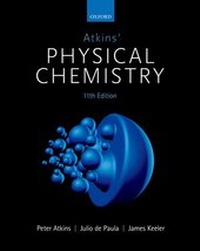
Atkins' Physical Chemistry
11. Auflage
Erschienen am 28. Dezember 2017
Buch
Softcover
944 Seiten
978-0-19-876986-6 (ISBN)
Beschreibung
The exceptional quality of previous editions has been built upon to make this new edition of Atkins' Physical Chemistry even more closely suited to the needs of both lecturers and students. Re-organised into discrete Topics, the text is more flexible to teach from and more readable for students.
Now in its eleventh edition, the text has been enhanced with additional learning features and maths support to demonstrate the absolute centrality of mathematics to physical chemistry. Increasing the digestibility of the text in this new approach, the reader is brought to a question, then the maths is used to show how it can be answered and progress made. The expanded and redistributed maths support also includes a greatly increased number of 'Chemist's toolkits' which provide students with
succinct reminders of mathematical concepts and techniques right where they need them.
Checklists of key concepts at the end of each Topic add to the extensive learning support provided throughout the book, to reinforce the main take-home messages in each section. The coupling of the broad coverage of the subject with a structure and use of pedagogy that is even more innovative will ensure Atkins' Physical Chemistry remains the textbook of choice for studying physical chemistry.
Online resources
Atkins' Physical Chemistry is accompanied by a range of online resources:
For registered adopters of the book:
? Figures and tables from the book, in ready to download format
? Tables of key equations
? Instructor's Solutions Manual
For students:
? Web links to a range of additional physical chemistry resources on the internet
? Group theory tables, available for downloading
? Molecular modelling problems
? Impact sections show the application of physical chemistry in a diverse range of modern contexts
? 'Further Information' sections which consist of longer derivations
Now in its eleventh edition, the text has been enhanced with additional learning features and maths support to demonstrate the absolute centrality of mathematics to physical chemistry. Increasing the digestibility of the text in this new approach, the reader is brought to a question, then the maths is used to show how it can be answered and progress made. The expanded and redistributed maths support also includes a greatly increased number of 'Chemist's toolkits' which provide students with
succinct reminders of mathematical concepts and techniques right where they need them.
Checklists of key concepts at the end of each Topic add to the extensive learning support provided throughout the book, to reinforce the main take-home messages in each section. The coupling of the broad coverage of the subject with a structure and use of pedagogy that is even more innovative will ensure Atkins' Physical Chemistry remains the textbook of choice for studying physical chemistry.
Online resources
Atkins' Physical Chemistry is accompanied by a range of online resources:
For registered adopters of the book:
? Figures and tables from the book, in ready to download format
? Tables of key equations
? Instructor's Solutions Manual
For students:
? Web links to a range of additional physical chemistry resources on the internet
? Group theory tables, available for downloading
? Molecular modelling problems
? Impact sections show the application of physical chemistry in a diverse range of modern contexts
? 'Further Information' sections which consist of longer derivations
Rezensionen / Stimmen
I like the division of the material into shorter "chapters". This helps to navigate through the material and break it up into "lecture-size" bites. This is a comprehensive and well-organised textbook that covers all the core physical chemistry. It is attractively presented with excellent online resources and makes a major effort to guide the student carefully through the more demanding mathematics and derivations. * Professor Eleanor Campbell, Edinburgh University * Once again the authors have succeeded in improving on the already very high standard of the previous edition. * Matthew Ryder, student, Heriot-Watt University * I really like the new approach. I like the checklist of concepts and the overarching "why you need to know this material" pointers at the start of each chapter. * Dr Darren Walsh, University of Nottingham * I have used this book for more than 30 years. It is the best textbook of physical chemistry for year 2 and year 3 students in physical science departments, and for their teachers. I also use this textbook as reference book for teaching other courses and even for my research. * Wuzong Zhou, St Andrews University *Weitere Details
Auflage
11th Revised edition
Sprache
Englisch
Verlagsort
Oxford
Großbritannien
Zielgruppe
Für höhere Schule und Studium
Für die Erwachsenenbildung
Editions-Typ
Überarbeitete Ausgabe
Illustrationen
1104
Maße
Höhe: 273 mm
Breite: 217 mm
Dicke: 34 mm
Gewicht
2010 gr
ISBN-13
978-0-19-876986-6 (9780198769866)
Copyright in bibliographic data and cover images is held by Nielsen Book Services Limited or by the publishers or by their respective licensors: all rights reserved.
Schweitzer Klassifikation
Weitere Ausgaben
Nachauflagen
Peter Atkins | Julio de Paula | James Keeler
Atkins' Physical Chemistry
Buch
12/2022
12. Auflage
Oxford University Press
88,50 €
Sofort lieferbar
Andere Ausgaben
Peter Atkins | Julio de Paula | James Keeler
Atkins' Physical Chemistry
Buch
03/2018
Oxford University Press
61,87 €
Versand in 15-20 Tagen
Personen
Peter Atkins is a fellow of Lincoln College in the University of Oxford and the author of about seventy books for students and a general audience. His texts are market leaders around the globe. A frequent lecturer in the United States and throughout the world, he has held visiting professorships in France, Israel, Japan, China, and New Zealand. He was the founding chairman of the Committee on Chemistry Education of the International Union of Pure and Applied
Chemistry and was a member of IUPAC's Physical and Biophysical Chemistry Division. Peter was the 2016 recipient of the American Chemical Society's Grady-Stack Award for science journalism.
Julio de Paula is Professor of Chemistry, Lewis & Clark College. A native of Brazil, Professor de Paula received a B.A. degree in chemistry from Rutgers, The State University of New Jersey, and a Ph.D. in biophysical chemistry from Yale University. His research activities encompass the areas of molecular spectroscopy, biophysical chemistry, and nanoscience. He has taught courses in general chemistry, physical chemistry, biophysical chemistry, instrumental analysis, and writing.
James Keeler is Senior Lecturer in Chemistry at the University of Cambridge, and Walters Fellow in Chemistry of Selwyn College, Cambridge. He took his first degree from the University of Oxford and continued there for doctoral research in nuclear magnetic resonance spectroscopy. He is Director of Teaching for undergraduate chemistry, and teaches courses covering a range of topics in physical and theoretical chemistry.
Chemistry and was a member of IUPAC's Physical and Biophysical Chemistry Division. Peter was the 2016 recipient of the American Chemical Society's Grady-Stack Award for science journalism.
Julio de Paula is Professor of Chemistry, Lewis & Clark College. A native of Brazil, Professor de Paula received a B.A. degree in chemistry from Rutgers, The State University of New Jersey, and a Ph.D. in biophysical chemistry from Yale University. His research activities encompass the areas of molecular spectroscopy, biophysical chemistry, and nanoscience. He has taught courses in general chemistry, physical chemistry, biophysical chemistry, instrumental analysis, and writing.
James Keeler is Senior Lecturer in Chemistry at the University of Cambridge, and Walters Fellow in Chemistry of Selwyn College, Cambridge. He took his first degree from the University of Oxford and continued there for doctoral research in nuclear magnetic resonance spectroscopy. He is Director of Teaching for undergraduate chemistry, and teaches courses covering a range of topics in physical and theoretical chemistry.
Inhalt
PART 1: THERMODYNAMICS; PART 2: STRUCTURE; PART 3: CHANGE