

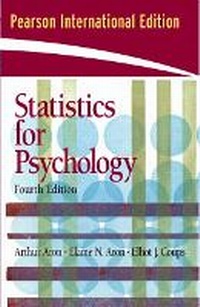
Statistics for Psychology
International Edition
4. Auflage
Erschienen am 4. Oktober 2005
Buch
Softcover
768 Seiten
978-0-13-201810-4 (ISBN)
Beschreibung
The fourth edition of this popular text uses definitional formulas to emphasize concepts of statistics, rather than rote memorization. This approach constantly reminds students of the logic behind what they are learning, and each procedure is taught both verbally and numerically, which helps to emphasize the concepts. Thoroughly revised, with new content and many new practice examples, this text takes the reader from basic procedures through analysis of variance (ANOVA). Students cover statistics and also learn to read and inderstand research articles.
Weitere Details
Auflage
4th edition
Sprache
Englisch
Verlagsort
USA
Verlagsgruppe
Pearson Education (US)
Zielgruppe
Für Beruf und Forschung
Maße
Höhe: 254 mm
Breite: 204 mm
Dicke: 28 mm
Gewicht
1352 gr
ISBN-13
978-0-13-201810-4 (9780132018104)
Copyright in bibliographic data and cover images is held by Nielsen Book Services Limited or by the publishers or by their respective licensors: all rights reserved.
Schweitzer Klassifikation
Weitere Ausgaben
Nachauflagen
Buch
04/2008
5. Auflage
Pearson
69,13 €
Artikel ist vergriffen; siehe Neuauflage
Vorauflage
Buch
08/2002
3. Auflage
Pearson
43,20 €
Artikel ist vergriffen; siehe Neuauflage
Inhalt
1. Displaying the order in a group of numbers.
2. Central tendency and variability.
3. Some key ingredients for inferential statistics: Z scores, the normal curve, sample versus population, and probability.
4. Introduction to hypothesis testing.
5. Hypothesis testing with means of samples.
6. Making sense of statistical significance: Effect size and statistical power.
7. Introduction to the t test: Single sample and dependent means.
8. The t test for independent means.
9. Introduction to the analysis of variance.
10. Factorial analysis of variance.
11. Correlation.
12. Prediction.
13. Chi-square tests.
14. Strategies when population distributions are not normal: Data transformations and rank-order tests.
15. Integration and the general linear model.
16. Making sense of advanced statistical procedures in research articles.
2. Central tendency and variability.
3. Some key ingredients for inferential statistics: Z scores, the normal curve, sample versus population, and probability.
4. Introduction to hypothesis testing.
5. Hypothesis testing with means of samples.
6. Making sense of statistical significance: Effect size and statistical power.
7. Introduction to the t test: Single sample and dependent means.
8. The t test for independent means.
9. Introduction to the analysis of variance.
10. Factorial analysis of variance.
11. Correlation.
12. Prediction.
13. Chi-square tests.
14. Strategies when population distributions are not normal: Data transformations and rank-order tests.
15. Integration and the general linear model.
16. Making sense of advanced statistical procedures in research articles.