

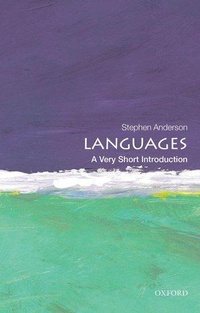
Languages
A Very Short Introduction
1. Auflage
Erschienen am 28. Juni 2012
Buch
Softcover
160 Seiten
978-0-19-959059-9 (ISBN)
Beschreibung
How many languages are there? What differentiates one language from another? Are new languages still being discovered? Why are so many languages disappearing?
The diversity of languages today is varied, but it is steadily declining. In this Very Short Introduction, Stephen Anderson answers the above questions by looking at the science behind languages. Considering a wide range of different languages and linguistic examples, he demonstrates how languages are not uniformly distributed around the world; just as some places are more diverse than others in terms of plants and animal species, the same goes for the distribution of languages.
Exploring the basis for linguistic classification and raising questions about how we identify a language, as well as considering signed languages as well as spoken, Anderson examines the wider social issues of losing languages, and their impact in terms of the endangerment of cultures and peoples.
ABOUT THE SERIES: The Very Short Introductions series from Oxford University Press contains hundreds of titles in almost every subject area. These pocket-sized books are the perfect way to get ahead in a new subject quickly. Our expert authors combine facts, analysis, perspective, new ideas, and enthusiasm to make interesting and challenging topics highly readable.
The diversity of languages today is varied, but it is steadily declining. In this Very Short Introduction, Stephen Anderson answers the above questions by looking at the science behind languages. Considering a wide range of different languages and linguistic examples, he demonstrates how languages are not uniformly distributed around the world; just as some places are more diverse than others in terms of plants and animal species, the same goes for the distribution of languages.
Exploring the basis for linguistic classification and raising questions about how we identify a language, as well as considering signed languages as well as spoken, Anderson examines the wider social issues of losing languages, and their impact in terms of the endangerment of cultures and peoples.
ABOUT THE SERIES: The Very Short Introductions series from Oxford University Press contains hundreds of titles in almost every subject area. These pocket-sized books are the perfect way to get ahead in a new subject quickly. Our expert authors combine facts, analysis, perspective, new ideas, and enthusiasm to make interesting and challenging topics highly readable.
Weitere Details
Reihe
Sprache
Englisch
Verlagsort
Oxford
Großbritannien
Zielgruppe
Für Beruf und Forschung
Für höhere Schule und Studium
General readers with no background in linguistics, including students in introductory courses in language and linguistics.
Illustrationen
Approximately 15 black and white illustrations
Maße
Höhe: 172 mm
Breite: 111 mm
Dicke: 15 mm
Gewicht
118 gr
ISBN-13
978-0-19-959059-9 (9780199590599)
Copyright in bibliographic data and cover images is held by Nielsen Book Services Limited or by the publishers or by their respective licensors: all rights reserved.
Schweitzer Klassifikation
Weitere Ausgaben
Andere Ausgaben
E-Book
06/2012
1. Auflage
OUP eBook
5,49 €
Als Download verfügbar
Person
Stephen Anderson has been the Dorothy R. Diebold Professor of Linguistics at Yale University for the last 15 years. He has written or co-authored six books in Linguistics, including Doctor Dolittle's Delusion (Yale University Press, 2004) a book on animal communication and its relation to human language intended for the educated general reader that was chosen as the Best Book in Psychology for 2004 by the Professional/Scholarly Publishing Division of the Association of American Publishers. He is a Fellow of the American Academy of Arts and Sciences, the American Association for the Advancement of Science, the Linguistic Society of America, and the Association for Psychological Science. He was also President of the Linguistic Society of America in 2007.
Inhalt
1. Introduction: dimensions of linguistic diversity ; 2. How many languages are there in the world? ; 3. Phylogenetic linguistics: establishing linguistic relationships ; 4. The future of languages ; 5. Some problems in the counting of languages ; 6. The genotypes of languages ; 7. The diversity of signed languages ; 8. Conclusion: the unity of human language ; References ; Further reading