

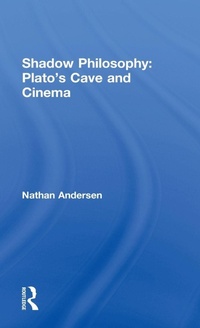
Shadow Philosophy: Plato's Cave and Cinema
Plato's Cave and Cinema
1. Auflage
Erschienen am 10. April 2014
Buch
Hardcover
172 Seiten
978-0-415-74205-4 (ISBN)
Beschreibung
Shadow Philosophy: Plato's Cave and Cinema is an accessible and exciting new contribution to film-philosophy, which shows that to take film seriously is also to engage with the fundamental questions of philosophy. Nathan Andersen brings Stanley Kubrick's film A Clockwork Orange into philosophical conversation with Plato's Republic, comparing their contributions to themes such as the nature of experience and meaning, the character of justice, the contrast between appearance and reality, the importance of art, and the impact of images.
At the heart of the book is a novel account of the analogy between Plato's allegory of the cave and cinema, developed in conjunction with a provocative interpretation of the most powerful image from A Clockwork Orange, in which the lead character is strapped to a chair and forced to watch violent films.
Key features of the book include:
a comprehensive bibliography of suggested readings on Plato, on film, on philosophy, and on the philosophy of film
a list of suggested films that can be explored following the approach in this book, including brief descriptions of each film, and suggestions regarding its philosophical implications
a summary of Plato's Republic, book by book, highlighting both dramatic context and subject matter.
Offering a close reading of the controversial classic film A Clockwork Orange, and an introductory account of the central themes of the philosophical classic The Republic, this book will be of interest to both scholars and students of philosophy and film, as well as to readers of Plato and fans of Stanley Kubrick.
At the heart of the book is a novel account of the analogy between Plato's allegory of the cave and cinema, developed in conjunction with a provocative interpretation of the most powerful image from A Clockwork Orange, in which the lead character is strapped to a chair and forced to watch violent films.
Key features of the book include:
a comprehensive bibliography of suggested readings on Plato, on film, on philosophy, and on the philosophy of film
a list of suggested films that can be explored following the approach in this book, including brief descriptions of each film, and suggestions regarding its philosophical implications
a summary of Plato's Republic, book by book, highlighting both dramatic context and subject matter.
Offering a close reading of the controversial classic film A Clockwork Orange, and an introductory account of the central themes of the philosophical classic The Republic, this book will be of interest to both scholars and students of philosophy and film, as well as to readers of Plato and fans of Stanley Kubrick.
Rezensionen / Stimmen
'A marvellous introduction to film-philosophy that opens up a genuine dialogue between philosophy and cinema. Through a brilliant exploration of Plato's Cave alongside A Clockwork Orange, Andersen shows how the attentive experience of watching movies can also be an exercise in philosophical thinking. Highly recommended for students, film scholars, and anyone passionate about the art of film.' - Robert Sinnerbrink, Macquarie University, Australia'A well-needed step in the path of film-philosophy, both in terms of methodology and content. Andersen explores the shockingly uncharted depths of the most commonly used philosophical analogy in film theory, and demonstrates the value of exploring a single film in great textual detail and with exceptional analytic care.' - Hunter Vaughan, Oakland University, USA
'An absolutely necessary addition to the literature on A Clockwork Orange and The Republic. Andersen's book allows students and scholars alike to be 'active witnesses' not only to Plato and Kubrick but to what it means to explicate the texts of our vision, action, and desire. I foresee scholars having to acknowledge their indebtedness to Andersen for opening up new avenues of interdisciplinary work.' - Peter Costello, Providence College, USA
'Andersen provides an introduction to philosophy and film via an examination of Stanley Kubrick's film A Clockwork Orange through the lens of Plato's Republic (principally Books VII and X). Alternating between the film itself and Plato's dialogue, the chapters cover a range of topics from basic film concepts to "the conditions of cinematic intelligibility" and questions of justice, freedom, and tyranny. ... [T]his would be a good introductory text for philosophical film studies classes. ... The book includes lists of suggested films and readings, a ten-page glossary of names and terms, and a brief book-by-book summary of the Republic. Summing Up: Recommended.' - Charles D. Kay, CHOICE
Weitere Details
Sprache
Englisch
Verlagsort
London
Großbritannien
Verlagsgruppe
Taylor & Francis Ltd
Zielgruppe
Für höhere Schule und Studium
Illustrationen
10 s/w Abbildungen, 10 s/w Photographien bzw. Rasterbilder
10 Halftones, black and white; 10 Illustrations, black and white
Maße
Höhe: 222 mm
Breite: 145 mm
Dicke: 13 mm
Gewicht
358 gr
ISBN-13
978-0-415-74205-4 (9780415742054)
Copyright in bibliographic data and cover images is held by Nielsen Book Services Limited or by the publishers or by their respective licensors: all rights reserved.
Schweitzer Klassifikation
Weitere Ausgaben
Andere Ausgaben
Nathan Andersen
Shadow Philosophy: Plato's Cave and Cinema
E-Book
04/2014
1. Auflage
Routledge
62,99 €
Als Download verfügbar
Nathan Andersen
Shadow Philosophy: Plato's Cave and Cinema
E-Book
04/2014
1. Auflage
Routledge
62,99 €
Als Download verfügbar
Buch
04/2014
1. Auflage
Routledge
68,60 €
Versand in 15-20 Tagen
Person
Nathan Andersen teaches philosophy and film at Eckerd College, USA. He programs an award-winning cinema series in Tampa Bay, Florida, and is the co-director of the "Visions of Nature/Voices of Nature," Environmental Film Festival. He has published articles on the history of philosophy, environmental philosophy, and film.
Inhalt
Introduction: What We See on Screen 1. Making Sense of Motion Pictures: On Faces and Frames in Kubrick's A Clockwork Orange 2. Plato's Cave and Cinema 3. Feeling and Image: The Ludovico Technique 4. Plato's Critique of Poetry and the Peril and Promise of Cinema 5. Justice and Freedom: Alex's Cure Conclusion: Shadow Philosophy Suggested films Suggested readings Glossary of Artists and Thinkers, Terms and Concepts Appendix: Summary of Plato's Republic, book by book. Index