

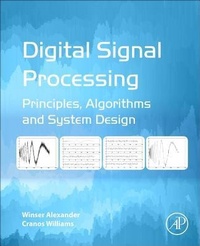
Digital Signal Processing
Principles, Algorithms and System Design
Erschienen am 2. Februar 2017
Buch
Softcover
634 Seiten
978-0-12-804547-3 (ISBN)
Beschreibung
Digital signal processing (DSP) has been applied to a very wide range of applications. This includes voice processing, image processing, digital communications, the transfer of data over the internet, image and data compression, etc. Engineers who develop DSP applications today, and in the future, will need to address many implementation issues including mapping algorithms to computational structures, computational efficiency, power dissipation, the effects of finite precision arithmetic, throughput and hardware implementation. It is not practical to cover all of these in a single text. However, this text emphasizes the practical implementation of DSP algorithms as well as the fundamental theories and analytical procedures that form the basis for modern DSP applications.
Digital Signal Processing: Principles, Algorithms and System Design provides an introduction to the principals of digital signal processing along with a balanced analytical and practical treatment of algorithms and applications for digital signal processing. It is intended to serve as a suitable text for a one semester junior or senior level undergraduate course. It is also intended for use in a following one semester first-year graduate level course in digital signal processing. It may also be used as a reference by professionals involved in the design of embedded computer systems, application specific integrated circuits or special purpose computer systems for digital signal processing, multimedia, communications, or image processing.
Digital Signal Processing: Principles, Algorithms and System Design provides an introduction to the principals of digital signal processing along with a balanced analytical and practical treatment of algorithms and applications for digital signal processing. It is intended to serve as a suitable text for a one semester junior or senior level undergraduate course. It is also intended for use in a following one semester first-year graduate level course in digital signal processing. It may also be used as a reference by professionals involved in the design of embedded computer systems, application specific integrated circuits or special purpose computer systems for digital signal processing, multimedia, communications, or image processing.
Weitere Details
Sprache
Englisch
Verlagsort
San Diego
USA
Verlagsgruppe
Elsevier Science Publishing Co Inc
Zielgruppe
Für höhere Schule und Studium
Undergraduate and first year graduate level courses in digital signal processsing
Produkt-Hinweis
Broschur/Paperback
Klebebindung
Maße
Höhe: 235 mm
Breite: 192 mm
Dicke: 30 mm
Gewicht
1200 gr
ISBN-13
978-0-12-804547-3 (9780128045473)
Copyright in bibliographic data and cover images is held by Nielsen Book Services Limited or by the publishers or by their respective licensors: all rights reserved.
Schweitzer Klassifikation
Weitere Ausgaben
Andere Ausgaben
Winser Alexander | Cranos M. Williams
Digital Signal Processing
Principles, Algorithms and System Design
E-Book
11/2016
1. Auflage
Academic Press
49,99 €
Als Download verfügbar
Personen
Winser E. Alexander is a Professor of Electrical and Computer Engineering at North Carolina State University. He served as Interim Provost and Vice-Chancellor for Academic Affairs (2011-2013) and as Interim Dean of the College of Engineering at North Carolina Agricultural and Technical (A & T) State University (2009-2011) while of leave of absence from North Carolina State University. He received the B. S. Degree in Electrical Engineering from North Carolina A & T State University and he received the M. S. Degree in Engineering and the Ph. D. in Electrical Engineering from the University of New Mexico. He served as an officer in the U. S. Air Force (highest rank of captain), he was a Member of Technical Staff at Sandia Laboratories, Albuquerque, NM and he was previously Chair of the Department of Electrical Engineering at North Carolina A & T State University. His research interests include digital signal processing (DSP), genomic signal processing, parallel algorithms and special purpose multiprocessor architectures for DSP. He has taught courses in DSP, DSP architecture and fundamentals of logic systems design at North Carolina State University since 1982.Dr. Alexander is a senior life member of IEEE, a member of Sigma Xi and he is registered as a professional engineer in North Carolina. Cranos M.Williams is an Associate Professor of Electrical and Computer Engineering at North Carolina State University. He received the B. S. Degree in Electrical Engineering from North Carolina A & T State University and he received the M. S. and Ph. D. degrees in Electrical Engineering from North Carolina State University. His research focuses on developing computational and analytical solutions for modeling and understanding the combinatorial interactions of biomolecular, physiological, and structural processes that impact plant growth, development, and adaptation. His research involves the development of methodologies familiar to other areas of electrical and computer engineering (e.g. computational intelligence, system identification, uncertainty propagation, experimental design, nonlinear systems analysis, control, and signal processing) to predict the impact that internal (genetic) and external (environmental) perturbations have on overall plant response (e.g. biomass, cellulose content, and plant cell wall strength). He has taught courses in analytical foundations of electrical and computer engineering, DSP, and analysis of nonlinear complex systems at North Carolina State University since 2008.Dr. Williams is a member of IEEE.
Inhalt
1. Introduction to Digital Signal Processing2. Fundamental DSP Concepts3. Frequency Domain Analysis4. Design of Digital Filters5. Implementation of Discrete Time Systems6. Finite Word Length Effects7. Multi-rate Digital Signal Processing8. Digital Signal Processing Systems Design9. Hardware Implementation10. Introduction to Multi-demensional Discrete Time Systems