

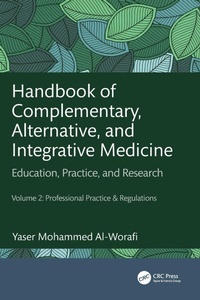
Handbook of Complementary, Alternative, and Integrative Medicine
Education, Practice, and Research Volume 2: Professional Practice & Regulations
1. Auflage
Erschienen am 10. Oktober 2024
Buch
Hardcover
363 Seiten
978-1-032-34683-0 (ISBN)
Beschreibung
Six volumes combine to make up the Handbook of Complementary, Alternative, and Integrative Medicine: Education, Practice and Research, which describes the education, practice, and research-related issues of complementary, alternative, and integrative medicine; and its efficacy and safety in treating diseases and health conditions. Further the volumes review integrative medicine around the world to share the best practices and experiences in terms of education, practice and research; and identify the challenges and suggest recommendations to overcome them.
The 20 chapters of Volume 2 focus on complementary, alternative, and integrative medicine practice-related issues. It begins with a history of complementary, alternative, and integrative medicine practice and continues with coverage of terminologies and types of complementary and alternative medicine and addresses regulations and laws around the world. It introduces integrative medicine-related issues and discusses herbal medicines and the herbal industry, including safety.
Key Features:
Explains the quality of complementary and alternative medicine practice and services
Describes the continuous professional development (CPD) for CAM practitioners, facilitators, and barriers of online CPD
Covers the technology-related issues in complementary and alternative medicine practice and services
Describes the challenges of complementary, alternative, and integrative medicine practice and suggests recommendations to overcome them
The 20 chapters of Volume 2 focus on complementary, alternative, and integrative medicine practice-related issues. It begins with a history of complementary, alternative, and integrative medicine practice and continues with coverage of terminologies and types of complementary and alternative medicine and addresses regulations and laws around the world. It introduces integrative medicine-related issues and discusses herbal medicines and the herbal industry, including safety.
Key Features:
Explains the quality of complementary and alternative medicine practice and services
Describes the continuous professional development (CPD) for CAM practitioners, facilitators, and barriers of online CPD
Covers the technology-related issues in complementary and alternative medicine practice and services
Describes the challenges of complementary, alternative, and integrative medicine practice and suggests recommendations to overcome them
Weitere Details
Sprache
Englisch
Verlagsort
London
Großbritannien
Verlagsgruppe
Taylor & Francis Ltd
Zielgruppe
Für höhere Schule und Studium
Undergraduate Advanced
Maße
Höhe: 260 mm
Breite: 183 mm
Dicke: 25 mm
Gewicht
901 gr
ISBN-13
978-1-032-34683-0 (9781032346830)
Copyright in bibliographic data and cover images is held by Nielsen Book Services Limited or by the publishers or by their respective licensors: all rights reserved.
Schweitzer Klassifikation
Weitere Ausgaben
Andere Ausgaben
Yaser Mohammed Al-Worafi
Handbook of Complementary, Alternative, and Integrative Medicine
Education, Practice, and Research Volume 2: Professional Practice & Regulations
E-Book
10/2024
1. Auflage
CRC Press
73,49 €
Als Download verfügbar
Yaser Mohammed Al-Worafi
Handbook of Complementary, Alternative, and Integrative Medicine
Education, Practice, and Research Volume 2: Professional Practice & Regulations
E-Book
10/2024
1. Auflage
CRC Press
73,49 €
Als Download verfügbar
Person
Prof. Yaser Mohammed Al-Worafi is a Professor of Clinical Pharmacy at the College of Pharmacy, University of Science and Technology of Fujairah, UAE (Previously known as Ajman University). He graduated with a bachelor's degree in Pharmacy (BPharm) from Sana'a University, Yemen and earned his Master's and PhD degrees in Clinical Pharmacy from the Universiti Sains Malaysia (USM), Malaysia. Prof. Yaser has many postgraduate program certificates including: Training to Teach in Medicine 2023 from Harvard Medical School, Harvard University and Contemporary Approaches to University Teaching from The Council of Australasian University Leaders in Learning and Teaching (CAULLT). He has more than 20 years' experiences in education, practice, and research in Yemen, Saudi Arabia, United Arab Emirates and Malaysia. He has held various academic and professional positions including Deputy Dean and acting dean for Medical Sciences College and Pharmacy College; PharmD program director, Head of Clinical Pharmacy/Pharmacy Practice department; Head of Teaching & Learning Committee, Head of Training Committee, Head of Curriculum Committee and other committees. He has authored over 100 peer-reviewed papers in international journals, editing/authoring more than 30 books and 800 book chapters published by Springer, Elsevier, Taylor & Francis, USA. Prof.Yaser has supervised/co-supervised many PhD, Master's, PharmD and B-Pharm students. He is a reviewer for eight recognized international peer-reviewed journals. Prof. Yaser taught, prepared, designed, and wrote many pharmacy programs for many universities including Master of Clinical Pharmacy/Pharmacy Practice program; PharmD program and BPharm program; internship/clerkships for Master, PharmD and BPharm programs; more than 30 courses related to Clinical Pharmacy, Pharmacy Practice, Social Pharmacy and Patient Care.
Inhalt
Chapter 1. History of Complementary and Alternative Medicine (CAM) Practice
Chapter 2. Complementary and Alternative Medicine (CAM) Terminologies
Chapter 3. Complementary and Alternative Medicine (CAM) Regulations Worldwide
Chapter 4. Complementary and Alternative Medicine (CAM) Types
Chapter 5. Integrative of Complementary and Alternative Medicine
Chapter 6. Herbal medicines
Chapter 7. Herbal Medicines industry
Chapter 8. Complementary and Alternative Medicine (CAM) Practice: Workforce Issues
Chapter 9. Complementary and Alternative Medicine (CAM) Practice: Licensing/relicensing requirements
Chapter 10. Complementary and Alternative Medicine (CAM) Practice: Interprofessional Practice
Chapter 11. Complementary and Alternative Medicine (CAM) Practice: Access/Equitable Access to the Services
Chapter 12. Complementary and Alternative Medicine (CAM) Practice: Quality of Services
Chapter 13. Complementary and Alternative Medicine (CAM) Practice: Continuous Professional Development
Chapter 14. Complementary and Alternative Medicine (CAM) Practice: Impact of COVID-19 & Pandemics
Chapter 15. Complementary and Alternative Medicine (CAM) Services Prices/Cost
Chapter 16. Complementary and Alternative Medicine (CAM) Prevalence
Chapter 17. Complementary and Alternative Medicine (CAM) Reasons/Motivations
Chapter 18. Complementary and Alternative Medicine (CAM) Practice: Technology
Chapter 19. Health Care Professionals and Patients/public Perspectives on Complementary and Alternative Medicine (CAM) Practice
Chapter 20. Complementary and Alternative Medicine (CAM) Practice: Achievements, Challenges and Recommendations
Chapter 2. Complementary and Alternative Medicine (CAM) Terminologies
Chapter 3. Complementary and Alternative Medicine (CAM) Regulations Worldwide
Chapter 4. Complementary and Alternative Medicine (CAM) Types
Chapter 5. Integrative of Complementary and Alternative Medicine
Chapter 6. Herbal medicines
Chapter 7. Herbal Medicines industry
Chapter 8. Complementary and Alternative Medicine (CAM) Practice: Workforce Issues
Chapter 9. Complementary and Alternative Medicine (CAM) Practice: Licensing/relicensing requirements
Chapter 10. Complementary and Alternative Medicine (CAM) Practice: Interprofessional Practice
Chapter 11. Complementary and Alternative Medicine (CAM) Practice: Access/Equitable Access to the Services
Chapter 12. Complementary and Alternative Medicine (CAM) Practice: Quality of Services
Chapter 13. Complementary and Alternative Medicine (CAM) Practice: Continuous Professional Development
Chapter 14. Complementary and Alternative Medicine (CAM) Practice: Impact of COVID-19 & Pandemics
Chapter 15. Complementary and Alternative Medicine (CAM) Services Prices/Cost
Chapter 16. Complementary and Alternative Medicine (CAM) Prevalence
Chapter 17. Complementary and Alternative Medicine (CAM) Reasons/Motivations
Chapter 18. Complementary and Alternative Medicine (CAM) Practice: Technology
Chapter 19. Health Care Professionals and Patients/public Perspectives on Complementary and Alternative Medicine (CAM) Practice
Chapter 20. Complementary and Alternative Medicine (CAM) Practice: Achievements, Challenges and Recommendations