

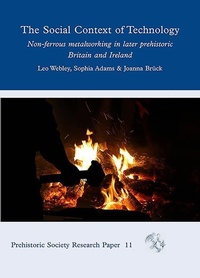
The Social Context of Technology
Non-ferrous Metalworking in Later Prehistoric Britain and Ireland
Erschienen am 14. Juni 2020
Buch
Hardcover
280 Seiten
978-1-78925-176-0 (ISBN)
Beschreibung
The Social Context of Technology explores non-ferrous metalworking in Britain and Ireland during the Bronze and Iron Ages (c. 2500 BC to 1st century AD). Bronze-working dominates the evidence, though the crafting of other non-ferrous metals - including gold, silver, tin and lead - is also considered. Metalwork has long played a central role in accounts of European later prehistory. Metals were important for making functional tools, and elaborate decorated objects that were symbols of prestige. Metalwork could be treated in special or ritualised ways, by being accumulated in large hoards or placed in rivers or bogs. But who made these objects? Prehistoric smiths have been portrayed by some as prosaic technicians, and by others as mystical figures akin to magicians. They have been seen both as independent, travelling 'entrepreneurs', and as the dependents of elite patrons. Hitherto, these competing models have not been tested through a comprehensive assessment of the archaeological evidence for metalworking.
This volume fills that gap, with analysis focused on metalworking tools and waste, such as crucibles, moulds, casting debris and smithing implements. The find contexts of these objects are examined, both to identify places where metalworking occurred, and to investigate the cultural practices behind the deposition of metalworking debris.
The key questions are: what was the social context of this craft, and what was its ideological significance? How did this vary regionally and change over time? As well as elucidating a key aspect of later prehistoric life in Britain and Ireland, this important examination by leading scholars contributes to broader debates on material culture and the social role of craft.
This volume fills that gap, with analysis focused on metalworking tools and waste, such as crucibles, moulds, casting debris and smithing implements. The find contexts of these objects are examined, both to identify places where metalworking occurred, and to investigate the cultural practices behind the deposition of metalworking debris.
The key questions are: what was the social context of this craft, and what was its ideological significance? How did this vary regionally and change over time? As well as elucidating a key aspect of later prehistoric life in Britain and Ireland, this important examination by leading scholars contributes to broader debates on material culture and the social role of craft.
Rezensionen / Stimmen
...a scholarly work, good reference book, and a great read. * Current World Archaeology *Weitere Details
Reihe
Sprache
Englisch
Verlagsort
Oxford
Großbritannien
Zielgruppe
Für Beruf und Forschung
Produkt-Hinweis
Fadenheftung
Gewebe-Einband
Illustrationen
b/w
Maße
Höhe: 282 mm
Breite: 215 mm
Dicke: 22 mm
Gewicht
1252 gr
ISBN-13
978-1-78925-176-0 (9781789251760)
Copyright in bibliographic data and cover images is held by Nielsen Book Services Limited or by the publishers or by their respective licensors: all rights reserved.
Schweitzer Klassifikation
Weitere Ausgaben
Andere Ausgaben
Webley Leo Webley | Adams Sophia Adams | Bruck Joanna Bruck
Social Context of Technology
Non-ferrous Metalworking in Later Prehistoric Britain and Ireland
E-Book
06/2020
Oxbow Books
25,49 €
Als Download verfügbar
Webley Leo Webley | Adams Sophia Adams | Bruck Joanna Bruck
Social Context of Technology
Non-ferrous Metalworking in Later Prehistoric Britain and Ireland
E-Book
06/2020
Oxbow Books
25,49 €
Als Download verfügbar
Personen
Sophia Adams is a post-doctoral research associate at SUERC, University of Glasgow, investigating the chronology of Iron Age brooches on a Leverhulme Trust funded project: Setting Artefacts Free. Her research interests focus on the production, use and deposition of Bronze Age and Iron Age artefacts. She is currently a council member for the Historical Metallurgy Society, the Prehistoric Society and the Later Prehistoric Finds Group. Joanna Brueck is Professor of Archaeology at the University of Bristol. Her primary area of research is the archaeology of the British Bronze Age, and she is particularly interested in the treatment of the human body and concepts of the self; depositional practices and what these reveal about the meanings and values ascribed to objects; and the relationship between space and society including domestic architecture and the changing organisation of landscape. She co-organises the Bronze Age Forum and is an editor of Archaeological Dialogues. Leo Webley is Head of Post-Excavation at Oxford Archaeology South. He holds a PhD from the University of Cambridge and has published widely on the European Bronze and Iron Ages. He is currently a council member for the Prehistoric Society.
Inhalt
Chapter 1: Introduction
Chapter 2: Chalcolithic and early Bronze Age, c 2500-1700 BC
Chapter 3: Later Bronze Age and earliest Iron Age, c 1700-600 BC
Chapter 4: Iron Age, c. 600 BC-1st century AD
Chapter 5: Discussion
Appendices
Catalogues of finds of metalworking equipment from different periods.
Bibliography
Index
Chapter 2: Chalcolithic and early Bronze Age, c 2500-1700 BC
Chapter 3: Later Bronze Age and earliest Iron Age, c 1700-600 BC
Chapter 4: Iron Age, c. 600 BC-1st century AD
Chapter 5: Discussion
Appendices
Catalogues of finds of metalworking equipment from different periods.
Bibliography
Index