

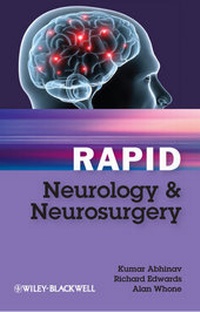
Rapid Neurology and Neurosurgery
Erschienen am 10. August 2012
Buch
Softcover
202 Seiten
978-0-470-65443-9 (ISBN)
Beschreibung
Rapid Neurology and Neurosurgery is a must for all medical students and junior doctors - it is a quick and easy on-the-ward or clinic reference and the perfect revision tool for those approaching finals, undergraduate neurology and neurosurgery examinations, and the Membership of Royal College of Surgeons (MRCS) examinations.
It provides a concise, structured approach to neurology and neurosurgery learning, covering key facts in a simple and memorable way:
Part I - The Basics - features the basic principles and facts essential for a good understanding of neurology and neurosurgery and includes sections on relevant neuroanatomy; neurological history and examination; and investigations including neurophysiology and neuroradiology. MRI and CT scans are included throughout the text.
Part II - Complaints: face to face with the patient - features OSCE-style and the viva-voce examination preparation and has chapters on presenting complaints with relevant and selected questions to ask for establishing the differential diagnoses (presented in a table) with basic investigations and management.
Part III - Conditions: applying the basics - presents important clinical conditions with sections on definition; epidemiology; aetiology; associations/risk factors; pathology; history; examination; investigations; management; complications; prognosis and a list of differential diagnoses usually in a table with general clinical information and distinguishing information to exclude the alternative diagnoses.
Each chapter also includes key points to remember and highlights key facts.
Rapid Neurology and Neurosurgery contains only the essential, core, and relevant facts in a concise, pocket-sized, 'rapid' refresher providing a thorough foundation of neurology and neurosurgery knowledge allowing you to excel in the examinations.
Rezensionen / Stimmen
"Rapid Neurology and Neurosurgery contains only the essential, core, and relevant facts in a concise, pocket-sized, 'rapid' refresher providing a thorough foundation of neurology and neurosurgery knowledge allowing you to excel in the examinations." (Kingbook73's Medical Ebook and Video Collection, 7 September 2014) "It provides a concise, structured approach to neurology and neurosurgery learning, covering key facts in a simple and memorable way." (Buchtipps, 1 September 2012)Weitere Details
Reihe
Auflage
1. Auflage
Sprache
Englisch
Verlagsort
Hoboken
Großbritannien
Verlagsgruppe
John Wiley and Sons Ltd
Zielgruppe
Für Beruf und Forschung
Produkt-Hinweis
Broschur/Paperback
Klebebindung
Maße
Höhe: 213 mm
Breite: 140 mm
Dicke: 13 mm
Gewicht
295 gr
ISBN-13
978-0-470-65443-9 (9780470654439)
Schweitzer Klassifikation
Weitere Ausgaben
Andere Ausgaben
Kumar Abhinav | Richard Edwards | Alan Whone
Rapid Neurology and Neurosurgery
E-Book
06/2012
Wiley-Blackwell
29,99 €
Als Download verfügbar
Kumar Abhinav | Richard Edwards | Alan Whone
Rapid Neurology and Neurosurgery
E-Book
06/2012
1. Auflage
Wiley-Blackwell
28,30 €
Als Download verfügbar
Personen
Kumar Abhinav is a Registrar in Neurosurgery at the Frenchay Hospital in Bristol and is Honorary Research Associate at the MRC Centre for Neurodegeneration Research, Institute of Psychiatry, King's College Hospital, King's college London.
Richard Edwardsis a Consultant Neurosurgeon at the Institute of Clinical Neurosciences, Frenchay Hospital, Bristol.
Alan Whone is a Consultant Neurologist at the Institute of Clinical Neurosciences, Frenchay Hospital, Bristol.
Richard Edwardsis a Consultant Neurosurgeon at the Institute of Clinical Neurosciences, Frenchay Hospital, Bristol.
Alan Whone is a Consultant Neurologist at the Institute of Clinical Neurosciences, Frenchay Hospital, Bristol.
Inhalt
List of Abbreviations, vii
Preface, xi
Acknowledgements, xiii
PART I The basics
1 About this book and how to use it, 3
2 Basic neuroanatomy, 4
3 Neurological history, examination, signs and localisation, 7
4 Neurological investigations, 21
PART II Complaints: Face-to-face with the patient
5 Headache, 31
6 Blackouts, 34
7 Visual disturbances, 36
8 Dizziness and vertigo, 39
9 Weak legs, 41
10 Numbness and sensory disturbance, 44
11 Gait assessment and disturbance, 46
PART III Conditions: Applying the basics
12 Headache, 51
13 Transient ischaemic attacks (TIAs), 55
14 Stroke I: Thromboembolic stroke and syndromes, 59
15 Stroke II: Intracerebral haemorrhage, 65
16 Stroke III: Subarachnoid haemorrhage, 68
17 Epilepsy, 75
18 Multiple sclerosis, 80
19 Parkinson's disease and other related syndromes, 84
20 Other movement disorders, 88
21 Central nervous system infections: Meningitis, 91
22 Central nervous system infections: Cerebral abscess, 94
23 Radiculopathy and disc herniation, 97
24 Peripheral neuropathies' syndromes, 100
25 Common peripheral nerve lesions: Mononeuropathies, 104
26 Motor neurone disease (MND), 108
27 Myasthenia gravis and Lambert-Eaton myasthenic syndrome, 111
28 Diseases of the muscle, 114
29 Alzheimer's disease and other dementia syndromes, 118
30 Raised intracranial pressure and herniation syndromes, 122
31 Coma and brainstem death, 127
32 Head injury: General approach and management, 130
33 Head injury: Subdural haematoma, skull fractures and contusions, 135
34 Head injury: Extradural haematoma, 141
35 Spinal injuries and spinal cord syndromes, 144
36 CNS neoplasia, 151
37 Hydrocephalus, 155
Appendices
Appendix 1 Management of status epilepticus (SE), 163
Appendix 2 Glasgow Coma Scale (GCS), 164
Appendix 3 Primary neuroepithelial tumours of the central nervous system, 166
Appendix 4 Other tumours affecting the central nervous system, 173
Index, 181