

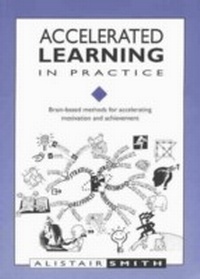
Accelerated Learning in Practice
1st Edition
Published on 1. July 1998
256 pages
978-1-85539-629-6 (ISBN)
Description

This book offers nine principles for brain based approaches to accelerating learning, improving motivation and raising achievement. It offers the reader a coherent structure and describes:
- guaranteed ways to motivate learners
- esteem-building tools for schools, teachers and parents
- how to access and teach to different types of intelligence
- 17 different ways in which schools can make Accelerated Learning work
More details
Edition
1. Auflage
Language
English
Place of publication
London
United Kingdom
Publishing group
Bloomsbury Publishing PLC
Target group
Professional and scholarly
ISBN-13
978-1-85539-629-6 (9781855396296)
Copyright in bibliographic data and cover images is held by Nielsen Book Services Limited or by the publishers or by their respective licensors: all rights reserved.
Schweitzer Classification
Other editions
Additional editions
Alistair Smith
Accelerated Learning in Practice
Book
07/1998
Network Educational Press Ltd
€37.50
Shipment within 3-4 weeks
Person
Alistair Smith is a leading trainer in modern learning methods and his techniques are used with startling success by thousands of teachers and parents in the UK and abroad. He is the chairperson of Alite; a company he founded to work in the field of motivation, learning and training. Alistair has written award-winning books, featured on radio and television programmes, and spoken at conferences internationally.
Content
- Intro
- Contents
- How to use this book
- A note on memory mapping
- Acknowledgements
- Introduction: A model of learning Memory map of Introduction
- 1 A new paradigm for learning
- 2 The Accelerated Learning in the Classroom Cycle
- 3 Nine principles for brain-based learning
- 4 The brain and its construction for learning
- Section One: What the most recent brain research tells us about learning Memory map of Section One
- Preview of Section One
- 1 Multi-sensory stimulation
- 2 Learning, challenge and stress
- 3 Feedback and choice in learning
- 4 Whole brain learning
- 5 Learning to learn - the personal search for meaning
- 6 The multiplicity and modifiability of intelligence
- 7 Physical readiness for learning
- 8 The musical impulse and learning
- 9 How we store and retrieve information using three memory systems
- Review of Section One
- Section Two: Creating a positive learning attitude and an achievement culture Memory map of Section Two
- Preview of Section Two
- 1 The barrier between potential and achievement
- 2 How feedback shapes performance
- 3 The secrets of motivating through goals and targets
- 4 The influence of teacher talk
- 5 How to build and maintain positive self-belief in your learning community
- 6 Questioning strategies for teachers
- 7 How to start learning positively and stay positive
- Review of Section Two
- Section Three: The strategies to accelerate learning in the classroom Memory map of Section Three
- Preview of Section Three
- 1 Connecting the learning
- 2 Providing the Big Picture
- 3 Specifying outcomes
- 4 Input via VAK
- 5 Activating through multiple intelligences (7 plus 1)
- 6 Demonstrating the new understanding
- 7 Review and recall for retention
- 8 17 ways to integrate accelerated learning in the classroom into your school
- Review of Section Three
- Section Four: Resources and contacts for accelerated learning in the classroom Preview of Section Four
- Preview of Section Four
- 1 Templates for accelerated learning across the curriculum
- 2 The great and the good: peripherals for classrooms
- 3 Music to aid learning
- 4 Contact list of organizations
- 5 Glossary of terms
- A
- B
- C
- D
- F
- H
- I
- J
- L
- M
- N
- P
- R
- S
- T
- V
- 6 References
- Acknowledgements
- Index
- A
- B
- C
- D
- E
- F
- G
- H
- I
- J
- K
- L
- M
- N
- O
- P
- Q
- R
- S
- T
- U
- V
- W
