

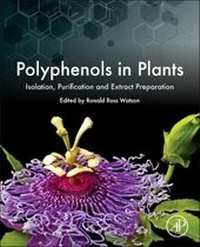
Polyphenols in Plants
Isolation, Purification and Extract Preparation
Published on 20. March 2014
Book
Hardback
360 pages
978-0-12-397934-6 (ISBN)
Description
Polyphenols in Plants assists plant scientists and dietary supplement producers in assessing polyphenol content and factors affecting their composition. It also aids in selecting sources and regulating environmental conditions affecting yield for more consistent and function dietary supplements.
Polyphenols play key roles in the growth, regulation and structure of plants and vary widely within different plants. Stress, growth conditions and plant species modify polyphenol structure and content. This book describes techniques to identify, isolate and characterize polyphenols, taking mammalian toxicology into account as well.
Polyphenols play key roles in the growth, regulation and structure of plants and vary widely within different plants. Stress, growth conditions and plant species modify polyphenol structure and content. This book describes techniques to identify, isolate and characterize polyphenols, taking mammalian toxicology into account as well.
More details
Language
English
Place of publication
San Diego
United States
Publishing group
Elsevier Science Publishing Co Inc
Target group
Professional and scholarly
Food scientists, Plant scientists including those with an interest in food/dietary disease prevention, Nutritionists, Dieticians, Health scientists/researchers whose focus is improved health outcomes based on dietary change/impact.
Product notice
sewn/stitched
Paper over boards
Dimensions
Height: 241 mm
Width: 192 mm
Thickness: 25 mm
Weight
899 gr
ISBN-13
978-0-12-397934-6 (9780123979346)
Copyright in bibliographic data and cover images is held by Nielsen Book Services Limited or by the publishers or by their respective licensors: all rights reserved.
Schweitzer Classification
Other editions
New editions
Book
08/2018
2nd Edition
Academic Press
€146.08
Shipment within 15-20 days
Additional editions
E-Book
01/2014
1st Edition
Academic Press
€96.95
Available for download
Person
Ronald Ross Watson, PhD, is Professor of Health Promotion Sciences at the University of Arizona, Mel and Enid Zuckerman College of Public Health. Dr. Watson began his research in public health at the Harvard School of Public Health as a Fellow in 1971 doing field work on vaccines in Saudi Arabia. He has done clinical studies in Colombia, Iran, Egypt, Saudi Arabia and the United States which provides a broad international view of public health. He has served in the military reserve hospital for 17 years with extensive training in medical responses to disasters as the chief biochemistry officer of a general hospital, retiring as a Lt. Colonel. He is a distinguished member of several national and international nutrition, immunology, and cancer societies. Dr. Watson's career has involved studying many lifestyle aspects for their uses in health promotion. He has edited over 100 biomedical reference books and 450 papers and chapters. His teaching and research focuses on alcohol, tobacco, and drugs of abuse in heart function and disease in mouse models.
Content
Part 1: Modification by plant growth and environment
1. Cultivar and production effects on bioactive polyphenols
2. Plant polyphenol profiles as a tool for traceability and valuable support to biodiversity
Section A: Stress and polyphenol in plants
3. Phenolic compounds and saponins in plants grown under different irrigation regimes
4. Lichen phenolics: environment effects Section B: Plant systems of polyphenol modification
5. Modulation of plant endogenous antioxidant systems by polyphenols
6. Plant polyphenols: do they control freshwater planktonic nuisance phototrophs?
Part 2: Isolation and analysis of polyphenol structure
Section A: Analysis techniques for polyphenols
7. Gas chromatography - mass spectrometry analysis of polyphenols in foods
8. Novel techniques towards the identification of different classes of polyphenols
9. Characterization of polyphenolic profile of citrus fruit by HPLC/PDA/ESI/MS-MS
Section B: Isolation and extraction techniques
10. Non-extractable polyphenols in plant food: nature, isolation and analysis
11. Resin adsorption and ion exchange to recover and fractionate polyphenols
12. Polyphenolic compounds from flowers of Hibiscus: characterization and bioactivity
13. Hydrothermal processing on phenols and polyphenols vegetables
Part 3: Polyphenols identification and occurrence
14. Improved characterization of polyphenols using liquid chromatography
15. Characterization and quantification of polyphenols in fruits
16. Determination of polyphenols, flavonoids, and antioxidant capacity in seeds
1. Cultivar and production effects on bioactive polyphenols
2. Plant polyphenol profiles as a tool for traceability and valuable support to biodiversity
Section A: Stress and polyphenol in plants
3. Phenolic compounds and saponins in plants grown under different irrigation regimes
4. Lichen phenolics: environment effects Section B: Plant systems of polyphenol modification
5. Modulation of plant endogenous antioxidant systems by polyphenols
6. Plant polyphenols: do they control freshwater planktonic nuisance phototrophs?
Part 2: Isolation and analysis of polyphenol structure
Section A: Analysis techniques for polyphenols
7. Gas chromatography - mass spectrometry analysis of polyphenols in foods
8. Novel techniques towards the identification of different classes of polyphenols
9. Characterization of polyphenolic profile of citrus fruit by HPLC/PDA/ESI/MS-MS
Section B: Isolation and extraction techniques
10. Non-extractable polyphenols in plant food: nature, isolation and analysis
11. Resin adsorption and ion exchange to recover and fractionate polyphenols
12. Polyphenolic compounds from flowers of Hibiscus: characterization and bioactivity
13. Hydrothermal processing on phenols and polyphenols vegetables
Part 3: Polyphenols identification and occurrence
14. Improved characterization of polyphenols using liquid chromatography
15. Characterization and quantification of polyphenols in fruits
16. Determination of polyphenols, flavonoids, and antioxidant capacity in seeds