

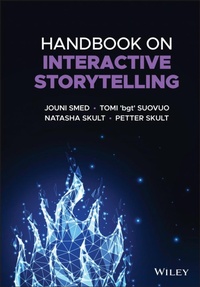
Handbook on Interactive Storytelling
Published on 5. August 2021
Book
Hardback
240 pages
978-1-119-68813-6 (ISBN)
Description
Games are no longer ?just? entertainment or simply a leisure activity; multiple platforms that make games available at any moment of the day and connect the player to other players to become a part of a community play a big role in modern society. Interactive storytelling focuses on creating computer systems, where users experience a dramatically compelling narrative that responds to their actions. The objective of this book is to provide readers with a cohesive picture of the research currently being undertaken in interactive storytelling. In addition to the wealth of material, systematic structure, and extensive bibliography, each chapter provides a set of exercises ranging from implementational tasks to open research questions and starting points for further study. The book is also an inspiring source of information for game designers working in the game industry, focusing on the challenges in creating immersive narrative experiences for the player, irrespective of the technical aspects of game production. The case studies presented have been carefully selected with the aim of proposing specific design approaches where narrative is one of the main features of the gaming experience. Therefore, the book is also aimed at gaming industry- experts who wish to tackle the notion of interactive storytelling to its full potential.
More details
Other editions
Additional editions
Jouni Smed | Tomi 'Bgt' Suovuo | Natasha Skult
Handbook on Interactive Storytelling
E-Book
07/2021
1st Edition
Wiley
€118.99
Available for download
Jouni Smed | Tomi 'Bgt' Suovuo | Natasha Skult
Handbook on Interactive Storytelling
E-Book
06/2021
1st Edition
Wiley
€118.99
Available for download
Persons
Jouni Smed: Senior Lecturer and Adjunct Professor, Department of Future Technologies, University of Turku, Finland. Jouni Smed holds a PhD in Computer Science. For the past twenty years he has organized and taught game development on diverse topics ranging from game algorithms and networking in multiplayer games to game software construction, game design and interactive storytelling. Tomi ?bgt? Suovuo: Doctoral Candidate and Teacher, Department of Future Technologies, University of Turku, Finland. Tomi is a Ph.D. student with a M.Sc. degree in Computer Science. He focuses on the virtual barrier in mediated interaction, particularly between multiple users, looking for thinner areas of the barrier in methods used in the digital game industry. Bgt has been teaching a course, Principles of Interaction Design for four years. Natasha Skult: Doctoral Candidate and Teacher, Department of Art History, University of Turku, and CEO & Creative Director, MiTale Oy (game development company, Finland). Natasha Trygg is an active member of the Finnish games industry as Chairwoman on IGDA Finland and Hive - Turku Game Hub, as well as board member of Neogames and Suomen Pelinkehittajat Ry. Alongside her work in industry, she teaches courses on game design and game (digital) art production. Petter Skult: Department of English Language and Literature, ?bo Akademi University, and Lead Game Designer & Game Narrative Designer, MiTale Oy (as above). Petter Skult recently (2019) received his PhD in English language and literature from ?bo Akademi University. In addition to his academic work, Petter works as a game designer and a game writer.
Content
Preface viii
1 Introduction 1
1.1 Interactive storytelling 3
1.1.1 Partakers 6
1.1.2 Narrative, plot and story 7
1.1.3 Interaction 9
1.2 History of interactive storytelling 11
1.2.1 Theatre 12
1.2.2 Multicursal literature 14
1.3 Role-playing games 15
1.3.1 Hypertext fiction 16
1.3.2 Webisodics 16
1.3.3 Interactive cinema 17
1.3.4 Television 19
1.3.5 Games 20
1.4 Summary 24
Exercises 24
2 Background 28
2.1 Analysis of storytelling 28
2.1.1 Aristotle's Poetics 28
2.1.2 Visual storytelling 33
2.1.3 Structuralism 37
2.1.4 Joseph Campbell and the hero's journey 47
2.1.5 Kernels and satellites 49
2.2 Research on interactive storytelling 50
2.2.1 Brenda Laurel and interactive drama 53
2.2.2 Janet Murray and the cyberbard 55
2.2.3 Models for interactive storytelling 56
2.2.4 Narrative paradox and other research challenges 57
2.3 Summary 62
Exercises 62
3 Platform 66
3.1 Software development 67
3.1.1 Model-view-controller 68
3.1.2 Interactor's interface 70
3.1.3 Designer's interface 73
3.1.4 Modding 73
3.2 Solving the narrative paradox 74
3.2.1 Author-centric approach 76
3.2.2 Character-centric approach 79
3.2.3 Hybrid approach 80
3.3 Implementations 82
3.3.1 Pioneering storytelling systems 82
3.3.2 Crawford's IDS systems 84
3.3.3 Stern's and Mateas' Façade 85
3.3.4 Experimental systems 86
3.3.5 Other systems 87
3.4 Summary 88
Exercises 89
4 Designer 92
4.1 Storyworld types 93
4.1.1 Linear storyworlds 94
4.1.2 Branching storyworlds 96
4.1.3 Open storyworlds 99
4.2 Design process and tools 102
4.2.1 Concepting the storyworld 102
4.2.2 Iterative design process 109
4.2.3 Evaluating interactive stories 111
4.3 Relationship with the interactor 114
4.3.1 Focalization 114
4.3.2 Story as message 115
4.4 Summary 117
Exercises 117
5 Interactor 121
5.1 Experiencing an interactive story 122
5.1.1 Onboarding - from amnesia to awareness 124
5.1.2 Supporting the journey 124
5.1.3 Is there an end? 126
5.1.4 Re-experiencing an interactive story 127
5.2 Agency 128
5.2.1 Theoretical and perceived agency 129
5.2.2 Local and global agency 130
5.2.3 Invisible agency 130
5.2.4 Limited agency and no agency 131
5.2.5 Illusion of agency 131
5.3 Immersion 132
5.3.1 Immersion types 132
5.3.2 Models for immersion 133
5.3.3 Flow 134
5.4 Transformation 135
5.5 Interactor types 136
5.5.1 Top-down analysis 137
5.5.2 Bottom-up analysis 140
5.5.3 Discussion 141
5.6 Summary 141
Exercises 143
6 Storyworld 146
6.1 Characters 147
6.1.1 Perception 148
6.1.2 Memory 149
6.1.3 Personality 150
6.1.4 Decision-making 154
6.2 Elemental building blocks 157
6.2.1 Props 157
6.2.2 Scenes 160
6.2.3 Events 161
6.3 Representation 162
6.3.1 Visual 164
6.3.2 Audio 165
6.4 Summary 167
Exercises 167
7 Perspectives 170
7.1 Multiple interactors 170
7.1.1 Multiple focus 170
7.1.2 Persistence 171
7.2 Extended reality 172
7.2.1 Visual considerations 172
7.2.2 Developing a language of expression 174
7.3 Streaming media 175
7.3.1 Problems 175
7.3.2 Solution proposals 176
7.4 Other technological prospects 177
7.4.1 Voice recognition 177
7.4.2 Locating 178
7.4.3 Artificial intelligence 178
7.5 Ethical considerations 180
7.5.1 Platform 180
7.5.2 Designer 181
7.5.3 Interactor 182
7.5.4 Storyworld 182
7.6 Summary 182
Exercises 183
Bibliography 187
Ludography 204
Index 207Preface Imagine a group sitting by a campfire. The evening sky is getting dark and the first stars begin to appear. Everybody is getting cosy and warm but something is missing. Then somebody starts telling a story. This setup could have happened at any time and anywhere in human history - it might have included even our hominid ancestors. There is something inherently human in the scene. The story and the process of telling it - they cannot be separated from one another. Telling stories is how we construct our memories, how we pass on our values and communicate our experiences. It allows us to have a glimpse into another person's mind. Just us, and the story. This book tells a story, a story of how stories could be told using digital media. In many occasions digital media is said to revolutionize or disrupt the way things have been done before. This is not what we are claiming here. Digital storytelling is not about disruption, breaking or replacing old order. How could it? The stories will remain stories as before. Rather, this will bring stories back to where they once were. They will become alive, and include our digital world in them. Someone will tell the story - human or computer - to somebody else - human or computer. This will be the new digital campfire. Acknowledgments First and foremost the authors would like to thank Harri Hakonen for his early involvement and initial work in analysing the material and having sharp views and insights into the essential matters. We would like to thank the team at Wiley for their efforts, especially our editor Sandra Grayson and managing editor Juliet Booker. We are grateful for their flexibility during the trying times of the COVID-19 pandemic that have rattled up also our writing process. Jouni. I want to acknowledge the important role that my late friend and colleague Timo Kaukoranta played twenty years ago in launching this expedition into the world of interactive storytelling. I express my gratitude to the valuable input from the students over the years, and I am indebted to everybody who has attended my courses on interactive storytelling at the University of Turku in 2004-20. My special greetings go to Lilia and Julian: I am always amazed by your fantastical storyworlds, and, now that I am done writing (at least for a while), I will be happy to spend more time hanging out there with Lord Kanther, D'opa, Härpats and your other marvellous creations. And Iris, thank you for being there - living, laughing and loving. BGT. I wish to thank the hobbyist associations of Turun science fiction seura, Turun yliopiston tieteiskulttuurikabinetti and Turun yliopiston rooli- ja strategiapeliseura for providing for inspiration and insightful discussions relating to storytelling and games. I also wish to thank everyone I have played role playing games and live action role playing games with, especially those who endured the most ridiculous and embarrassing clumsy experiments of mine on this field of interactive storytelling. Loving thanks also to my dearest wife and role playing company, Riikka. Natasha. I wish to thank fellow authors of this book, it has been an amazing journey and inspiring collaboration which is one of many to come. I also want to thank IGDA Finland, Turku Game Hub and MiTale teams for all the support and tireless discussions on the topics of interactive storytelling and 'industry' views. I wish to dedicate special gratitude to my family, Petter and Sara, for endless support and inspiration. Petter. I want to thank Åbo Akademi University for keeping me on as a researcher after finishing my PhD during the writing of this book, my fellow authors for their patience and expertise, and of course to my family and friends for their support. Turku/Åbo, Finland November 2020 Jouni Smed Tomi 'bgt' Suovuo Natasha Skult Petter SkultPreface Imagine a group sitting by a campfire. The evening sky is getting dark and the first stars begin to appear. Everybody is getting cosy and warm but something is missing. Then somebody starts telling a story. This setup could have happened at any time and anywhere in human history - it might have included even our hominid ancestors. There is something inherently human in the scene. The story and the process of telling it - they cannot be separated from one another. Telling stories is how we construct our memories, how we pass on our values and communicate our experiences. It allows us to have a glimpse into another person's mind. Just us, and the story. This book tells a story, a story of how stories could be told using digital media. In many occasions digital media is said to revolutionize or disrupt the way things have been done before. This is not what we are claiming here. Digital storytelling is not about disruption, breaking or replacing old order. How could it? The stories will remain stories as before. Rather, this will bring stories back to where they once were. They will become alive, and include our digital world in them. Someone will tell the story - human or computer - to somebody else - human or computer. This will be the new digital campfire. Acknowledgments First and foremost the authors would like to thank Harri Hakonen for his early involvement and initial work in analysing the material and having sharp views and insights into the essential matters. We would like to thank the team at Wiley for their efforts, especially our editor Sandra Grayson and managing editor Juliet Booker. We are grateful for their flexibility during the trying times of the COVID-19 pandemic that have rattled up also our writing process. Jouni. I want to acknowledge the important role that my late friend and colleague Timo Kaukoranta played twenty years ago in launching this expedition into the world of interactive storytelling. I express my gratitude to the valuable input from the students over the years, and I am indebted to everybody who has attended my courses on interactive storytelling at the University of Turku in 2004-20. My special greetings go to Lilia and Julian: I am always amazed by your fantastical storyworlds, and, now that I am done writing (at least for a while), I will be happy to spend more time hanging out there with Lord Kanther, D'opa, Härpats and your other marvellous creations. And Iris, thank you for being there - living, laughing and loving. BGT. I wish to thank the hobbyist associations of Turun science fiction seura, Turun yliopiston tieteiskulttuurikabinetti and Turun yliopiston rooli- ja strategiapeliseura for providing for inspiration and insightful discussions relating to storytelling and games. I also wish to thank everyone I have played role playing games and live action role playing games with, especially those who endured the most ridiculous and embarrassing clumsy experiments of mine on this field of interactive storytelling. Loving thanks also to my dearest wife and role playing company, Riikka. Natasha. I wish to thank fellow authors of this book, it has been an amazing journey and inspiring collaboration which is one of many to come. I also want to thank IGDA Finland, Turku Game Hub and MiTale teams for all the support and tireless discussions on the topics of interactive storytelling and 'industry' views. I wish to dedicate special gratitude to my family, Petter and Sara, for endless support and inspiration. Petter. I want to thank Åbo Akademi University for keeping me on as a researcher after finishing my PhD during the writing of this book, my fellow authors for their patience and expertise, and of course to my family and friends for their support. Turku/Åbo, Finland November 2020 Jouni Smed Tomi 'bgt' Suovuo Natasha Skult Petter Skult