

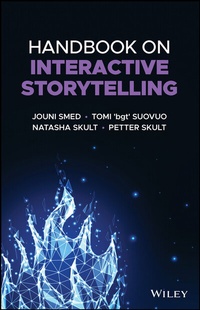
Handbook on Interactive Storytelling
Description

Discover the latest research on crafting compelling narratives in interactive entertainment
Electronic games are no longer considered "mere fluff" alongside the "real" forms of entertainment, like film, music, and television. Instead, many games have evolved into an art form in their own right, including carefully constructed stories and engaging narratives enjoyed by millions of people around the world.
In Handbook on Interactive Storytelling, readers will find a comprehensive discussion of the latest research covering the creation of interactive narratives that allow users to experience a dramatically compelling story that responds directly to their actions and choices.
Systematically organized, with extensive bibliographies and academic exercises included in each chapter, the book offers readers new perspectives on existing research and fresh avenues ripe for further study. In-depth case studies explore the challenges involved in crafting a narrative that comprises one of the main features of the gaming experience, regardless of the technical aspects of a game's production.
Readers will also enjoy:
- A thorough introduction to interactive storytelling, including discussions of narrative, plot, story, interaction, and a history of the phenomenon, from improvisational theory to role-playing games
- A rigorous discussion of the background of storytelling, from Aristotle's Poetics to Joseph Campbell and the hero's journey
- Compelling explorations of different perspectives in the interactive storytelling space, including different platforms, designers, and interactors, as well as an explanation of storyworlds
Perfect for game designers, developers, game and narrative researchers, academics, undergraduate and graduate students studying storytelling, game design, gamification, and multimedia systems, Handbook on Interactive Storytelling is an indispensable resource for anyone interested in the deployment of compelling narratives in an interactive context.
More details
Other editions
Additional editions
Persons
Jouni Smed, PhD, holds his doctorate in Computer Science. He has twenty years of experience in the game development, from algorithms and networking in multiplayer games to game software construction, design, and interactive storytelling.
Tomi 'BGT' Suovuo focuses on the virtual barrier in mediated interaction, particularly between multiple users. He has taught Principles of Interaction Design for four years.
Natasha Skult is an active member of the Finnish and international game developers community as the Chairperson of IGDA and founder of Hive - Turku Game Hub.
Petter Skult, PhD, obtained his doctorate in 2019 in English language and literature from Åbo Akademi University. He is a game designer and writer.
Content
List of Figures ix
List of Tables xiii
Preface xv
Acknowledgements xvii
1 Introduction 1
1.1 Interactive Storytelling 3
1.1.1 Partakers 5
1.1.2 Narrative, Plot, and Story 6
1.1.3 Interaction 8
1.2 History of Interactive Storytelling 10
1.2.1 Theatre 11
1.2.2 Multicursal Literature 12
1.3 Role-playing Games 13
1.3.1 Hypertext Fiction 14
1.3.2 Webisodics 14
1.3.3 Interactive Cinema 15
1.3.4 Television 17
1.3.5 Games 17
1.3.5.1 Interactive Fiction 18
1.3.5.2 Digital Games 19
1.4 Summary 21
Exercises 22
2 Background 25
2.1 Analysis of Storytelling 25
2.1.1 Aristotle's Poetics 25
2.1.1.1 Elements of Tragedy 26
2.1.1.2 Narrative Forms 27
2.1.1.3 Dramatic Arc 27
2.1.2 Visual Storytelling 29
2.1.2.1 Semiotics 30
2.1.2.2 Work of Art 31
2.1.2.3 Video Games as Visual Art 31
2.1.3 Structuralism 33
2.1.3.1 Propp's Morphology of Russian Folktales 33
2.1.3.2 Colby's Grammar of Alaska Natives' Folktales 35
2.1.3.3 Story Grammars 37
2.1.4 Joseph Campbell and the Hero's Journey 41
2.1.5 Kernels and Satellites 42
2.2 Research on Interactive Storytelling 44
2.2.1 Brenda Laurel and Interactive Drama 46
2.2.2 Janet Murray and the Cyberbard 47
2.2.3 Models for Interactive Storytelling 48
2.2.4 Narrative Paradox and Other Research Challenges 49
2.2.4.1 Platform 52
2.2.4.2 Designer 52
2.2.4.3 Interactors 53
2.2.4.4 Storyworld 53
2.2.4.5 Terminology 53
2.3 Summary 54
Exercises 54
3 Platform 57
3.1 Software Development 58
3.1.1 Model-View-Controller 59
3.1.2 Interactor's Interface 61
3.1.3 Designer's Interface 63
3.1.4 Modding 63
3.2 Solving the Narrative Paradox 65
3.2.1 Author-centric Approach 66
3.2.2 Character-centric Approach 68
3.2.3 Hybrid Approach 69
3.3 Implementations 71
3.3.1 Pioneering Storytelling Systems 71
3.3.2 Crawford's IDS Systems 73
3.3.3 Stern's and Mateas's Façade 74
3.3.4 Experimental Systems 75
3.3.5 Other Systems 76
3.4 Summary 77
Exercises 78
4 Designer 81
4.1 Storyworld Types 82
4.1.1 Linear Storyworlds 83
4.1.2 Branching Storyworlds 84
4.1.3 Open Storyworlds 87
4.2 Design Process and Tools 89
4.2.1 Concepting the Storyworld 90
4.2.1.1 Character Design 92
4.2.1.2 Plot Composition 93
4.2.1.3 Adapting Material from Other Media 94
4.2.1.4 Transmedia Design 95
4.2.1.5 Adams' Template for Requirements Specifications 96
4.2.2 Iterative Design Process 97
4.2.3 Evaluating Interactive Stories 98
4.3 Relationship with the Interactor 100
4.3.1 Focalization 100
4.3.2 Story as Message 101
4.4 Summary 103
Exercises 103
5 Interactor 107
5.1 Experiencing an Interactive Story 108
5.1.1 Onboarding -- From Amnesia to Awareness 109
5.1.2 Supporting the Journey 110
5.1.3 Is There an End? 111
5.1.4 Re-experiencing an Interactive Story 112
5.2 Agency 113
5.2.1 Theoretical and Perceived Agency 114
5.2.2 Local and Global Agency 115
5.2.3 Invisible Agency 115
5.2.4 Limited Agency and No Agency 116
5.2.5 Illusion of Agency 116
5.3 Immersion 117
5.3.1 Immersion Types 117
5.3.2 Models for Immersion 118
5.3.3 Flow 119
5.4 Transformation 120
5.5 Interactor Types 121
5.5.1 Top-down Analysis 122
5.5.2 Bottom-up Analysis 124
5.5.3 Discussion 125
5.6 Summary 126
Exercises 126
6 Storyworld 131
6.1 Characters 132
6.1.1 Perception 133
6.1.2 Memory 133
6.1.3 Personality 135
6.1.4 Decision-making 138
6.2 Elemental Building Blocks 141
6.2.1 Props 141
6.2.1.1 Schrödinger's Gun 142
6.2.1.2 Internal Economy 143
6.2.2 Scenes 144
6.2.3 Events 144
6.3 Representation 145
6.3.1 Visual 147
6.3.2 Audio 148
6.3.2.1 Diegetic 148
6.3.2.2 Non-diegetic 149
6.4 Summary 150
Exercises 151
7 Perspectives 153
7.1 Multiple Interactors 153
7.1.1 Multiple Focus 153
7.1.2 Persistence 154
7.2 Extended Reality 155
7.2.1 Visual Considerations 155
7.2.2 Developing a Language of Expression 157
7.3 Streaming Media 157
7.3.1 Problems 157
7.3.2 Solution Proposals 159
7.4 Other Technological Prospects 160
7.4.1 Voice Recognition 160
7.4.2 Locating 160
7.4.3 Artificial Intelligence 161
7.5 Ethical Considerations 162
7.5.1 Platform 163
7.5.2 Designer 163
7.5.3 Interactor 164
7.5.4 Storyworld 164
7.6 Summary 165
Exercises 165
Bibliography 169
Ludography 187
Index 191
1
Introduction
Humans are storytelling animals. We crave hearing stories at an early age, and as soon as we start telling them ourselves. The simplest life forms carry their legacy to their children as genetic instincts. More complex animals take this further by teaching their young through play and concrete examples. Humans are the only known species to bring up their young also with stories of imaginary and abstract examples. Take away stories and you would reduce humans to something else. As Barbara Hardy (1968) observes '[in] order really to live, we make up stories about ourselves and others, about the personal as well as the social past and future.' Alasdair MacIntyre (1981, p. 201) echoes this sentiment by concluding that 'man is in his actions and practice, as well as in his fictions, essentially a story-telling animal' because 'we all live our narratives in our lives and because we understand our lives in terms of narratives' (MacIntyre 1981, p. 197). Simply put, a human being is homo narrans, the 'storytelling human' (Fisher 1984).
When storytellers begin their story, there is a sense of wonder that the audience has. Out of a sudden, a new world is created in front of their eyes with characters and events that, at the same time, are relatable and familiar but are also new and strange. Who of us has not had that feeling when starting a book or a movie, a television series or video game - or simply hearing someone reiterate a story of what happened to them in the previous day. Story is a human way to connect with other people over the barriers of language, culture, or even time. Epic of Gilgamesh is almost 5000-year-old story, but we can still understand and relate its protagonist as he struggles through trials and tribulations.
It is not only that stories are used for entertainment or pastime but they are also records of our past, collections of wisdom and knowledge. They are a way to teach culture, values, norms, history, science to our children, to educate them to be a part of our bigger pack.
At the heart of this is the storyteller, the one who composes and collects the material into a presentable form to the public. In the beginning, they were doing all this by themself, but with time and technological advances they could use the latest inventions - writing, painting, printing, filming, computing - as an extension. Such advancements allowed them to store the stories, help to disseminate them, and bring them to the masses even on a global scale.
But this is not a story of the storyteller alone, because they would be nothing without the audience, the ones to whom the story is being told, who make the storyteller, lift them up or bring them down. Such popularity has become an essential aspect for many whose livelihood depends on the audience's goodwill.
The relationship between them has been a struggle of control. The storyteller cannot live in a vacuum and cut ties to the audience. Although there might be exceptions, many of them are now forgotten. There is interaction between the two that can take many forms. In oral storytelling, the bards would adapt to the audience's reactions and change the presentation whilst keeping the formula - the structure of the story. An author of a novel seems isolated from interactions, writing in solitude, a work that gets them printed and distributed, or a game designer working with a computer. None of them is working in a vacuum, but there is feedback, albeit slow and from a limited set. They have time to react and make changes. But what if the need for change is immediate and the range of possible choices is vast?
Digital media allows us to tell stories as well as any of the traditional ones. When we think about what is special about digital media, we have
- the possibility of combining different formats;
- the reproducibility (i.e. getting perfect copies in unlimited numbers);
- the ease, scale, and speed of distribution (e.g. by eliminating middlemen such as publishers); and
- permanence (at least in the short term).
The greatest concern with digital media is the long-term permanence. How many of today's digital stories will last as long as Epic of Gilgamesh? We are already witnessing deprecation or 'digital rust' due to outdated formats or devices. For example, the original assets and source codes of the video game Blade Runner (Westwood Studios 1997) were lost and had to be reverse engineered with great effort (GOG.com 2019).
New medium means that we have to refine our concepts. Traditionally, storytelling is seen as the author conveying the story to an audience via a medium. The author's story can be conveyed as a book to the reader, a film to the spectators, a play to an audience. Digital stories are not different, but digital devices are another medium. However, what is different is the possibility of interactivity. This allows the audience to affect the story being told. This is not anything new per se, but many non-digital storytelling situations retain this aspect. Imagine a bard telling a story orally, observing the audience's reactions and adapting the story accordingly. The same happens when a parent is inventing a good-night story to a child: the story changes and adapts. This requires a second-person insight. It is something that good teachers or tour guides can cultivate to capture their audience. The topics of a historical sight remain the same, but what the guide tells can be totally different for a group of bored teenagers than for a senior citizen on a holiday trip.
Computers thrive from interaction. The pace has got faster until we now expect to have a real-time response, the range is getting wider so that we can choose freely within the context, and interfaces have been getting clearer so that the users know what they are getting. This does sound like a perfect solution to the problem of providing interaction to storytelling - a storytelling machine. The idea is not that new but Ramon Llull proposed in Ars Magna from 1305 a machine to study the aspect of God with words, which influenced many thinkers such as Gottfried Leibniz to ponder the possibilities of a logical machine. Having left the analogue behind story generation became an aspect of study and creation. Since the 1990s there has been steady progress in research and development of interactive storytelling as a digital media.
The idea of interactive storytelling is an appealing one: what if I could change the flow of the story. Instead of being a passive recipient, what if I could actually have an impact on the way the story proceeds - but without the need of being the one who does the hard work and carries on the story. It is easy to see the lure of interactive storytelling because authoring itself is cumbersome and requires a lot of work and skills. It would be easier to just affect the story whenever one feels like, make little twists and changes so that the events would turn out how one wishes for.
This lost interaction is the key ingredient in the mix. We have become so accustomed to the ready-made worlds that many are craving an outlet for participatory action. It can be fanfic or cosplay or going to a themepark of our favourite storyverse. What if the story and its world (i.e. the storyworld) would be manageable enough to let you change it to your own liking. Naturally, you would say that we already have video games that allow us to fulfil our dreams (Adams 2014, p. 47). But think bigger. Instead of going through somebody's authored narrative, what if you could be the one in control, co-authoring (if you like) the story. This is the call of digital interactive storytelling where technology (i.e. algorithms) would be your tireless guide and bard leading you to a world that was designed to be experienced. You could play it, but you could have something else. Within these pages, we will get to know this world.
Before recounting that this chapter presents the basic terms and structure of interactive storytelling and how it differs from conventional (i.e. non-interactive) storytelling, we see how the four partakers - platform, designer, interactor and storyworld - are connected to one another, and in the subsequent chapter we look at each of them more closely. We also go through the history of interactive storytelling from non-digital to digital in various media to provide a historical perspective about the roles of interaction in storytelling. First, we need to clarify the terminology and basic concepts in Section 1.1. We provide a cursory glance on storytelling, narratives, interactivity, which we deepen throughout this book. Then, we take a look at examples of this in Section 1.2.
1.1 Interactive Storytelling
Storytelling is always interactive. Even an author working alone on an isolated island has the potential readers in their mind, and this interactive thought process affects how the story is being constructed. But we do not have to go so far because the sounding board is generally close to the author - family members, colleagues, the editor. Also, the reader of any book is not just passively having the same experience every other reader: there are personal contexts that make individual differences to the reading experience, and even those contexts change over time, so no two read-throughs are exactly the same (Falk and Dierking 2016; Mäyrä...
