

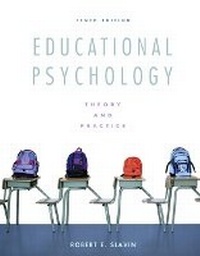
Educational Psychology
Theory and Practice Plus MyEducationLab with Pearson eText -- Access Card Package
10th Edition
Published on 28. November 2012
Book
Mixed media product
608 pages
978-0-13-301809-7 (ISBN)
Description
ALERT: Before you purchase, check with your instructor or review your course syllabus to ensure that you select the correct ISBN. Several versions of Pearson's MyLab & Mastering products exist for each title, including customized versions for individual schools, and registrations are not transferable. In addition, you may need a CourseID, provided by your instructor, to register for and use Pearson's MyLab & Mastering products.
Packages
Access codes for Pearson's MyLab & Mastering products may not be included when purchasing or renting from companies other than Pearson; check with the seller before completing your purchase.
Used or rental books
If you rent or purchase a used book with an access code, the access code may have been redeemed previously and you may have to purchase a new access code.
Access codes
Access codes that are purchased from sellers other than Pearson carry a higher risk of being either the wrong ISBN or a previously redeemed code. Check with the seller prior to purchase.
-- From renowned educational psychologist, Robert Slavin, the Tenth Edition of this popular text translates theory into practices that teachers can use in their classrooms with deeper inquiry into the concept of intentionality and a thorough integration of standards. This edition highlights current issues and emerging trends in the field of educational psychology.
The tenth edition continues to have in-depth, practical coverage with a focus on the intentional teacher by presenting up-to-the-minute research that a reflective, intentional teacher can apply. An "intentional teacher," according to Slavin, is one who constantly reflects on his or her practice and makes instructional decisions based on a clear conception of how these practices affect students. To help readers become "intentional teachers," the author offers a set of questions to guide them and models best practices through classroom examples.
Packages
Access codes for Pearson's MyLab & Mastering products may not be included when purchasing or renting from companies other than Pearson; check with the seller before completing your purchase.
Used or rental books
If you rent or purchase a used book with an access code, the access code may have been redeemed previously and you may have to purchase a new access code.
Access codes
Access codes that are purchased from sellers other than Pearson carry a higher risk of being either the wrong ISBN or a previously redeemed code. Check with the seller prior to purchase.
-- From renowned educational psychologist, Robert Slavin, the Tenth Edition of this popular text translates theory into practices that teachers can use in their classrooms with deeper inquiry into the concept of intentionality and a thorough integration of standards. This edition highlights current issues and emerging trends in the field of educational psychology.
The tenth edition continues to have in-depth, practical coverage with a focus on the intentional teacher by presenting up-to-the-minute research that a reflective, intentional teacher can apply. An "intentional teacher," according to Slavin, is one who constantly reflects on his or her practice and makes instructional decisions based on a clear conception of how these practices affect students. To help readers become "intentional teachers," the author offers a set of questions to guide them and models best practices through classroom examples.
More details
Edition
10th edition
Language
English
Place of publication
United States
Publishing group
Pearson Education (US)
Target group
Professional and scholarly
ISBN-13
978-0-13-301809-7 (9780133018097)
Copyright in bibliographic data is held by Nielsen Book Services Limited or its licensors: all rights reserved.
Schweitzer Classification
Other editions
New editions
Book
02/2014
11th Edition
Pearson
Unfortunately, price unknown
Article exhausted; check for reprint
Person
Robert Slavin is director of the Center for Research and Reform in Education, Johns Hopkins University, director of the Institute for Effective Education at the University of York (England), and chairman of the Success for All Foundation. He received his Ph.D. in Social Relations from Johns Hopkins in 1975, and since that time he has authored more than 200 articles and book chapters on such topics as cooperative learning, ability grouping, school and classroom organization, desegregation, mainstreaming, research review, and evidence-based reform. Dr. Slavin is the author or -coauthor of 20 books, including Cooperative Learning, School and Classroom Organization, Effective Programs for Students at Risk, Preventing Early School Failure, Show Me the Evidence: Proven and Promising Programs for America's Schools, Two Million Children: Success for All, Effective Programs for Latino Students, and Educational Research in the Age of Accountability. In 1985 Dr. Slavin received the Raymond Cattell Early Career Award for Programmatic Research from the American Educational Research Association. In 1988 he received the Palmer O. Johnson Award for the best article in an AERA journal. In 1994 he received the Charles A. Dana Award, in 1998 he received the James Bryant Conant Award from the Education Commission of the States, and in 2000 he received the Distinguished Services Award from the Council of Chief State School Officers. He again received the Palmer O. Johnson award for the best article in an AERA journal in 2008, and received the AERA Review of Research award in 2009.
Content
Chapter 1 - Educational Psychology: A Foundation for Teaching
Chapter 2 - Cognitive, Language, and Literacy Development
Chapter 3 - Social, Moral, and Emotional Development
Chapter 4 - Student Diversity
Chapter 5 - Behavioral Theories of Learning
Chapter 6 - Information Processing and Cognitive Theories of Learning
Chapter 7 - The Effective Lesson
Chapter 8 - Student-Centered and Constructivist Approaches to Instruction
Chapter 9 - Grouping, Differentiation, and Technology
Chapter 10 - Motivating Students to Learn
Chapter 11 - Effective Learning Environments
Chapter 12 - Learners with Exceptionalities
Chapter 13 - Assessing Student Learning
Chapter 14 - Standardized Tests and Accountability
Chapter 2 - Cognitive, Language, and Literacy Development
Chapter 3 - Social, Moral, and Emotional Development
Chapter 4 - Student Diversity
Chapter 5 - Behavioral Theories of Learning
Chapter 6 - Information Processing and Cognitive Theories of Learning
Chapter 7 - The Effective Lesson
Chapter 8 - Student-Centered and Constructivist Approaches to Instruction
Chapter 9 - Grouping, Differentiation, and Technology
Chapter 10 - Motivating Students to Learn
Chapter 11 - Effective Learning Environments
Chapter 12 - Learners with Exceptionalities
Chapter 13 - Assessing Student Learning
Chapter 14 - Standardized Tests and Accountability