

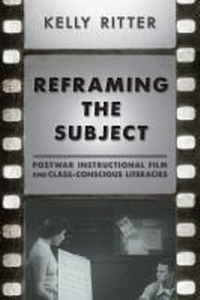
Reframing the Subject
Postwar Instructional Film and Class-Conscious Literacies
Published on 11. December 2015
Book
Paperback/Softback
368 pages
978-0-8229-6388-2 (ISBN)
Description
"Mental hygiene" films developed for classroom use touted vigilance, correct behavior, morality, and model citizenship. They also became powerful tools for teaching literacy skills and literacy-based behaviors to young people following the Second World War.
In this study, Kelly Ritter offers an extensive theoretical analysis of the alliance of the value systems inherent in mental hygiene films (class-based ideals, democracy, patriotism) with writing education-an alliance that continues today by way of the mass digital technologies used in teaching online. She further details the larger material and cultural forces at work in the production of these films behind the scenes and their effects on education trends.
Through her examination of literacy theory, instructional films, policy documents, and textbooks of the late 1940s to mid-1950s, Ritter demonstrates a reliance on pedagogies that emphasize institutional ideologies and correctness over epistemic complexity and de-emphasize the role of the student in his or her own learning process. To Ritter, these practices are sustained in today's pedagogies and media that create a false promise of social uplift through formalized education, instead often resulting in negative material consequences.
In this study, Kelly Ritter offers an extensive theoretical analysis of the alliance of the value systems inherent in mental hygiene films (class-based ideals, democracy, patriotism) with writing education-an alliance that continues today by way of the mass digital technologies used in teaching online. She further details the larger material and cultural forces at work in the production of these films behind the scenes and their effects on education trends.
Through her examination of literacy theory, instructional films, policy documents, and textbooks of the late 1940s to mid-1950s, Ritter demonstrates a reliance on pedagogies that emphasize institutional ideologies and correctness over epistemic complexity and de-emphasize the role of the student in his or her own learning process. To Ritter, these practices are sustained in today's pedagogies and media that create a false promise of social uplift through formalized education, instead often resulting in negative material consequences.
Reviews / Votes
. . . a rigorous and incisive account of the use of instructional films. . . . Ritter makes a compelling case that the attitudes that established their appeal remain an intrinsic part of our pedagogies today. In that sense, the book issues a timely call for educators to reconsider the connections between our methods of classroom instruction and the material realities of students' lives. * Community Literacy Journal * Kelly Ritter's incisive and fascinating analysis of these films is an argument about how ideology and institutional power work on both the corporate level and the level of individual teachers to shape education. What's more, she makes a persuasive case for the ways in which new technologies and debates about literacy are, in many ways, reproducing ideologies and practices that are little changed from those of sixty years ago. * Bronwyn T. Williams, University of Louisville * I was especially taken with Ritter's account of postwar current-traditionalism in U.S. composition pedagogy, that includes (for the first time, to my knowledge) instructional films in the educational effort to inculcate and discipline student behavior, including literate behavior, and the longer view of the role of technology in modern schooling, an ever-ready (but problematic) solution to mass proportions, teacher fatigue, and diverse student populations. * David Fleming, University of Massachusetts, Amherst *More details
Series
Language
English
Place of publication
Pittsburgh PA
United States
Target group
Professional and scholarly
Product notice
Paperback (trade)
Illustrations
33 black & white illustrations
Dimensions
Height: 229 mm
Width: 152 mm
ISBN-13
978-0-8229-6388-2 (9780822963882)
Copyright in bibliographic data and cover images is held by Nielsen Book Services Limited or by the publishers or by their respective licensors: all rights reserved.
Schweitzer Classification
Other editions
Additional editions
E-Book
01/2016
David & Charles
€58.99
Available for download
Person
Kelly Ritter is professor of English and director of undergraduate rhetoric at the University of Illinois at Urbana-Champaign. She is the author of To Know Her Own History: Writing at the Woman's College, 1943?1963; Before Shaughnessy: Basic Writing at Yale and Harvard, 1920?1960; and Who Owns School? Authority, Students, and Online Discourse. Ritter also is editor of the journal College English.