

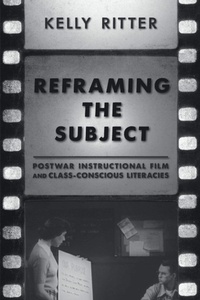
Reframing the Subject
Postwar Instructional Film and Class-Conscious Literacies
Published on 23. January 2016
366 pages
978-0-8229-8117-6 (ISBN)
Description

"Mental hygiene" films developed for classroom use touted vigilance, correct behavior, morality, and model citizenship. They also became powerful tools for teaching literacy skills and literacy-based behaviors to young people following the Second World War.
In this study, Kelly Ritter offers an extensive theoretical analysis of the alliance of the value systems inherent in mental hygiene films (class-based ideals, democracy, patriotism) with writing education-an alliance that continues today by way of the mass digital technologies used in teaching online. She further details the larger material and cultural forces at work in the production of these films behind the scenes and their effects on education trends.
Through her examination of literacy theory, instructional films, policy documents, and textbooks of the late 1940s to mid-1950s, Ritter demonstrates a reliance on pedagogies that emphasize institutional ideologies and correctness over epistemic complexity and de-emphasize the role of the student in his or her own learning process. To Ritter, these practices are sustained in today's pedagogies and media that create a false promise of social uplift through formalized education, instead often resulting in negative material consequences.
In this study, Kelly Ritter offers an extensive theoretical analysis of the alliance of the value systems inherent in mental hygiene films (class-based ideals, democracy, patriotism) with writing education-an alliance that continues today by way of the mass digital technologies used in teaching online. She further details the larger material and cultural forces at work in the production of these films behind the scenes and their effects on education trends.
Through her examination of literacy theory, instructional films, policy documents, and textbooks of the late 1940s to mid-1950s, Ritter demonstrates a reliance on pedagogies that emphasize institutional ideologies and correctness over epistemic complexity and de-emphasize the role of the student in his or her own learning process. To Ritter, these practices are sustained in today's pedagogies and media that create a false promise of social uplift through formalized education, instead often resulting in negative material consequences.
More details
Other editions
Additional editions
Book
12/2015
University of Pittsburgh Press
€75.65
Article exhausted; check different version
Person
Kelly Ritter is professor of English and director of undergraduate rhetoric at the University of Illinois at Urbana-Champaign. She is the author of To Know Her Own History: Writing at the Woman's College, 1943Ð1963; Before Shaughnessy: Basic Writing at Yale and Harvard, 1920Ð1960; and Who Owns School? Authority, Students, and Online Discourse. Ritter also is editor of the journal College English.
Content
- Intro
- Contents
- Acknowledgments
- Introduction: Sometimes We Expect Great Things
- 1. Social Inequalities and the Enterprise of Schooling
- 2. Wartime Literacies and the Curricular Tensions of Democracy
- 3. Mediating Literacies: The Postwar Literacy Sponsorship of Composition Textbooks and Instructional Films
- 4. Modeling Social Literacies on Film: Coronet Instructional Films and Class Maintenance
- 5. Enacting Literacies: Current-Traditionalism via Coronet's Role-Play
- 6. The Rhetorical Economies of Mass Literacy Instruction in the Twenty-First Century: A Critical Observation
- Notes
- Works Cited
- Index
