

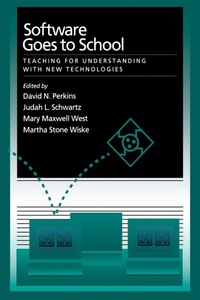
Software Goes to School
Teaching for Understanding with New Technologies
Published on 1. May 1997
Book
Paperback/Softback
304 pages
978-0-19-511577-2 (ISBN)
Description
This work brings together leading experts to offer an in-depth examination of how computer technology can play an invaluable part in educational efforts through its unique capacities to support the development of students in the understanding of difficult concepts. It is intended for students, researchers and professionals in educational psychology, developmental psychology, and software design.
More details
Language
English
Place of publication
New York
United States
Target group
Professional and scholarly
Illustrations
black and white photographs and line figures
Dimensions
Height: 234 mm
Width: 156 mm
Thickness: 17 mm
Weight
471 gr
ISBN-13
978-0-19-511577-2 (9780195115772)
Copyright in bibliographic data and cover images is held by Nielsen Book Services Limited or by the publishers or by their respective licensors: all rights reserved.
Schweitzer Classification
Other editions
Additional editions
David N. Perkins | Judah L. Schwartz | Mary Maxwell West
Software Goes to School
Teaching for Understanding with New Technologies
Book
09/1995
Oxford University Press Inc
€115.00
Shipment within 15-20 days
Persons
David N. Perkins is Co-director of Project Zero, Associate of the Educational Technology Center, and Senior Research Associate, all at the Harvard Graduate School of Education.
Judah L. Schwartz is Professor of Engineering Science and Education at the Massachusetts Institute of Technology, and Professor of Education and Co-director at the Educational Technology Center at Harvard.
Martha Stone Wiske is Co-director of the Educational Technology Center, Senior Research Associate at Project Zero, and Lecturer at Harvard.
Mary Maxwell West is Senior Research Associate in the Program Evaluation & Research Group at Lesley College.
Judah L. Schwartz is Professor of Engineering Science and Education at the Massachusetts Institute of Technology, and Professor of Education and Co-director at the Educational Technology Center at Harvard.
Martha Stone Wiske is Co-director of the Educational Technology Center, Senior Research Associate at Project Zero, and Lecturer at Harvard.
Mary Maxwell West is Senior Research Associate in the Program Evaluation & Research Group at Lesley College.
Content
Contributors
Introduction
PART I: Understanding Understanding
1: Raymond S. Nickerson: Can Technology Help Teach for Understanding?
2: Marianne Wiser: Use of History of Science to Understand and Remedy Students' Misconceptions about Heat and Temperature
3: Susan Carey and Carol Smith: On Understanding the Nature of Scientific Knowledge
4: Carlos E. Vasco: History of Mathematics as a Tool for Teaching Mathematics for Understanding
5: David N. Perkins et al.: Inside Understanding
PART II: Using Technology to Make a Distinctive Contribution
6: Judah L. Schwartz: Shuttling Between the Particular and the General: Reflections of the Role of Conjecture and Hypothesis in the Generation of Knowledge in Science and Mathematics
7: Joseph Snir, Carol Smith, and Lorraine Grosslight: Conceptually Enhanced Simulations: A Computer Tool for Science Teaching
8: James J. Kaput: Creating Cybernetic and Psychological Ramps from the Concrete to the Abstract: Examples from Multiplicative Structures
9: E. Paul Goldenberg: Multiple Representations: A Vehicle for Understanding Understanding
10: Judah L. Schwartz: The Right Size Byte: Reflections of an Educational Software Designer
PART III: Connecting Educational Research and Practice
11: Martha Stone Wiske: A Cultural Perspective on School-University Collaboration
12: Magdalene Lampert: Managing the Tensions in Connecting Students' Inquiry with Learning Mathematics in School
13: Joseph Snir and Carol Smith: Constructing Understanding in the Science Classroom: Integrating Laboratory Experiments, Student and Computer Models, and Class Discussion in Learning Scientific Concepts
14: Steven H. Schwartz and David N. Perkins: Teaching the Metacurriculum: A New Approach to Enhancing Subject-Matter Learning
15: Margaret Vickers and Jane Smalley: Integrating Computers into Classroom Teaching: Cross-National Perspectives
Index
Introduction
PART I: Understanding Understanding
1: Raymond S. Nickerson: Can Technology Help Teach for Understanding?
2: Marianne Wiser: Use of History of Science to Understand and Remedy Students' Misconceptions about Heat and Temperature
3: Susan Carey and Carol Smith: On Understanding the Nature of Scientific Knowledge
4: Carlos E. Vasco: History of Mathematics as a Tool for Teaching Mathematics for Understanding
5: David N. Perkins et al.: Inside Understanding
PART II: Using Technology to Make a Distinctive Contribution
6: Judah L. Schwartz: Shuttling Between the Particular and the General: Reflections of the Role of Conjecture and Hypothesis in the Generation of Knowledge in Science and Mathematics
7: Joseph Snir, Carol Smith, and Lorraine Grosslight: Conceptually Enhanced Simulations: A Computer Tool for Science Teaching
8: James J. Kaput: Creating Cybernetic and Psychological Ramps from the Concrete to the Abstract: Examples from Multiplicative Structures
9: E. Paul Goldenberg: Multiple Representations: A Vehicle for Understanding Understanding
10: Judah L. Schwartz: The Right Size Byte: Reflections of an Educational Software Designer
PART III: Connecting Educational Research and Practice
11: Martha Stone Wiske: A Cultural Perspective on School-University Collaboration
12: Magdalene Lampert: Managing the Tensions in Connecting Students' Inquiry with Learning Mathematics in School
13: Joseph Snir and Carol Smith: Constructing Understanding in the Science Classroom: Integrating Laboratory Experiments, Student and Computer Models, and Class Discussion in Learning Scientific Concepts
14: Steven H. Schwartz and David N. Perkins: Teaching the Metacurriculum: A New Approach to Enhancing Subject-Matter Learning
15: Margaret Vickers and Jane Smalley: Integrating Computers into Classroom Teaching: Cross-National Perspectives
Index