

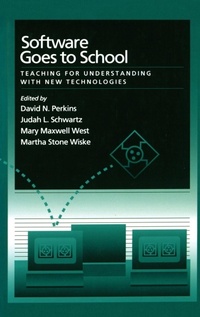
Software Goes to School
Teaching for Understanding with New Technologies
Published on 28. September 1995
Book
Hardback
304 pages
978-0-19-508938-7 (ISBN)
Description
Declining test scores, burgeoning drop-out rates, poor showings in international comparisons--the malaise of public education seems to grow everyday. In this context, technology has emerged as one of the hopes of a renewed educational enterprise. Yet modern information-processing technologies have proved far from a panacea for the ills of education. Software Goes to School describes why that is the case in its consideration of three broad themes. The first part of the book addresses the question of what it means to understand. What constitutes understanding something? What are our principle resources in teaching for understanding? The second part of the book focuses front and centre on what technology can offer in teaching for understanding. Individual chapters examine how technologies afford new ways of representing complex concepts and make available new means by which students can manipulate abstract entities in a "hands-on" way. The last part of the book discusses the complexities of realistic educational settings, explores what happens when technology-based innovations are introduced, and examines the means by which a pedagogy of understanding can take root and thrive. Authored by an eminent group of researchers, this book offers numerous practical guidelines on how computers and software can work together for the betterment of the teaching process. Students and professionals in educational psychology, developmental psychology, and educational computing--as well as concerned parents--will want to read this stimulating new work.
More details
Language
English
Place of publication
New York
United States
Target group
Professional and scholarly
Illustrations
black and white photographs and line figures
Dimensions
Height: 240 mm
Width: 161 mm
Thickness: 21 mm
Weight
628 gr
ISBN-13
978-0-19-508938-7 (9780195089387)
Copyright in bibliographic data and cover images is held by Nielsen Book Services Limited or by the publishers or by their respective licensors: all rights reserved.
Schweitzer Classification
Other editions
Additional editions
David N. Perkins | Judah L. Schwartz | Mary Maxwell West
Software Goes to School
Teaching for Understanding with New Technologies
Book
05/1997
Oxford University Press Inc
€104.80
Shipment within 15-20 days
Persons
David N. Perkins is Co-director of Project Zero, Associate of the Educational Technology Center, and Senior Research Associate, all at the Harvard Graduate School of Education.
Judah L. Schwartz is Professor of Engineering Science and Education at the Massachusetts Institute of Technology, and Professor of Education and Co-director at the Educational Technology Center at Harvard.
Martha Stone Wiske is Co-director of the Educational Technology Center, Senior Research Associate at Project Zero, and Lecturer at Harvard.
Mary Maxwell West is Senior Research Associate in the Program Evaluation & Research Group at Lesley College.
Judah L. Schwartz is Professor of Engineering Science and Education at the Massachusetts Institute of Technology, and Professor of Education and Co-director at the Educational Technology Center at Harvard.
Martha Stone Wiske is Co-director of the Educational Technology Center, Senior Research Associate at Project Zero, and Lecturer at Harvard.
Mary Maxwell West is Senior Research Associate in the Program Evaluation & Research Group at Lesley College.
Content
Contributors
Introduction
PART I: Understanding Understanding
1: Raymond S. Nickerson: Can Technology Help Teach for Understanding?
2: Marianne Wiser: Uses of History of Science to Understand and Remedy Students' Misconceptions about Heat and Temperature
3: Susan Carey and Carol Smith: On Understanding the Nature of Scientific Knowledge
4: Carlos E. Vasco: History of Mathematics as a Tool for Teaching Mathematics for Understanding
5: David N. Perkins et al.: Inside Understanding
PART II: Using Technology to Make a Distinctive Contribution
6: Judah L. Schwartz: Shuttling Between the Particular and the General: Reflections of the Role of Conjecture and Hypothesis in the Generation of Knowledge in Science and Mathematics
7: Joseph Snir, Carol Smith, and Lorraine Grosslight: Conceptually Enhanced Simulations: A Computer Tool for Science Teaching
8: James J. Kaput: Creating Cybernetic and Psychological Ramps from the Concrete to the Abstract: Examples from Multiplicative Structure
9: E. Paul Goldenberg: Multiple Representations: A Vehicle for Understanding Understanding
10: Judah L. Schwartz: The Right Size Byte: Reflections of an Educational Software Designer
PART III: Connecting Educational Research and Practice
11: Martha Stone Wiske: A Cultural Perspective on School-University Collaboration
12: Magdalene Lampert: Managing the Tensions in Connecting Students' Inquiry with Learning Mathematics in School
13: Joseph Snir and Carol Smith: Constructing Understanding in the Science Classroom: Integrating Laboratory Experiments, Student and Computer Models, and Class Discussion in Learning Scientific Concepts
14: Steven H. Schwartz and David N. Perkins: Teaching the Metacurriculum: A New Approach to Enhancing Subject-Matter Learning
15: Margaret Vickers and Jane Smalley: Integrating Computers into Classroom Teaching: Cross-National Perspectives
Index
Introduction
PART I: Understanding Understanding
1: Raymond S. Nickerson: Can Technology Help Teach for Understanding?
2: Marianne Wiser: Uses of History of Science to Understand and Remedy Students' Misconceptions about Heat and Temperature
3: Susan Carey and Carol Smith: On Understanding the Nature of Scientific Knowledge
4: Carlos E. Vasco: History of Mathematics as a Tool for Teaching Mathematics for Understanding
5: David N. Perkins et al.: Inside Understanding
PART II: Using Technology to Make a Distinctive Contribution
6: Judah L. Schwartz: Shuttling Between the Particular and the General: Reflections of the Role of Conjecture and Hypothesis in the Generation of Knowledge in Science and Mathematics
7: Joseph Snir, Carol Smith, and Lorraine Grosslight: Conceptually Enhanced Simulations: A Computer Tool for Science Teaching
8: James J. Kaput: Creating Cybernetic and Psychological Ramps from the Concrete to the Abstract: Examples from Multiplicative Structure
9: E. Paul Goldenberg: Multiple Representations: A Vehicle for Understanding Understanding
10: Judah L. Schwartz: The Right Size Byte: Reflections of an Educational Software Designer
PART III: Connecting Educational Research and Practice
11: Martha Stone Wiske: A Cultural Perspective on School-University Collaboration
12: Magdalene Lampert: Managing the Tensions in Connecting Students' Inquiry with Learning Mathematics in School
13: Joseph Snir and Carol Smith: Constructing Understanding in the Science Classroom: Integrating Laboratory Experiments, Student and Computer Models, and Class Discussion in Learning Scientific Concepts
14: Steven H. Schwartz and David N. Perkins: Teaching the Metacurriculum: A New Approach to Enhancing Subject-Matter Learning
15: Margaret Vickers and Jane Smalley: Integrating Computers into Classroom Teaching: Cross-National Perspectives
Index