

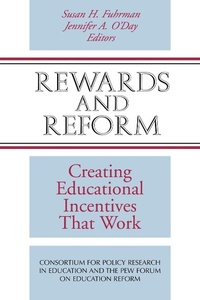
Rewards and Reform
Creating Educational Incentives That Work
1st Edition
Published on 8. October 2009
Book
Paperback/Softback
394 pages
978-0-470-60442-7 (ISBN)
Description
Noted experts offer a comprehensive view of student, teacher, managerial, and organizational incentives and show how they are linked to school reform goals.
Reviews / Votes
"Kelvin Knight has done so much more to situate my thought historically, and to relate it to the philosophical and political thought of others, not only than I have ever done, but than I would ever have been able to do." Alasdair MacIntyre in Analyse & Kritik "A clear, judicious history of Aristotelianism in Western thought in order to explain the development of Alasdair MacIntyre's thought. The book is exceptionally well organized, and the analyses of the different interpreters of Aristotle - especially MacIntyre - are intelligently concise and probing. Highly recommended [for] upper-division undergraduates, graduate students and researchers/faculty." Charles E. Butterworth, Choice "A very fine piece of scholarship ... [It] will be regularly used for teaching at postgraduate level." Peter McMylor, (author of Alasdair MacIntyre: Critic of Modernity) writing in Philosophy of Management "Well-structured and tightly packed without being impenetrable, it should prove vital to contemporary work on Aristotelianism and MacIntyre and more generally useful to advanced students of political theory." Journal of Moral Philosophy "Just as we can be grateful to MacIntyre for his revitalization of Aristotle in the present day, so too can we be grateful to Knight for a lucid and valuable account of MacIntyre's own thought. His book helps to clarify MacIntyre's philosophical lineage and in particular to re-assert the continued importance of his early Marxism. In so doing, it helps to make the case for "revolutionary Aristotelianism" as not the oxymoron it might initially appear, but rather a powerful contemporary alternative to both conservatism and liberal democracy." Notre Dame Philosophical Reviews "At times highly technical due to its depth and nuance of complex concepts, Aristotelian Philosophy is a welcome addition to college library and philosophical studies shelves." Midwest Book Review "Writing with passion and on the basis of deep knowledge of the evolution of MacIntyre's thought, Knight argues convincingly that he effects an anti-elitist reformation of Aristotelian philosophy." Political Studies Review "Kelvin Knight puts his readers greatly in debt for this masterful and erudite study of the history of Aristotelian philosophy, with particular emphasis on MacIntyre's place in that history. Notwithstanding his disclaimers in the conclusion, Knight has in fact produced a clear account of 'the conceptual subtleties and political implications' of MacIntyre's Aristotelianism elsewhere unmatched." Bruce Ballard, author of Understanding MacIntyre "Philosophically and historically informed, but written in an engaging and readable style, the book presents a stimulating and often distinctive account of key phases in the development of Aristotelian thought, culminating in an extended and sympathetic discussion of the work of Alasdair MacIntyre. Knight's account of MacIntyre's political philosophy is the best that I know of." John Horton, University of Keele "This is an impressive intellectual history, both with respect to its account of the various receptions and transformations of Aristotelian practical philosophy generally and with respect to its account of the development and character of Alasdair MacIntyre's own distinctive Aristotelianism. With respect to the former: Aristotelianism is not a monolithic tradition, and Knight does a masterful job in pulling apart the Aristotelianisms that are elitist from those that are anti-elitist and in pulling apart those Aristotelianisms that are conservative from those that are revolutionary. With respect to the latter: MacIntyre's views are widely caricatured by shallow writers, and we have been much in need of an account of those views that shows just how radical and anti-elitist MacIntyre's Aristotelianism is; Knight's book fulfils this need with great thoroughness and skill." Mark Murphy, Georgetown UniversityMore details
Language
English
Place of publication
New York
United States
Publishing group
John Wiley & Sons Inc
Target group
Professional and scholarly
Product notice
Paperback (trade)
Unsewn / adhesive bound
Dimensions
Height: 234 mm
Width: 156 mm
Thickness: 21 mm
Weight
597 gr
ISBN-13
978-0-470-60442-7 (9780470604427)
Copyright in bibliographic data and cover images is held by Nielsen Book Services Limited or by the publishers or by their respective licensors: all rights reserved.
Schweitzer Classification
Other editions
Additional editions

Book
05/1996
Jossey-Bass
€60.84
Article exhausted; check different version
Persons
SUSAN H. FUHRMAN is dean of the Graduate School of Education at the University of Pennsylvania and a director of the Consortium for Policy Research in Education. JENNIFER A. O'DAY is associate director of the Pew Forum on Education Reform.
Content
Preface
The Editors
The Contributors
1 Introduction: Incentives and School Improvement 1
2 Motivating Students to Learn: An American Dilemma 19
3 Rewarding Teachers for Student Performance 60
4 Motivation for School Reform 115
5 Restructuring Schools for High Performance 144
6 Standards as Incentives for Instructional Reform 195
7 Incentives, School Organization, and Teacher Compensation 226
8 Teaching to New Standards 257
9 Getting to Scale with Successful Educational Practices 294
10 Conclusion: Building a Better System of Incentives 330
Index 343
The Editors
The Contributors
1 Introduction: Incentives and School Improvement 1
2 Motivating Students to Learn: An American Dilemma 19
3 Rewarding Teachers for Student Performance 60
4 Motivation for School Reform 115
5 Restructuring Schools for High Performance 144
6 Standards as Incentives for Instructional Reform 195
7 Incentives, School Organization, and Teacher Compensation 226
8 Teaching to New Standards 257
9 Getting to Scale with Successful Educational Practices 294
10 Conclusion: Building a Better System of Incentives 330
Index 343