

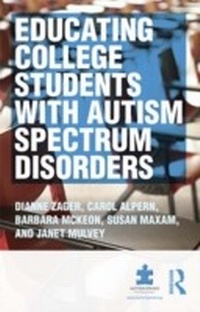
Educating College Students with Autism Spectrum Disorders
1st Edition
Published on 12. December 2012
128 pages
978-1-136-27757-3 (ISBN)
Description

Educating College Students with Autism Spectrum Disorders is one of the first books to specifically address the accommodation of students with significant learning differences in postsecondary education. Developed with the support of Autism Speaks, and piloted at Pace University, each component of this book is scientifically-based and provides a model of emerging best practices for college instruction involving students with ASD. The text is designed to give college faculty a deep understanding of students with ASD and help faculty to productively engage students with ASD, while also meeting the needs of all students in their classes. The strategies included in the manual are solidly grounded in principles of universal design and will prove indispensible for teaching college students of varying ability levels and diverse learning styles.
A companion video shows clips of students and educators that are engaged in inclusive practices to illustrate approaches that have been successful in dealing with challenging situations in the classroom.
A companion video shows clips of students and educators that are engaged in inclusive practices to illustrate approaches that have been successful in dealing with challenging situations in the classroom.
Reviews / Votes
"Recognizing the increasing diversity of our college classrooms, Educating College Students with Autism Spectrum Disorders provides a useful overview of common challenges experienced by students on the autism spectrum and helpful strategies and suggestions for faculty who wish to support them in their classrooms." -Teachers College RecordMore details
Language
English
Place of publication
London
United Kingdom
Publishing group
Taylor & Francis Ltd
Target group
Professional and scholarly
File size
1,02 MB
ISBN-13
978-1-136-27757-3 (9781136277573)
Copyright in bibliographic data and cover images is held by Nielsen Book Services Limited or by the publishers or by their respective licensors: all rights reserved.
Schweitzer Classification
Other editions
Additional editions
Dianne Zager | Carol S. Alpern | Barbara McKeon
Educating College Students with Autism Spectrum Disorders
The OASIS Model
Book
08/2012
1st Edition
Routledge
€215.41
Shipment within 15-20 days
Dianne Zager | Carol S. Alpern | Barbara McKeon
Educating College Students with Autism Spectrum Disorders
The OASIS Model
Book
08/2012
1st Edition
Routledge
€57.20
Shipment within 15-20 days
Persons
Dianne Zager is Michael C. Koffler Professor in Autism and Director of the Autism Specialist Advanced Certification Program at Pace University, where she founded and directed the Center for Teaching and Research in Autism and the OASIS College Support Program. She was founding co-editor of the journal Focus on Autism and Other Developmental Disabilities.
Carol Alpern is Director of the Communication Sciences and Disorders Program at Pace Univeristy. She is a licensed speech-language pathologist, and has the Certificate of Clinical Competence and Specialty Board Recognition in Child Language from the American Speech-Language and Hearing Association.
Barbara McKeon is Director of Aaron Academy, a private special education program serving students in grades 6 to 12, as well as a licensed speech-language pathologist. She holds an Advanced Certificate in Autism from the University of Vermont and has studied Critical Issues in Urban Special Education Institutes at Harvard. She is currently on the faculty at Pace University and is enrolled in a doctoral program at Seton Hall University.
Susan Maxam is University Director for Student Success at Pace University. She is currently enrolled in a doctoral program in Higher Education Leadership and Social Justice at Union Institute & University.
Janet Mulvey is an assistant professor and an educational supervisor in a college support program at Pace University. She received her Ph.D. from Fordham University, and has also served as a school principal and teacher.
Carol Alpern is Director of the Communication Sciences and Disorders Program at Pace Univeristy. She is a licensed speech-language pathologist, and has the Certificate of Clinical Competence and Specialty Board Recognition in Child Language from the American Speech-Language and Hearing Association.
Barbara McKeon is Director of Aaron Academy, a private special education program serving students in grades 6 to 12, as well as a licensed speech-language pathologist. She holds an Advanced Certificate in Autism from the University of Vermont and has studied Critical Issues in Urban Special Education Institutes at Harvard. She is currently on the faculty at Pace University and is enrolled in a doctoral program at Seton Hall University.
Susan Maxam is University Director for Student Success at Pace University. She is currently enrolled in a doctoral program in Higher Education Leadership and Social Justice at Union Institute & University.
Janet Mulvey is an assistant professor and an educational supervisor in a college support program at Pace University. She received her Ph.D. from Fordham University, and has also served as a school principal and teacher.
Content
Section I Introduction
This section explains who these students are, why they are arriving in greater numbers at colleges, and legal mandates regarding students' educational rights and college/professorial responsibilities.
Section II In the Classroom
Section II considers specific learning characteristics and styles of students with ASD and provides recommended strategies for engaging and assessing students on the spectrum.
Section III Case Studies
In Section III, particular cases are used to highlight student and faculty experiences and to illustrate approaches that have been successful in dealing with challenging situations.
Section IV Annotated References and Resources
A final section includes a list of resources with descriptions for learning more about teaching and supporting students on the autism spectrum.
This section explains who these students are, why they are arriving in greater numbers at colleges, and legal mandates regarding students' educational rights and college/professorial responsibilities.
Section II In the Classroom
Section II considers specific learning characteristics and styles of students with ASD and provides recommended strategies for engaging and assessing students on the spectrum.
Section III Case Studies
In Section III, particular cases are used to highlight student and faculty experiences and to illustrate approaches that have been successful in dealing with challenging situations.
Section IV Annotated References and Resources
A final section includes a list of resources with descriptions for learning more about teaching and supporting students on the autism spectrum.
