

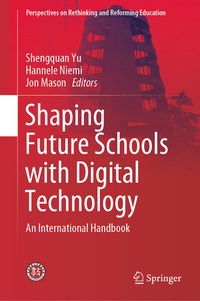
Shaping Future Schools with Digital Technology
An International Handbook
1st Edition
Published on 24. August 2019
XIV, 239 pages
978-981-13-9439-3 (ISBN)
Description

This book presents an overview of education technology and its use in schools, with a primary emphasis on best practices of technology enhanced learning; how new technologies such as mobile, augmented and wearable technologies affect instructional design strategies; and the content curriculum development process. Providing insights into the future of education and the upcoming pedagogies that will be applied in schools, it helps educators and other stakeholders make innovations for the new generations of learners in the 21st century.
The use of emerging technologies such as mobile and ubiquitous technologies, context-aware technology, augment-reality, and virtual reality is contributing to making education adaptive and smarter. With the ever-changing technologies, how to equip teachers with these digital skills and transform their teaching style is also important to ensure that school education is more individualised and customised for students.
Offering a global perspective with integrated practical cases, this timely book is of interest to educators, teachers, and education policymakers. And although most of the authors are from the academia, it provides non-experts with a novel view of what future schools will be like with the help of technology.
The use of emerging technologies such as mobile and ubiquitous technologies, context-aware technology, augment-reality, and virtual reality is contributing to making education adaptive and smarter. With the ever-changing technologies, how to equip teachers with these digital skills and transform their teaching style is also important to ensure that school education is more individualised and customised for students.
Offering a global perspective with integrated practical cases, this timely book is of interest to educators, teachers, and education policymakers. And although most of the authors are from the academia, it provides non-experts with a novel view of what future schools will be like with the help of technology.
Reviews / Votes
"The book presents many interesting and challenging thoughts and ideas about the schools of the future. Everyone working in education, from teachers to policymakers to librarians, should consider this edition as they prepare for the future." (F. J. Ruzic, Computing Reviews, December 14, 2020)
More details
Series
Language
English
Place of publication
Singapore
Singapore
Publishing group
Springer Singapore
Target group
Professional and scholarly
Product notice
Reflowable
Illustrations
XIV, 239 p. 60 illus., 51 illus. in color.
File size
6,39 MB
ISBN-13
978-981-13-9439-3 (9789811394393)
DOI
10.1007/978-981-13-9439-3
Schweitzer Classification
Other editions
Additional editions
Shengquan Yu | Hannele Niemi | Jon Mason
Shaping Future Schools with Digital Technology
An International Handbook
Book
09/2019
Springer
€139.09
Shipment within 15-20 days
Persons
Shengquan Yu is a professor, Executive Director of Advanced Innovation Center for Future Education at Beijing Normal University and Director of the Joint Laboratory for Mobile Learning, Ministry of Education-China Mobile Communications Corporation. His research interests include artificial intelligence in education, ubiquitous learning, and big data in education. Prof. Yu was funded by the National Program for New Century Excellent Talents in 2008. He is a fellow of China E-learning Standard Committee, consulting expert of 12th Five-Year Informationization Plan of Chinese Academy of Science, research fellow of China Educational Policy Research Institute, and expert committee member of Ten Year National Educational Technology Plan. He has published more than 180 academic papers and 6 scholarly monographs, has led more than 50 research projects, and owns numerous patents in his field. His main achievements include the Smart Learning Partner Platform, the Learning Cell Platform, teaching innovation with ICT in K12 projects with over 300 participant schools involved and the 4A Learning Platform with more than 1 million registered users.
Hannele Niemi is a professor and Research Director at the Department of Educational Science, University of Helsinki, as well as Chairman of the Board of Directors of Joint Innovation Research Institute, University of Finland and University of China. She has served as Vice-Chancellor (2003-2009) and Dean (2001-2003) at the University of Helsinki. She has taught at numerous Finnish universities and was invited to be an honorary professor. Prof. Niemi will also serve as the Chair of UNESCO's Educational Equity and Quality of Learning Ecosystem (2018-2021).
Dr Jon Mason is a senior lecturer at Charles Darwin University (CDU) in Australia, where he leads research into digital education futures. He also holds adjunct positions as a professor within the Department of e-Learning at Korea National Open University, professor of Educational Technology at East China Normal University, and project consultant for the Advanced Innovation Center for Future Education at Beijing Normal University. Prior to his current academic appointments, Dr Mason's work was at the nexus of government services, education, and international IT standardization. Since 2012 he has been an elected member of the Executive Committee of the Asia Pacific Society for Computers in Education. His research spans the learning sciences, sense-making, question technologies, and student questioning skills.
Hannele Niemi is a professor and Research Director at the Department of Educational Science, University of Helsinki, as well as Chairman of the Board of Directors of Joint Innovation Research Institute, University of Finland and University of China. She has served as Vice-Chancellor (2003-2009) and Dean (2001-2003) at the University of Helsinki. She has taught at numerous Finnish universities and was invited to be an honorary professor. Prof. Niemi will also serve as the Chair of UNESCO's Educational Equity and Quality of Learning Ecosystem (2018-2021).
Dr Jon Mason is a senior lecturer at Charles Darwin University (CDU) in Australia, where he leads research into digital education futures. He also holds adjunct positions as a professor within the Department of e-Learning at Korea National Open University, professor of Educational Technology at East China Normal University, and project consultant for the Advanced Innovation Center for Future Education at Beijing Normal University. Prior to his current academic appointments, Dr Mason's work was at the nexus of government services, education, and international IT standardization. Since 2012 he has been an elected member of the Executive Committee of the Asia Pacific Society for Computers in Education. His research spans the learning sciences, sense-making, question technologies, and student questioning skills.
Content
Introduction: The Future of Education 2030.- Part I Future Learning Environment Supported by Technology.- 1. What Is a Smart Classroom?.- 2. Active Learning Classrooms (ALCs).- 3. Intelligent Learning Environments for Adaptive and Blended Learning.- 4. Virtual/Cyber-Physical STEM Labs.- Part II Future Learning with Technology.- 5. Supporting Student Learning towards 21st Century Skills through Digital Storytelling.- 6. Educational Mobile Technology and Its Pedagogic Applications.- 7. The Application of Wearable Devices in Primary and Secondary Schools.- 8. Game-Based Learning in Future School.- 9. Future School 2030: Using Wikis for Personalized Participatory Peer-Feedback in English Writing.- Part III Teachers and Students' Role in the Future School.- 10. New Ways to Learn - How to Facilitate Motivation, Learning, and Well-Being in Education?.- 11. Reimagining Technology-Enhanced STEM Teacher Education for 21st Century: From More Technology to Increase Quality of Teaching and Learning.- 12. Shifting Pedagogies in Digital Education.- 13. The Digital Teacher in a Mobile and Always-On World.- Part IV Concluding Remarks.
