

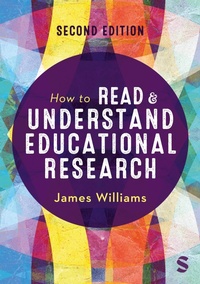
How to Read and Understand Educational Research
2nd Edition
Published on 12. September 2025
224 pages
978-1-0362-0258-3 (ISBN)
Description

This is the perfect guide to engaging with educational research. It explores how to read journal articles critically; what key academic terms really mean; different approaches to educational research, how they are used and what they aim to uncover, and how high quality findings can be meaningful for teaching and learning.
This second edition includes:
A new chapter on understanding quantitative research methods
Deeper discussion of qualitative and mixed methods research, and how to avoid bias
Expanded coverage on how to cite the work of others, understanding research ethics and advice on academic writing
Enhanced chapter features offering critical commentaries, advice on research basics and engaging case studies
A new glossary of key terms
Supported by examples that demonstrate the use (and misuse) of research in education, this is essential reading for initial teacher education students at all levels and students on any undergraduate or postgraduate course underpinned by educational research literature.
Dr James Williams is an Associate Professor/Reader in Science Education and Communication at the University of Sussex.
This second edition includes:
A new chapter on understanding quantitative research methods
Deeper discussion of qualitative and mixed methods research, and how to avoid bias
Expanded coverage on how to cite the work of others, understanding research ethics and advice on academic writing
Enhanced chapter features offering critical commentaries, advice on research basics and engaging case studies
A new glossary of key terms
Supported by examples that demonstrate the use (and misuse) of research in education, this is essential reading for initial teacher education students at all levels and students on any undergraduate or postgraduate course underpinned by educational research literature.
Dr James Williams is an Associate Professor/Reader in Science Education and Communication at the University of Sussex.
More details
Edition
Second Edition
Language
English
Place of publication
United Kingdom
Publishing group
SAGE Publishing (Digital)
Target group
College/higher education
Product notice
Reflowable
File size
15,90 MB
ISBN-13
978-1-0362-0258-3 (9781036202583)
Copyright in bibliographic data and cover images is held by Nielsen Book Services Limited or by the publishers or by their respective licensors: all rights reserved.
Schweitzer Classification
Other editions
Additional editions
James Williams
How to Read and Understand Educational Research
Book
09/2025
2nd Edition
SAGE Publications Ltd
€146.60
Shipment within 3-4 weeks
James Williams
How to Read and Understand Educational Research
Book
09/2025
2nd Edition
SAGE Publications Ltd
€125.90
Shipment within 3-4 weeks
Person
Dr James Williams is a Senior Lecturer in Education in the School of Education and Social Work at the University of Sussex. James initially studied Geology at the University of London and subsequently trained as a science teacher. He taught secondary science in North London (Enfield), South London (Croydon) and Surrey. He has been involved in initial teacher education and training for over twenty years and also teaches on various undergraduate and postgraduate education programmes.
His research interests currently entail understanding the place and teaching of 'The Nature of Science' and 'The Scientific Method' in the school curriculum. In particular, what do teachers understand about these concepts and ideas? Linked to this work he also researches the teaching of evolution in science and the place of creationism in a school based context. He has published a number of successful textbooks in science for Key Stage 3 children as well as authoring articles in international education journals and a book on teaching the nature of science.
His research interests currently entail understanding the place and teaching of 'The Nature of Science' and 'The Scientific Method' in the school curriculum. In particular, what do teachers understand about these concepts and ideas? Linked to this work he also researches the teaching of evolution in science and the place of creationism in a school based context. He has published a number of successful textbooks in science for Key Stage 3 children as well as authoring articles in international education journals and a book on teaching the nature of science.
Content
Part 1: Assessing Research
Chapter 1: Defining Research And The Hierarchy Of Research
Chapter 2: Where To Find Good Research And How To Reference It
Chapter 3: Reflecting On Research And Ethics
Part 2: Analysing Research
Chapter 4: Positionality And Paradigms In Research
Chapter 5: Qualitative Approaches To Research
Chapter 6: Quantitative Research Methods
Chapter 7: Mixed Methods Research And Avoiding Bias
Part 3: Appreciating And Understanding Research
Chapter 8: Understanding Criticality
Chapter 9: Approaches To Criticality
Chapter 10: How Research Is Written And Finding Your Academic Voice
Chapter 1: Defining Research And The Hierarchy Of Research
Chapter 2: Where To Find Good Research And How To Reference It
Chapter 3: Reflecting On Research And Ethics
Part 2: Analysing Research
Chapter 4: Positionality And Paradigms In Research
Chapter 5: Qualitative Approaches To Research
Chapter 6: Quantitative Research Methods
Chapter 7: Mixed Methods Research And Avoiding Bias
Part 3: Appreciating And Understanding Research
Chapter 8: Understanding Criticality
Chapter 9: Approaches To Criticality
Chapter 10: How Research Is Written And Finding Your Academic Voice
