

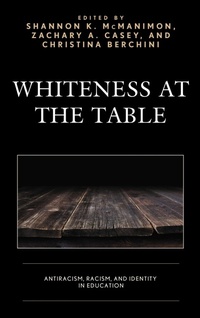
Whiteness at the Table
Antiracism, Racism, and Identity in Education
Lexington Books (Publisher)
1st Edition
Published on 7. July 2020
1 pages
978-1-9787-5034-0 (ISBN)
Description

Antiracist work in education has proceeded as if the only social relation at issue is the one between white people and people of color. But what if our antiracist efforts are being undermined by unexamined difficulties and struggles among white people?
Whiteness at the Table examines whiteness in the lived experiences of young children, family members, students, teachers, and school administrators. It focuses on racism and antiracism within the context of relationships. Its authors argue that we cannot read or understand whiteness as a phenomenon without attending to the everyday complexities and conflicts of white people's lives.
This edited volume is entitled Whiteness at the Table, then, for at least three reasons. First, the title evokes the origins of this book in the ongoing storytelling and theorizing of the Midwest Critical Whiteness Collective-a small collective of antiracist educators, scholars, and activists who have been gathering at its founders' dining room table for almost a decade.
Second, the book's authors are theorizing whiteness not just in terms of structural aspects of white power, but in terms of how whiteness is reproduced and challenged in the day-to-day interactions and relationships of white people. In this sense, whiteness is always already at the table, and this book seeks to illuminate how and why this is so.
Finally, one of the primary aims of Whiteness at the Table is to persuade white people of their moral and political responsibility to bring whiteness-as an explicit topic, as perhaps the most important problem to be solved at this historical moment-to the table. This responsibility to theorize and combat whiteness cannot and should not fall only to people of color.
Whiteness at the Table examines whiteness in the lived experiences of young children, family members, students, teachers, and school administrators. It focuses on racism and antiracism within the context of relationships. Its authors argue that we cannot read or understand whiteness as a phenomenon without attending to the everyday complexities and conflicts of white people's lives.
This edited volume is entitled Whiteness at the Table, then, for at least three reasons. First, the title evokes the origins of this book in the ongoing storytelling and theorizing of the Midwest Critical Whiteness Collective-a small collective of antiracist educators, scholars, and activists who have been gathering at its founders' dining room table for almost a decade.
Second, the book's authors are theorizing whiteness not just in terms of structural aspects of white power, but in terms of how whiteness is reproduced and challenged in the day-to-day interactions and relationships of white people. In this sense, whiteness is always already at the table, and this book seeks to illuminate how and why this is so.
Finally, one of the primary aims of Whiteness at the Table is to persuade white people of their moral and political responsibility to bring whiteness-as an explicit topic, as perhaps the most important problem to be solved at this historical moment-to the table. This responsibility to theorize and combat whiteness cannot and should not fall only to people of color.
More details
Series
Edition
1. Auflage
Language
English
Place of publication
United States
Publishing group
Bloomsbury Publishing Plc
Target group
Professional and scholarly
ISBN-13
978-1-9787-5034-0 (9781978750340)
Copyright in bibliographic data and cover images is held by Nielsen Book Services Limited or by the publishers or by their respective licensors: all rights reserved.
Schweitzer Classification
Other editions
Additional editions
Shannon K. McManimon | Zachary A. Casey | Christina Berchini
Whiteness at the Table
Antiracism, Racism, and Identity in Education
Book
07/2020
Lexington Books
€65.81
Shipment within 15-20 days
Persons
Shannon K. McManimon is assistant professor of educational studies atState University of New York, New Paltz
Zachary A. Casey is assistant professor of educational studies at Rhodes College
Christina Berchini is assistant professor of educational studies University of Wisconsin-Eau Claire
Zachary A. Casey is assistant professor of educational studies at Rhodes College
Christina Berchini is assistant professor of educational studies University of Wisconsin-Eau Claire
Content
Foreword by Decoteau J. Irby
Introduction, Timothy J. Lensmire
Chapter 1: Race, Class, Patriotism, and Religion in Early Childhood: The Formation of Whiteness, Erin T. Miller
Chapter 2: Walking the Walk, or Walking on Eggshells: Silence and the Limits of White Privilege, Christina Berchini
Chapter 3: Whiteness as Chaos and Weakness: Our "Abnormal" White Lives, Samuel Jaye Tanner and Audrey Lensmire
Chapter 4: The Colorblind Conundrum: Seeing and Not Seeing Color in White Rural Schools, Mary E. Lee-Nichols and Jessica Dockter Tierney
Chapter 5: A White Principal, a Fantasy of Dirt, and Anxieties of Attraction, Bryan Davis and Timothy J. Lensmire
Chapter 6: Uneasy Racial "Experts": White Teachers and Antiracist Action, Zachary A. Casey and Shannon K. McManimon
Chapter7: Who are We as White People to Be?: Thoughts on Learning, Loss, Confusion, and Commitment in Antiracist Work, Zachary A. Casey, with Shannon K. McManimon and Christina Berchini
Afterword by Beverly E. Cross
About the Authors
Introduction, Timothy J. Lensmire
Chapter 1: Race, Class, Patriotism, and Religion in Early Childhood: The Formation of Whiteness, Erin T. Miller
Chapter 2: Walking the Walk, or Walking on Eggshells: Silence and the Limits of White Privilege, Christina Berchini
Chapter 3: Whiteness as Chaos and Weakness: Our "Abnormal" White Lives, Samuel Jaye Tanner and Audrey Lensmire
Chapter 4: The Colorblind Conundrum: Seeing and Not Seeing Color in White Rural Schools, Mary E. Lee-Nichols and Jessica Dockter Tierney
Chapter 5: A White Principal, a Fantasy of Dirt, and Anxieties of Attraction, Bryan Davis and Timothy J. Lensmire
Chapter 6: Uneasy Racial "Experts": White Teachers and Antiracist Action, Zachary A. Casey and Shannon K. McManimon
Chapter7: Who are We as White People to Be?: Thoughts on Learning, Loss, Confusion, and Commitment in Antiracist Work, Zachary A. Casey, with Shannon K. McManimon and Christina Berchini
Afterword by Beverly E. Cross
About the Authors
