

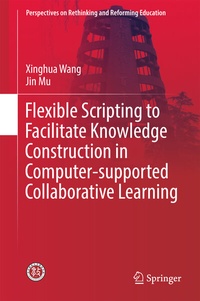
Flexible Scripting to Facilitate Knowledge Construction in Computer-supported Collaborative Learning
Description

In the first empirical study flexibility was accomplished through adaptivity, and through adaptability in the second. The results of these studies show that adaptive and adaptable scripts enhanced the quality of collaborative knowledge construction processes as well as learners' collaboration skills, compared to inflexible scripts.
The findings presented in this book will contribute to theory building of the scripting approach in CSCL. The authors propose two innovative ways of achieving flexible scripting and address the mechanisms by which adaptive versus adaptable script influences collaborative knowledge construction. Moreover, the adaptive and adaptable scripting approaches provide hands-on examples for practitionersand contribute to their understanding of teaching design in CSCL settings.
More details
Other editions
Additional editions
Persons
WANG Xinghua got her Ph.D degree in Educational Psychology at Ludwig Maximiliam University of Munich, Germany; and now is working as an assistant professor in the Faculty of Education at Beijing Normal University, China. Her research focuses on learning in different contexts, especially the authentic assessment of learning processes and outcomes in formal as well as informal setting.
MU Jin received her Ph.D in Educational Psychology at the University of Munich. Her main research area is Computer-Supported Collaborative Learning, specifically the assessment of the collaborative learning processes. She is particularly interested in emerging text classification and data mining technologies that provide novel approaches to analyze discourse data.
Content
Learning 2.0.- Introduction to Collaboration Scripts.- Flexible Scripting in CSCL.- An Empirical Study on Adaptive Scripting.- An Empirical Study on Adaptable Scripting.
