

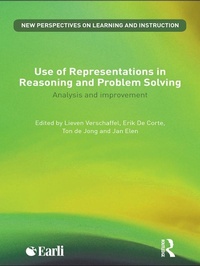
Use of Representations in Reasoning and Problem Solving
Analysis and Improvement
Published on 13. September 2010
270 pages
978-1-136-94399-7 (ISBN)
Description

Within an increasingly multimedia focused society, the use of external representations in learning, teaching and communication has increased dramatically. Whether in the classroom, university or workplace, there is a growing requirement to use and interpret a large variety of external representational forms and tools for knowledge acquisition, problem solving, and to communicate with others.
Use of Representations in Reasoning and Problem Solving brings together contributions from some of the world's leading researchers in educational and instructional psychology, instructional design, and mathematics and science education to document the role which external representations play in our understanding, learning and communication. Traditional research has focused on the distinction between verbal and non-verbal representations, and the way they are processed, encoded and stored by different cognitive systems. The contributions here challenge these research findings and address the ambiguity about how these two cognitive systems interact, arguing that the classical distinction between textual and pictorial representations has become less prominent. The contributions in this book explore:
how we can theorise the relationship between processing internal and external representations
what perceptual and cognitive restraints can affect the use of external representations
how individual differences affect the use of external representations
how we can combine external representations to maximise their impact
how we can adapt representational tools for individual differences.
Using empirical research findings to take a fresh look at the processes which take place when learning via external representations, this book is essential reading for all those undertaking postgraduate study and research in the fields of educational and instructional psychology, instructional design and mathematics and science education.
Use of Representations in Reasoning and Problem Solving brings together contributions from some of the world's leading researchers in educational and instructional psychology, instructional design, and mathematics and science education to document the role which external representations play in our understanding, learning and communication. Traditional research has focused on the distinction between verbal and non-verbal representations, and the way they are processed, encoded and stored by different cognitive systems. The contributions here challenge these research findings and address the ambiguity about how these two cognitive systems interact, arguing that the classical distinction between textual and pictorial representations has become less prominent. The contributions in this book explore:
how we can theorise the relationship between processing internal and external representations
what perceptual and cognitive restraints can affect the use of external representations
how individual differences affect the use of external representations
how we can combine external representations to maximise their impact
how we can adapt representational tools for individual differences.
Using empirical research findings to take a fresh look at the processes which take place when learning via external representations, this book is essential reading for all those undertaking postgraduate study and research in the fields of educational and instructional psychology, instructional design and mathematics and science education.
More details
Series
Language
English
Place of publication
London
United Kingdom
Publishing group
Taylor & Francis Ltd
Target group
College/higher education
Illustrations
58 s/w Abbildungen, 19 s/w Tabellen
19 Tables, black and white; 58 Illustrations, black and white
File size
12,85 MB
ISBN-13
978-1-136-94399-7 (9781136943997)
Copyright in bibliographic data and cover images is held by Nielsen Book Services Limited or by the publishers or by their respective licensors: all rights reserved.
Schweitzer Classification
Other editions
Additional editions
Lieven Verschaffel | Erik de Corte | Ton de Jong
Use of Representations in Reasoning and Problem Solving
Analysis and Improvement
Book
07/2010
1st Edition
Routledge
€77.00
Shipment within 15-20 days
Lieven Verschaffel | Erik de Corte | Ton de Jong
Use of Representations in Reasoning and Problem Solving
Analysis and Improvement
Book
07/2010
1st Edition
Routledge
€231.90
Shipment within 15-20 days
Persons
Lieven Verschaffel is Professor at the faculty of Psychology and Educational Sciences, Katholieke Universiteit Leuven, Belgium.
Erik De Corte is Emeritus Professor of the faculty of Psychology and Educational Sciences, Katholieke Universiteit Leuven, Belgium.
Ton de Jong is Professor of Educational Psychology, University of Twente, Netherlands.
Jan Elen is Professor at the faculty of Psychology and Educational Sciences, Katholieke Universiteit Leuven, Belgium.
Erik De Corte is Emeritus Professor of the faculty of Psychology and Educational Sciences, Katholieke Universiteit Leuven, Belgium.
Ton de Jong is Professor of Educational Psychology, University of Twente, Netherlands.
Jan Elen is Professor at the faculty of Psychology and Educational Sciences, Katholieke Universiteit Leuven, Belgium.
Content
Introduction by the book editors Part 1 Theoretical and empirical analyses of psychological processes in thinking and learning with external representations 1. Creative thinking and problem solving with depictive and descriptive representations Wolfgang Schnotz, Christiane Baadte, Andreas Muelle and Renate Rasch (University of Landau, Germany) 2. Instructional considerations in the use of external representations: the distinction between perceptually-based depictions and pictures that represent conceptual models Stella Vosniadou (University of Athens, Greece) 3. Critical thinking about biology during web page reading: tracking students' evaluation of sources and information through eye fixations Lucia Mason & Nicola Ariasi (University of Padua, Italy) 4. Representational fluency and flexibility in the domain of linear functions: A choice/no choice study Ana Acevedo Nistal, Wim van Dooren, Geraldine Clarebout, Jan Elen, & Lieven Verschaffel (University of Leuven, Belgium) 5. Representations and proof: the case of the Isis problem Brian Greer, Dirk De Bock, & Wim Van Dooren (1 San Diego State University 2 University of Leuven, Belgium) 6. Secondary school students' availability and activation of diagrammatic strategies for learning from texts Michael Schneider, Catrin Rode and Elsbeth Stern (Swiss Federal Institute of Technology of Zuerich, Switzerland) Part 2 Development of representational tools and evaluation of their effects on student learning 7. Conceptual change in learning electricity: On the role of virtual and concrete external representations Tomi Jaakkola, Sami Nurmi & Erno Lehtinen (University of Turku, Finland) 8. Using static and dynamic visualisations to support the comprehension of complex dynamic phenomena in the natural sciences Peter Gerjets, Birgit Imhof , Tim Kuehl , Vanessa Pfeiffer, Katharina Scheiter, and Sven Gemballa (Knowledge Media Research Center, Tuebingen, Germany) 9. The role of external representations in learning combinatorics and probability theory Bas Kolloffel, Tessa H. S. Eysink, and Ton de Jong (University of Twente, The Netherlands) 10. Symbolizing and the development of meaning in computer-supported algebra education Koeno Gravemeijer, Michiel Doorman, and Paul Drijvers (University of Utrecht, The Netherlands) 11. The "numbers are points on a line" analogy: Does it have an instructional value? Xenia Vamvakoussi, (University of Athens, Greece) 12. Use of external representations in science: prompting and reinforcing prior knowledge activation Sandra Wetzels, Liesbeth Kester, & Jeroen van Merrienboer (University of Heerlen, The Netherlands) 13. Visualization of argumentation as shared activity Gijsbert Erkens, Paul Kirschner &, Jeroen Janssen (University of Utrecht, The Netherlands)
