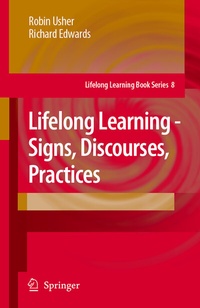
Lifelong Learning - Signs, Discourses, Practices
Description

This text explores the different ways in which the various social practices in which people participate becomes signed as learning, how and why that occurs and with what consequences. It takes seriously the linguistic turn in social theory to draw upon semiotics and poststructuralism through which to explore the significance of lifelong learning as an emerging discourse in education. The text explores the different ways in which learning conveys meaning and is given meaning. Given this, lifelong learning therefore is a way, and a significant way, in which learning is fashioned. The text then explores the notion that, if learning is lifelong and lifewide, what precisely is learning as distinct from other social practices and how those practices are given meaning as learning.
Reviews / Votes
From the reviews:
"The aspiration of the authors is that their text will have interesting things to say about lifelong learning and the application of a semiotic approach. . They have written a book that draws upon a range of intellectual resources to provide various significations of lifelong learning and this is a worthwhile project when set against the economism of education policy . . In conclusion, this is a worthwhile text that would be of interest to research students and academics . ." (James Avis, Studies in the Education of Adults, Vol. 41 (1), Spring, 2009)
More details
Other editions
Additional editions