

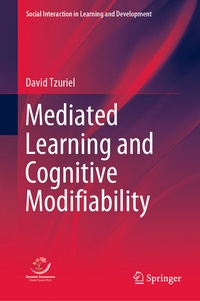
Mediated Learning and Cognitive Modifiability
Description

This book portrays an extensive and intensive discussion of theories and research that refer to Vygotsky's and Feuerstein's theories of mediated learning and their effects on learning potential and cognitive modifiability. Most topics are discussed in relation to a broad spectrum of developmental and cognitive research that are under the conceptual umbrella of mediated learning and cognitive modifiability. Some topics such as neural plasticity, executive functions, mental rotation, and cognitive education are related to mediated learning, though indirectly, and therefore are included in this book.
In many ways the book presents an extension of Vygotsky and Feuerstein's theories and empirical validation in a variety of family, social and cultural contexts. The book includes a thorough analysis and summary of 50 years of research and methodology of the intimate relation between mediated learning interactions and cognitive modifiability and of dynamic assessment underlying measurement of cognitive modifiability.
Special emphasis is given to Tzuriel's dynamic assessment instruments developed during more than four decades. Tzuriel's novel instruments are interwoven in the extensive research on parent-child interactions, siblings' , teachers' and peers' mediation and in validation of dynamic assessment approach and cognitive education programs aimed at development of thinking skills and academic achievements.More details
Other editions
Additional editions
Person
David Tzuriel, Ph.D. is Professor Emeritus at Bar-Ilan University. He is a clinical and educational psychologist and an expert on dynamic assessment of learning potential and theory of mediated learning experience (MLE) . David Tzuriel has received his B.A. (1970) and M.A. (1973) degrees in Psychology and Education at Bar-Ilan University (Israel) and his Ph.D. (1977) from Peabody College of Vanderbilt University (USA). Currently he works as Head of the Research Unit at Feuerstein Institute in Jerusalem and Chairman of Graduate Program of Learning Disabilities Program at Talpiot College. David Tzuriel served as the President of the International Association for Cognitive Education and Psychology (1999-2001) and as Editor-in-Chief of the Journal of Cognitive Education and Psychology (JCEP; 2006-2011; 2016--2020). His scientific work is related to empirical validation, implementation, and modification of the theories of Feuerstein and Vygotsky, and his research is cited frequently in the literature. David Tzuriel supervised 95 MA and Ph.D. students, and published many studies and books in the field of dynamic assessment, cognitive modifiability, parent-child mediated learning interactions, peers and siblings mediation, spatial abilities, executive functions and effectiveness of cognitive education programs. David Tzuriel is known as a leader and developer of the dynamic assessment movement and taught more than 200 international workshops in dynamic assessment and cognitive education programs.
