

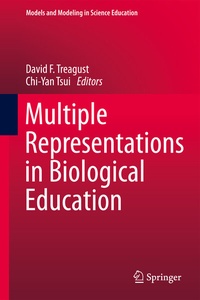
Multiple Representations in Biological Education
Description

This new publication in the Models and Modeling in Science Education series synthesizes a wealth of international research on using multiple representations in biology education and aims for a coherent framework in using them to improve higher-order learning. Addressing a major gap in the literature, the volume proposes a theoretical model for advancing biology educators' notions of how multiple external representations (MERs) such as analogies, metaphors and visualizations can best be harnessed for improving teaching and learning in biology at all pedagogical levels.
The content tackles the conceptual and linguistic difficulties of learning biology at each level-macro, micro, sub-micro, and symbolic, illustrating how MERs can be used in teaching across these levels and in various combinations, as well as in differing contexts and topic areas. The strategies outlined will help students' reasoning and problem-solving skills, enhance their ability to construct mental models and internal representations, and, ultimately, will assist in increasing public understanding of biology-related issues, a key goal in today's world of pressing concerns over societal problems about food, environment, energy, and health. The book concludes by highlighting important aspects of research in biological education in the post-genomic, information age.
Reviews / Votes
From the book reviews:
"The book . exemplifies how students could be actively engaged in their learning through interpretations and manipulations of models and other modes of external representations (ERs) . . I find this book a much-needed collection of resources and supportive research. Treagust and Tsui gathered under the same roof remarkable and thoughtful examples for using ERs in the classroom. . The book provides a comprehensive theoretical background, in addition to multiple practical examples that teachers could adopt in their classrooms." (Gili Marbach-Ad, Science & Education, January, 2015)
More details
Other editions
Additional editions
Content
FOREWORD, Kathleen Fisher.- PREFACE , David F. Treagust and Chi-Yan Tsui.- Introduction to Multiple Representations: Their Importance in Biology and Biological Education, Chi-Yan Tsui and David F. Treagust.- PART I : Role of Multiple Representations in Learning Biology.- Chapter 1 Identifying and Developing Students' Ability to Reason with Concepts and Representations in Biology, Trevor R. Anderson, Konrad J. Schönborn, Lynn du Plessis, Abindra S. Gupthar, and Tracy L. Hull.- Chapter 2 Pictures in Biology Education, Wolff-Michael Roth and Lilian Pozzer-Ardenghi .- Chapter 3 Possible Constraints of Visualization in Biology: Challenges in Learning with Multiple Representations, Billie Eilam.- Chapter 4 Promoting the Collaborative Use of Cognitive and Metacognitive Skills through Conceptual Representations in Hypermedia, Lei Liu and Cindy E. Hmelo-Silver .- Chapter 5 Learning and Teaching Biotechnological Methods Using Animations, Hagit Yarden and Anat Yarden.- PART II: Implications for Biology Teaching and Teacher Education with Multiple Representations.- Chapter 6 Experts' Views on Translation across Multiple External Representations in Acquiring Biological Knowledge about Ecology, Genetics, and Evolution, Konrad J. Schönborn and Susanne Bögeholz.- Chapter 7 Evolution is a Model, Why Not Teach It That Way?, Paul Horwitz.- Chapter 8 Multiple Representations of Human Genetics in Biology Textbooks, Pierre Clément and Jérémy Castéra.- Chapter 9 Deconstructing and Decoding Complex Process Diagrams in University Biology, Phyllis B. Griffard.- Chapter 10 Learning Tree Thinking: Developing a New Framework of Representational Competence, Kristy L. Halverson and Patricia Friedrichsen.- Chapter 11 Understanding Photosynthesis and Cellular Respiration: Encouraging a View of Biological Nested Systems, Reneé Schwartz and Mary Brown.- Chapter 12 Scientific Modelsin the Severe Acute Respiratory Syndrome (SARS) Research and in the Biology Curriculum, Siu Ling Wong, Maurice M. W. Cheng, and Valerie W.- Y. Yip.- PART III Assessment of Learning and Teaching with Multiple Representations.- Chapter 13 Supporting and Assessing Complex Biology Learning with Computer-based Simulations and Representations, Barbara C. Buckley.- Chapter 14 Secondary Students' Understanding of Genetics Using BioLogica: Two Case Studies, Chi-Yan Tsui and David F. Treagust.- Chapter 15 The Hidden Hand that Shapes Conceptual Understanding: Choosing Effective Representations for Teaching Cell Division and Climate Change, Kai Niebert, Tanja Riemeier, and Harald Gropengiesser .- Chapter 16 Analogy and Gesture for Mental Visualization of DNA Structure, Anveshna Srivastava and Jayashree Ramadas .- Chapter 17 Multiple Representations in Modeling Strategies for the Development of Systems Thinking in Biology Education, Roald Verhoeff, Kerst Boersma, and Arend Jan Waarlo.- Conclusion: Contributions of Multiple Representations to Biological Education, David F. Treagust and Chi-Yan Tsui.
