

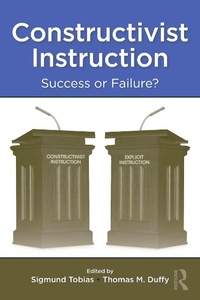
Constructivist Instruction
Success or Failure?
Published on 28. May 2009
392 pages
978-1-135-84793-7 (ISBN)
Description

Constructivist Instruction: Success or Failure? brings together leading thinkers from both sides of the hotly debated controversy about constructivist approaches to instruction. Although constructivist theories and practice now dominate the fields of the learning sciences, instructional technology, curriculum and teaching, and educational psychology, they have also been the subject of sharp criticism regarding sparse research support and adverse research findings. This volume presents:
the evidence for and against constructivism;
the challenges from information-processing theorists; and
commentaries from leading researchers in areas such as text comprehension, technology, as well as math and science education, who discuss the constructivist framework from their perspectives.
Chapters present detailed views from both sides of the controversy. A distinctive feature of the book is the dialogue built into it between the different positions. Each chapter concludes with discussions in which two authors with opposing views raise questions about the chapter, followed by the author(s)' responses to those questions; for some chapters there are several cycles of questions and answers. These discussions, and concluding chapters by the editors, clarify, and occasionally narrow the differences between positions and identify needed research.
the evidence for and against constructivism;
the challenges from information-processing theorists; and
commentaries from leading researchers in areas such as text comprehension, technology, as well as math and science education, who discuss the constructivist framework from their perspectives.
Chapters present detailed views from both sides of the controversy. A distinctive feature of the book is the dialogue built into it between the different positions. Each chapter concludes with discussions in which two authors with opposing views raise questions about the chapter, followed by the author(s)' responses to those questions; for some chapters there are several cycles of questions and answers. These discussions, and concluding chapters by the editors, clarify, and occasionally narrow the differences between positions and identify needed research.
Reviews / Votes
"I highly recommend this book to everyone in the field of educational technology, regardless of their "bent" for or against constructivist learning environments."--Educational TechnologyMore details
Language
English
Place of publication
London
United Kingdom
Publishing group
Taylor & Francis Ltd
Target group
College/higher education
Illustrations
3 s/w Tabellen
3 Tables, black and white
File size
2,98 MB
ISBN-13
978-1-135-84793-7 (9781135847937)
Copyright in bibliographic data and cover images is held by Nielsen Book Services Limited or by the publishers or by their respective licensors: all rights reserved.
Schweitzer Classification
Other editions
Additional editions
Book
04/2009
1st Edition
Routledge
€95.20
Shipment within 15-20 days

Book
03/2009
1st Edition
Routledge
€273.20
Shipment within 15-20 days
Persons
Sigmund Tobias is Distinguished Research Scientist at the Institute for Urban and Minority Education and Visiting Professor of Cognitive Studies in Education at Teachers College, Columbia University. His scholarly credentials include a long list authored, co-authored, and edited scholarly publications; grants; awards; invited addresses, and conference presentations. In addition, he is one of five former refugees who participated in the documentary film, Shanghai Ghetto, describing how a group of European Jews found safety from the Holocaust in Shanghai, China, during the Second World War, and which which won an Audience Choice Award at the Santa Barbara Film Festival. Tobias returned to Shanghai as a Visiting Professor at the Shanghai Institute of Education, where he began a memoir describing the life of his family in the refugee community in Shanghai. The book was subsequently published as Strange Haven: A Jewish Childhood in Wartime Shanghai.
Thomas M. Duffy is the Barbara Jacobs Chair of Education and Technology at Indiana University and the founding director of the Center for Research on Learning and Technology. He is a professor in instructional systems technology and the cognitive science program. His academic career has been dedicated to exploring the design and use of information in education and the workplace. Professor Duffy has written or edited several books and is the author of over 100 papers on learning, performance, and technology. He and his colleagues have also developed the Ready Program (adult literacy instruction), Strategic Teaching Frameworks (multimedia, teacher professional development), and ACT, an asynchronous collaboration tool for small group problem solving.
Thomas M. Duffy is the Barbara Jacobs Chair of Education and Technology at Indiana University and the founding director of the Center for Research on Learning and Technology. He is a professor in instructional systems technology and the cognitive science program. His academic career has been dedicated to exploring the design and use of information in education and the workplace. Professor Duffy has written or edited several books and is the author of over 100 papers on learning, performance, and technology. He and his colleagues have also developed the Ready Program (adult literacy instruction), Strategic Teaching Frameworks (multimedia, teacher professional development), and ACT, an asynchronous collaboration tool for small group problem solving.
Content
Foreword, Robert J. Sternberg
Preface
Part I. Introduction
Chapter 1. The Success or Failure of Constructivist Instruction: An Introduction
Sigmund Tobias and Timothy M. Duffy
Part II. The Evidence for Constructivism
Chapter 2. Reconciling a Human Cognitive Architecture
David Jonassen
Chapter 3. Constructivism in an Age of Non-Constructivist Assessments
Daniel L. Schwartz, Robb Lindgren, and Sarah Lewis
Chapter 4. Taking Guided Learning Theory to School: Reconciling the Cognitive, Motivational, and Social Contexts of Instruction
Phillip Herman and Louis M. Gomez
Chapter 5. Beyond More Versus Less: A Reframing of the Debate on Instructional Guidance
Alyssa Friend Wise and Kevin O'Neill
Chapter 6. Constructivism: When It's the Wrong Idea and When It's the Only Idea
Rand J. Spiro and Michael DeSchryver
Part III. Challenges to the Constructivist View
Chapter 7. What Human Cognitive Architecture Tells Us About Constructivism
John Sweller
Chapter 8. Epistemology or Pedagogy, That Is the Question
Paul A. Kirschner
Chapter 9. How Much and What Type of Guidance is Optimal for Learning?
Richard E. Clark
Chapter 10. Constructivism as a Theory of Learning Versus Constructivism as a Prescription for Instruction.
Richard E. Mayer
Chapter 11. The Empirical Support for Direct Instruction
Barak Rosenshine
Part IV. An Examination of Specific Learning and Motivational Issues
Chapter 12. Learning and Constructivism
Walter Kintsch
Chapter 13. From Behaviorism to Constructivism: A Philosophical Journey from Drill and Practice to Situated Learning
J. D. Fletcher
Chapter 14. What's Worth Knowing about Mathematics?
Melissa Sommerfeld Gresalfi and Frank Lester
Chapter 15. "To every thing there is a season, and a time to every purpose under the heavens" What about Direct Instruction?
David Klahr
Chapter 16. Beyond the Fringe: Building and Evaluating Scientific Knowledge Systems
Richard A. Duschl and Ravit Golan Duncan
Part V. Summing Up
Chapter 17. An Eclectic Appraisal of the Success or Failure of Constructivist Instruction
Sigmund Tobias
Chapter 18. Building Lines of Communication and a Research Agenda
Thomas M. Duffy
Preface
Part I. Introduction
Chapter 1. The Success or Failure of Constructivist Instruction: An Introduction
Sigmund Tobias and Timothy M. Duffy
Part II. The Evidence for Constructivism
Chapter 2. Reconciling a Human Cognitive Architecture
David Jonassen
Chapter 3. Constructivism in an Age of Non-Constructivist Assessments
Daniel L. Schwartz, Robb Lindgren, and Sarah Lewis
Chapter 4. Taking Guided Learning Theory to School: Reconciling the Cognitive, Motivational, and Social Contexts of Instruction
Phillip Herman and Louis M. Gomez
Chapter 5. Beyond More Versus Less: A Reframing of the Debate on Instructional Guidance
Alyssa Friend Wise and Kevin O'Neill
Chapter 6. Constructivism: When It's the Wrong Idea and When It's the Only Idea
Rand J. Spiro and Michael DeSchryver
Part III. Challenges to the Constructivist View
Chapter 7. What Human Cognitive Architecture Tells Us About Constructivism
John Sweller
Chapter 8. Epistemology or Pedagogy, That Is the Question
Paul A. Kirschner
Chapter 9. How Much and What Type of Guidance is Optimal for Learning?
Richard E. Clark
Chapter 10. Constructivism as a Theory of Learning Versus Constructivism as a Prescription for Instruction.
Richard E. Mayer
Chapter 11. The Empirical Support for Direct Instruction
Barak Rosenshine
Part IV. An Examination of Specific Learning and Motivational Issues
Chapter 12. Learning and Constructivism
Walter Kintsch
Chapter 13. From Behaviorism to Constructivism: A Philosophical Journey from Drill and Practice to Situated Learning
J. D. Fletcher
Chapter 14. What's Worth Knowing about Mathematics?
Melissa Sommerfeld Gresalfi and Frank Lester
Chapter 15. "To every thing there is a season, and a time to every purpose under the heavens" What about Direct Instruction?
David Klahr
Chapter 16. Beyond the Fringe: Building and Evaluating Scientific Knowledge Systems
Richard A. Duschl and Ravit Golan Duncan
Part V. Summing Up
Chapter 17. An Eclectic Appraisal of the Success or Failure of Constructivist Instruction
Sigmund Tobias
Chapter 18. Building Lines of Communication and a Research Agenda
Thomas M. Duffy
