

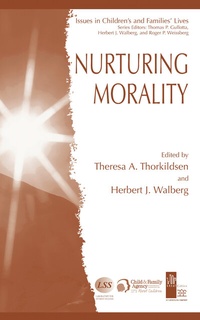
Nurturing Morality
Description

Despite often simplistic, black-and-white portrayals of good and evil, children and adolescents face complicated moral issues that can raise more questions than answers. Becoming aware of what constitutes morality is only the first step in determining a course of action, identifying and avoiding problems, and building communities that nurture morality.
Young people learn to define and respond to moral dilemmas by interacting with and observing numerous sources. They acquire knowledge from family members, teachers, church leaders, peers, and members of neighborhood organizations. Raising themes of cultural pluralism, responsibility, complexity, affectivity, and practicality, Nurturing Morality addresses such issues as:
- Definitions of morality that link past and current debates, enabling a more thorough understanding of moral functioning.
- Personal responsibilities and impediments to moral functioning.
- How societal structures can facilitate or inhibit moral agency and development.
- The importance of acknowledging the common good as well as individual accomplishments.
- Nurturing morality through wisdom.
Drawing from a wide range of independent research programs, Nurturing Morality makes clear that most forms of human interaction are laden with moral content. It highlights thorny and complex moral questions that cannot be resolved by simple adherence to moral rules. And on the basis of empirically grounded findings, contributors to this volume provide recommendations for how adults can offer valuable guidance to young people learning to negotiate life in a global society.
For clinicians, researchers, and students, Nurturing Morality provides much-needed insight and advice on young people's moral development.
More details
Other editions
Additional editions
Persons
Theresa Thorkildsen is an associate professor of education and psychology. She completed her Ph.D. from Purdue University in 1988 and has been actively involved in the field of moral development since 1986. She is a member of six international research associations and is a fellow of the American Psychological Association. Her research interests focus on how young people come to understand the fairness of institutional practices and how issues of morality and motivation are inextricably linked.
Herbert J. Walberg is University scholar and emeritus professor of education and psychology at the University of Illinois at Chicago and is a principal investigator at the Laboratory for Student Sucess, the Mid-Atlantic Regional Educational Laboratory. Editor of more than 40 boks and author of more than 300 papers for psychology and educational research journals, he has also written extensively for practicing professionals. He has lectured in a dozen countries; often testified to federal district courses and Congressional committees; and is a fellow of the American Association for the Advancement of Science, American Psychological Association, International Academy of Education, and Royal Statistical Society.
