

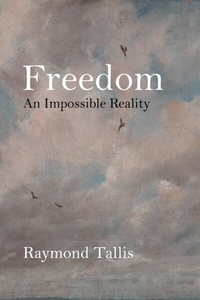
Freedom
Description

The question of free will has preoccupied philosophers for millennia. In recent years the debate has been reinvigorated by the findings of neuroscience and, for some, the notion that we have free will has finally been laid to rest. Not so, says Raymond Tallis. In his quest to reconcile our practical belief in our own agency with our theoretical doubts, Tallis advances powerful arguments for the reality of freedom.
Tallis challenges the idea that we are imprisoned by laws of nature that wire us into a causally closed world. He shows that our capacity to discover and exploit these laws is central to understanding the nature of voluntary action and to reconciling free will with our status as material beings.
Bringing his familiar verve and insight to this deep and most intriguing philosophical question, one that impacts most directly on our lives and touches on nearly every other philosophical problem - of consciousness, of time, of the nature of the natural world, and of our unique place in the cosmos - Tallis takes us to the heart of what we are. By understanding our freedom he reveals our extraordinary nature more clearly.
All prices
More details
Other editions
Additional editions
Person
Raymond Tallis trained in medicine at Oxford University and at St Thomas' Hospital London before becoming Professor of Geriatric Medicine at the University of Manchester. He was elected a Fellow of the Academy of Medical Sciences for his research in clinical neuroscience and he has played a key role in developing guidelines for the care of stroke patients in the UK. From 2011-14 he was Chair of Healthcare Professionals for Assisted Dying. He retired from medicine in 2006 to become a full-time writer. His books have ranged across many subjects - from philosophical anthropology to literary and cultural criticism - but all are characterised by a fascination for the infinite complexity of human lives and the human condition. The Economist's Intelligent Life magazine lists him as one of the world's leading polymaths.
Content
Overture: intention and intentionality1. The impossibility of free will 2. Bringing the laws on side3. Unpicking causation4. Actions5. The human agent6. The limits of freedomCodaAppendices
